In each of the following questions, there are three statements followed by…
2025
In each of the following questions, there are three statements followed by four conclusions. Choose the conclusion(s) that logically follow(s) from the given statements.
Statements:
Some questions are answers.
Some answers are writers.
All the writers are poets.
Conclusions:
Some writers are answers.
Some poets are questions.
All the questions are poets.
Some poets are answers.
- A.
Only (1) and (2)
- B.
Only (1) and (4)
- C.
Only (1) and (3)
- D.
Only (2) and (4)
Attempted by 2 students.
Show answer & explanation
Correct answer: B
Concept:
Two categorical-syllogism rules decide which conclusions a set of 'All'/'Some' statements forces: a particular ('Some A are B') statement always converts to its reverse ('Some B are A'); and a particular statement combined with a universal ('All B are C') statement sharing a common term B forces a new particular statement in the surviving terms ('Some A are C'). Two particular statements sharing a term, with no universal statement linking them, force nothing further — and in particular, they never force a universal ('All') conclusion.
Application:
Statement (Some answers are writers) is particular, so it converts directly to 'Some writers are answers' — conclusion (1) follows.
Statement (Some answers are writers) combined with statement (All writers are poets), sharing the term 'writers', forces 'Some answers are poets', which converts to 'Some poets are answers' — conclusion (4) follows.
Statement (Some questions are answers) and statement (Some answers are writers) are both particular; they share the term 'answers', but no universal statement links them, so no conclusion connecting questions with writers or poets is forced. Conclusion (2), 'Some poets are questions', and conclusion (3), 'All the questions are poets', do NOT follow — and (3), being a universal claim, would in any case need an unbroken chain of 'All' statements that isn't present here.
Cross-check:
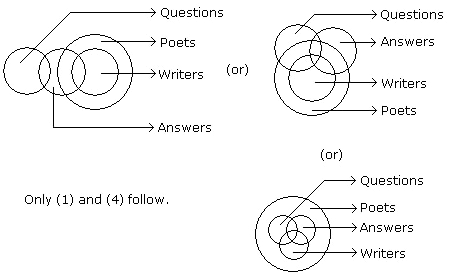
The Venn diagram confirms this: drawing the three groups in every arrangement consistent with the statements, 'Some writers are answers' and 'Some poets are answers' hold in every arrangement, while 'Some poets are questions' and 'All the questions are poets' fail in at least one valid arrangement — so only (1) and (4) are guaranteed.
Result:
Only conclusions (1) and (4) follow — so the answer is 'Only (1) and (4)'.