Read the information given below and answer the question that follows. Six…
2025
Read the information given below and answer the question that follows.
Six couples have been invited to a dinner party. They are Niti, Geeta, Lata, Rakhi, Sita, Champa and Farookh, Hari, Amit, Tilak, Ram, Ali. They are seated on a circular table, facing each other.
(i) Geeta refuses to sit next to Ali.
(ii) Lata wants to be between Amit and Hari.
(iii) Champa refuses to sit next to Farookh.
(iv) Niti is seated between Tilak and Ali.
(v) Farookh and Tilak are seated exactly opposite to each other.
(vi) Ram and Sita are seated to the left of Champa.
(vii) Neighbours Amit and Rakhi want to enjoy the company of Lata and Tilak respectively and are seated closest to them.
(viii) The seating arrangement is such that minimum one woman is always between two men.
If looked in an anti-clockwise manner, starting from Farookh, who are seated between Farookh and Tilak ?
Answer: A. Sita, Ram, Champa, Ali, Niti — Concept: This is a circular-table puzzle built from an 'opposite' clue and several 'between' / 'left of' / 'closest neighbour' clues. The general method: fix…
- A.
Sita, Ram, Champa, Ali, Niti
- B.
Sita, Ram, Rakhi, Amit, Lata
- C.
Sita, Ram, Geeta, Hari, Lata
- D.
Sita, Ram, Lata, Amit, Hari
Attempted by 3 students.
Show answer & explanation
Correct answer: A
Concept: This is a circular-table puzzle built from an 'opposite' clue and several 'between' / 'left of' / 'closest neighbour' clues. The general method: fix one facing pair as a diameter to split the circle into two equal arcs, then chain each 'between'-type clue into a fixed block and slot each block onto an arc, using the alternating-gender rule as a parity check at every step.
Applying this to the given conditions:
Six men and six women must be seated with at least one woman always separating two men; with equal counts, the only arrangement satisfying this for every pair of men is a strict Man-Woman-Man-Woman alternation all the way round the 12 seats.
Farookh and Tilak sit exactly opposite each other, so they split the circle into two arcs of exactly 5 seats each.
Niti sits directly between Tilak and Ali, fixing the block Ali-Niti-Tilak (Niti, a woman, flanked by two men, matching the alternation).
Ram and Sita sit to the left of Champa, fixing the block Sita-Ram-Champa, read in the same rotational direction as the Ali-Niti-Tilak block.
Chaining the Sita-Ram-Champa block and the Ali-Niti-Tilak block onto the 5-seat Farookh-Tilak arc from step 2 fixes that whole arc uniquely: Farookh, Sita, Ram, Champa, Ali, Niti, Tilak.
In this arc Champa's neighbours are Ram and Ali, not Farookh, so the condition that Champa does not sit next to Farookh is satisfied automatically, without any extra placement choice.
Amit and Rakhi are themselves neighbours, with Rakhi seated closest to Tilak and Amit seated closest to Lata, while Lata sits between Amit and Hari; chaining these four links fixes the remaining arc uniquely: Tilak, Rakhi, Amit, Lata, Hari, Geeta, Farookh, again alternating correctly and keeping Geeta away from Ali.
Cross-check: Laying the two arcs together satisfies every one of the eight conditions simultaneously — the opposite pair, both fixed blocks, the two non-adjacency conditions, and the alternating-gender rule — with no contradiction, so the arrangement is the unique one consistent with all the clues.
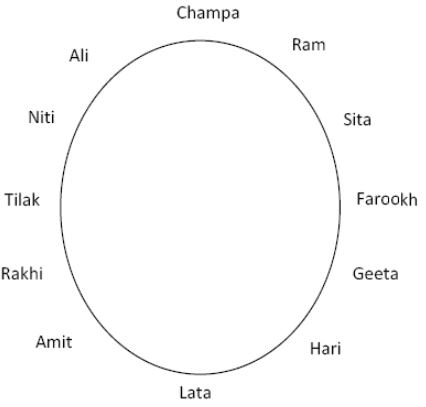
Result: Reading anti-clockwise from Farookh toward Tilak, the five people seated in between are Sita, Ram, Champa, Ali and Niti.