From amongst the given figures marked (1), (2), (3) and (4), select the figure…
2023
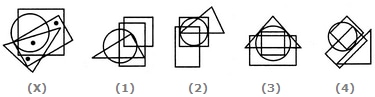
From amongst the given figures marked (1), (2), (3) and (4), select the figure which satisfies the same conditions of placement of the dots as in figure (X).
Select the figure which satisfies the same conditions of placement of the dots as in Figure-X.
Answer: A. 1 — Concept: In a 'dot situation' figure-matching question, every dot is defined by the exact set of shape-overlaps it sits inside — not by which shapes are…
- A.
1
- B.
2
- C.
3
- D.
4
Attempted by 17 students.
Show answer & explanation
Correct answer: A
Concept: In a 'dot situation' figure-matching question, every dot is defined by the exact set of shape-overlaps it sits inside — not by which shapes are present, but by precisely which ones overlap at that point and which do not. To find the matching figure, first record each dot in Figure (X) as its own combination of 'inside these shapes, outside those shapes'. Then test every answer figure against that same list of combinations — a figure only matches if EVERY one of those exact overlap combinations exists somewhere inside it.
Application: Figure (X) contains a square, a circle, a rectangle and a triangle, with three dots. Reading the figure gives three distinct overlap conditions that must all be reproduced:
a region that belongs to the square and the rectangle only (not the circle, not the triangle);
a region common to all four shapes together — the circle, the square, the triangle and the rectangle;
a region that belongs to the triangle and the rectangle only (not the circle, not the square).
Checking each answer figure against these three conditions:
Figure (1) — the square and rectangle overlap above the circle without the triangle reaching there, the circle/square/triangle/rectangle all cross in one shared patch near the centre, and the triangle's base extends into the rectangle beyond the circle: all three conditions are present.
Figure (2) — the triangle only crosses the square and the circle near the top and never reaches down into the tall rectangle, so the triangle-and-rectangle-only region does not exist here.
Figure (3) — the narrow square lies completely inside the circle everywhere it meets the rectangle, so there is no patch that is square-and-rectangle without the circle also covering it.
Figure (4) — the triangle only grazes the long rectangle strip at its edge and stays clear of the circle-and-diamond cluster, so the four shapes never overlap together in one spot.
Only Figure (1) reproduces all three of Figure (X)'s dot-defining overlaps, so it is the figure that satisfies the same conditions of dot placement.
Cross-check: Re-tracing each of Figure (X)'s three dots independently — the square-rectangle-only dot, the all-four dot, and the triangle-rectangle-only dot — against Figure (1) confirms each one lands in the matching region there, while every other figure fails at least one of the three, which independently rules them out.