Let a(x, y), b(x, y), and c(x, y) be three statements with variables x and y…
2004
Let a(x, y), b(x, y), and c(x, y) be three statements with variables x and y chosen from some universe. Consider the following statement:
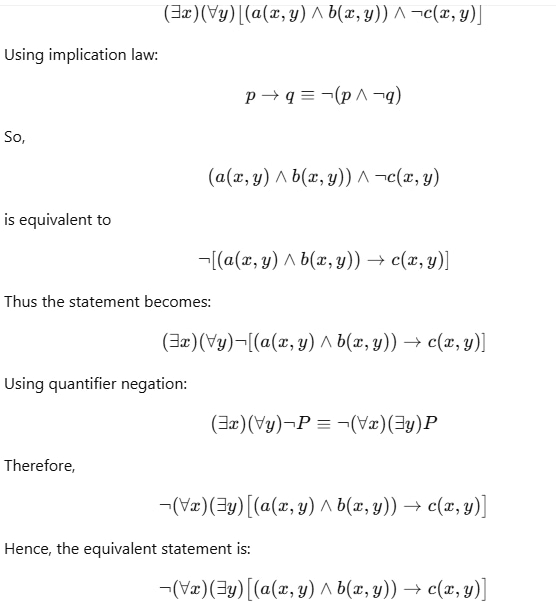
(∃x)(∀y) [(a(x, y) ∧ b(x, y)) ∧ ¬c(x, y)]
Which one of the following is its equivalent?
Answer: C. ¬(∀x)(∃y) [(a(x, y) ∧ b(x, y)) → c(x, y)]
- A.
(∀x)(∃y) [(a(x, y) ∨ b(x, y)) → c(x, y)]
- B.
(∃x)(∀y) [(a(x, y) ∨ b(x, y)) ∧ ¬c(x, y)]
- C.
¬(∀x)(∃y) [(a(x, y) ∧ b(x, y)) → c(x, y)]
- D.
¬(∀x)(∃y) [(a(x, y) ∨ b(x, y)) → c(x, y)]
Attempted by 33 students.
Show answer & explanation
Correct answer: C
A video solution is available for this question — log in and enroll to watch it.
Loading lesson…