Which one of the first order predicate calculus statements given below…
2006
Which one of the first order predicate calculus statements given below correctly express the following
English statement?
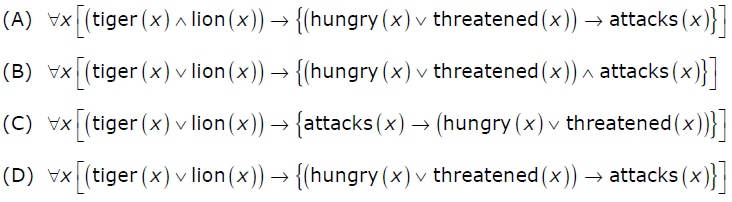
Tigers and lions attack if they are hungry or threatened. 
- A.
B
- B.
A
- C.
C
- D.
D
Attempted by 63 students.
Show answer & explanation
Correct answer: D
Correct formalization: ∀x[(tiger(x) ∨ lion(x)) → ((hungry(x) ∨ threatened(x)) → attacks(x))]
Explanation:
Universal quantifier ∀x ensures the statement applies to all individuals.
The antecedent (tiger(x) ∨ lion(x)) matches the English "Tigers and lions" meaning "either a tiger or a lion."
The inner implication (hungry(x) ∨ threatened(x)) → attacks(x) directly captures "attack if they are hungry or threatened": being hungry or threatened implies attacking.
Why the other formalizations are incorrect:
A formula using (tiger(x) ∧ lion(x)) as the antecedent is wrong because it requires an individual to be both a tiger and a lion.
A formulation with the consequent (hungry(x) ∨ threatened(x)) ∧ attacks(x) is wrong because it asserts attacks(x) whenever the subject is a tiger or lion, rather than making attacks conditional on being hungry or threatened.
A formulation with attacks(x) → (hungry(x) ∨ threatened(x)) reverses the implication: it states attacking implies being hungry or threatened, which is the opposite of the intended meaning.
Therefore the correct translation is the one that uses a universal quantifier, a disjunction for tiger or lion, and an inner implication where hungry or threatened implies attacks.
A video solution is available for this question — log in and enroll to watch it.