Consider 4-variable functions f1, f2, f3, f4 expressed in sum-of-minterms form…

2024

Consider 4-variable functions f1, f2, f3, f4 expressed in sum-of-minterms form as given below.

        f1 = ∑(0,2,3,5,7,8,11,13)

        f2 = ∑(1,3,5,7,11,13, 15)

        f3 = ∑(0,1,4,11) f4 = ∑(0,2,6,13)
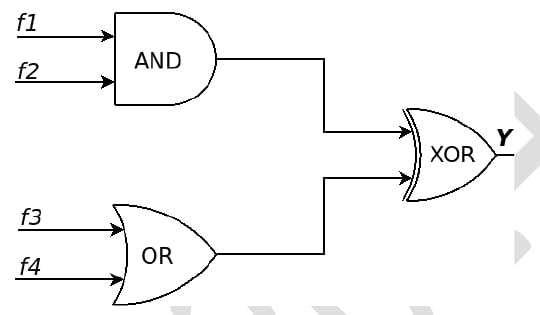
With respect to the circuit given above, which of the following options is/are CORRECT?

  1. A.

    𝒀 = ∑(0,1,2,11,13)

  2. B.

    𝒀 = Π(3,4, 5,6,7,8,9,10,12,14,15)

  3. C.

    𝒀 = ∑(0,1,2,3,4,5,6,7)

  4. D.

    𝒀 = Π(8,9,10,11,12,13,14,15)

Attempted by 127 students.

Show answer & explanation

Correct answer: C, D

Solution:

Evaluate the two intermediate signals and then the XOR:

  • a = f1 AND f2 = intersection of f1 and f2 = {3,5,7,11,13}.

  • b = f3 OR f4 = union of f3 and f4 = {0,1,2,4,6,11,13}.

  • Y = a XOR b = symmetric difference = {0,1,2,3,4,5,6,7} = ∑(0,1,2,3,4,5,6,7).

  • Equivalently, Y = Π(8,9,10,11,12,13,14,15) since those are exactly the minterms where Y = 0.

Quick check: for minterm 3, f1=1 and f2=1 so a=1; f3=0 and f4=0 so b=0; Y = 1 XOR 0 = 1, so 3 must be included—confirming the ∑(0..7) result.

A video solution is available for this question — log in and enroll to watch it.

Explore the full course: Gate Guidance By Sanchit Sir