Consider a logic circuit shown in figure below. The functions f1 ,f2 and f (in…
1997
Consider a logic circuit shown in figure below. The functions f1 ,f2 and f (in canonical sum of products form in decimal notation) are :
f1(w,x,y,z) = ∑ 8,9,10
f2(w,x,y,z) = ∑ 7,8,12,13,14,15
f(w,x,y,z) = ∑ 8,9
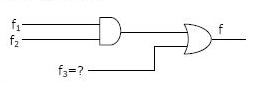
The Function f3 is
- A.
∑9,10 - B.
∑9 - C.
∑1,8,9 - D.
∑8,10,15
Attempted by 39 students.
Show answer & explanation
Correct answer: B
The given logic circuit implements the function f as (f1 AND f2) OR f3. First, we analyze the minterms of f1 and f2.
Function f1 is defined as ∑(8, 9, 10), while function f2 is ∑(7, 8, 13, 14, 15). To find the output of the AND gate (f1 AND f2), we look for common minterms between these two sets. Comparing the lists, there are no overlapping indices; f1 contains 8, 9, and 10, whereas f2 contains 7, 8, 13, 14, and 15. Wait, minterm 8 appears in both f1 ∑(8, 9, 10 ) and f2 ∑(7, 8, 13, 14, 15 ).
Therefore, the intersection is {8}. The AND gate output corresponds to minterm 8. However, the problem states f = ∑(8,9). Since f = (f1 AND f2) + f3, we have ∑(8,9) = {8} + f3. This implies f3 must provide the missing minterm 9 while not adding any extra terms that would alter the result.
Thus, f3 must be ∑(9). Option A (∑9,10) is incorrect because it adds minterm 10. Option C (∑1,8,9) is incorrect because it adds minterm 1. Option D (∑8,10,15) is incorrect as it introduces extra terms. Therefore, the correct function for f3 is ∑9.