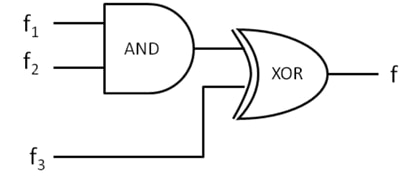
Consider three 4-variable functions f1, f2, and f3, which are expressed in…
2019
Consider three 4-variable functions f1, f2, and f3, which are expressed in sum-of-minterms as
\(f_1=\Sigma(0,2,5,8,14),\)
\(f_2=\Sigma(2,3,6,8,14,15),\)
\(f_3=\Sigma (2,7,11,14)\)
For the following circuit with one AND gate and one XOR gate, the output function \(f\) can be expressed as:

- A.
\(\Sigma(7,8,11)\) - B.
\(\Sigma(2,7,8,11,14)\) - C.
\(\Sigma(2, 14)\) - D.
\(\Sigma (0,2,3,5,6,7,8,11,14,15)\)
Attempted by 167 students.
Show answer & explanation
Correct answer: A
Key idea: the circuit outputs (f1 AND f2) XOR f3.
Step 1: Compute f1 AND f2 = intersection of their minterms = {2, 8, 14}.
Step 2: XOR with f3 (minterms {2, 7, 11, 14}) → symmetric difference: remove minterms present in both sets (2 and 14) and keep those in exactly one set.
Result: f = {7, 8, 11}, i.e. Σ(7,8,11).
Brief note: any minterm appearing in both (f1 AND f2) and f3 cancels in the XOR, so 2 and 14 do not appear in the final function.
A video solution is available for this question — log in and enroll to watch it.