Which homogeneous matrix transforms the figure on the left side
2018
Which homogeneous 2D matrix transforms the figure (a) on the left side to the figure (b) on the right ?
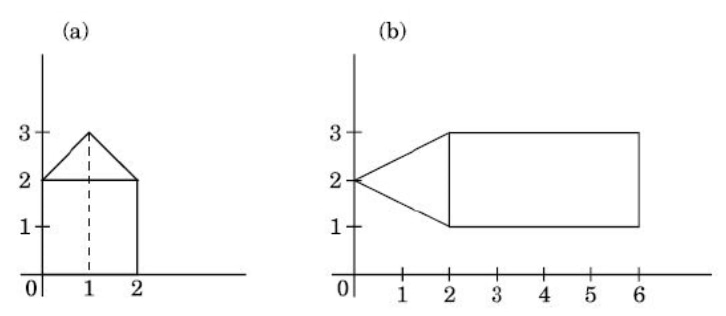
- A.
\(\begin{pmatrix} 1 & -2 & 6 \\ 1 & 0 & 2 \\ 0 & 0 & 1 \end{pmatrix}\) - B.
\(\begin{pmatrix} 0 & 2 & 6 \\ 1 & 0 & 1 \\ 0 & 0 & 1 \end{pmatrix}\) - C.
\(\begin{pmatrix} 0 & -2 & 6 \\ 1 & 0 & 1 \\ 0 & 0 & 1 \end{pmatrix}\) - D.
\(\begin{pmatrix} 0 & 2 & -6 \\ 2 & 0 & 1 \\ 0 & 0 & 1 \end{pmatrix}\)
Attempted by 59 students.
Show answer & explanation
Correct answer: C
Method to find the correct homogeneous 2D matrix:
Step 1: Identify three non-collinear points on the original figure and their corresponding images in the transformed figure. A convenient choice visible on the drawings is:
Original point (0,2) — the left top corner of the house roof
Original point (1,3) — the roof peak
Original point (2,2) — the right top corner of the house roof
Step 2: Read off the corresponding target points from the transformed figure.
The point (0,2) maps to (0,2) (the left apex of the wedge in the transformed figure).
The point (1,3) maps to (2,3) (the top-left corner where the wedge meets the rectangle).
The point (2,2) maps to (6,3) (the top-right corner of the rectangle).
Step 3: Set up the affine transform matrix with unknowns and solve.
Write the homogeneous matrix as [ [a b c], [d e f], [0 0 1] ]. For each chosen point (x,y) -> (x',y') we have x' = ax + by + c and y' = dx + ey + f.
Using the three correspondences above gives a 6×6 linear system. Solving that system yields:
Computed affine matrix: [[3, -1, 2], [1/2, 1/2, 1], [0, 0, 1]]
Step 4: Verify the matrix by applying it to the three original points:
(0,2) -> x' = 3*0 + (−1)*2 + 2 = 0 ; y' = 0.5*0 + 0.5*2 + 1 = 2 ⇒ (0,2)
(1,3) -> x' = 3*1 + (−1)*3 + 2 = 2 ; y' = 0.5*1 + 0.5*3 + 1 = 3 ⇒ (2,3)
(2,2) -> x' = 3*2 + (−1)*2 + 2 = 6 ; y' = 0.5*2 + 0.5*2 + 1 = 3 ⇒ (6,3)
Conclusion:
The correct affine transform (in homogeneous coordinates) that matches the picture is [[3, -1, 2], [1/2, 1/2, 1], [0, 0, 1]].
None of the four provided matrices equals this matrix, so none of the supplied answer choices is correct as written.
If the intention was to use integer entries only, check whether a different selection of sample points or a transcription error in the choices occurred; but based on the drawing and the standard method above, the computed matrix is the correct affine transform.