In the question given below, there are five figures marked A, B, C, D and E…
2024
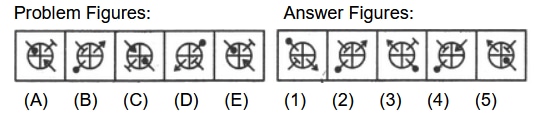
In the question given below, there are five figures marked A, B, C, D and E called the Problem Figures followed by five other figures marked 1, 2, 3, 4 and 5 called the Answer Figures.
Select a figure from amongst the Answer Figures which will continue the same series as established by the five Problem Figures.
Answer: B. 2 — Concept: In this type of circular rotating-spoke series, a fixed circle-and-cross frame stays the same in every figure while one diameter line (a spoke)…
- A.
1
- B.
2
- C.
3
- D.
4
- E.
5
Attempted by 7 students.
Show answer & explanation
Correct answer: B
Concept: In this type of circular rotating-spoke series, a fixed circle-and-cross frame stays the same in every figure while one diameter line (a spoke) carries two different end markers - a small filled ball at one end and a bold triangular arrowhead at the other, diametrically opposite end. From one figure to the next, this spoke turns by one constant quadrant step in one constant rotational sense. Since the circle has exactly four quadrant positions, a one-quadrant step every time brings the spoke back to its starting orientation after exactly four figures, so the whole series repeats with a period of four.
Across Problem Figures B, C and D, the ball marker's quadrant moves bottom-left, then bottom-right, then top-right - each move is exactly one quadrant in the anticlockwise sense (bottom-left to bottom-right passes through the bottom of the circle, bottom-right to top-right passes up the right side). The arrowhead always sits diametrically opposite the ball, so over the same three figures it moves top-right, then top-left, then bottom-left.
Continuing the same one-quadrant anticlockwise step from Problem Figure D (ball at top-right, arrowhead at bottom-left) predicts Problem Figure E's ball at top-left and arrowhead at bottom-right. That is exactly what Problem Figure E shows, and Problem Figure E is consequently identical to Problem Figure A - confirming the four-step repeating cycle A, B, C, D, A, B, ... .
Applying the same one-quadrant anticlockwise step once more from Problem Figure E (ball at top-left, arrowhead at bottom-right) gives the next figure in the series: ball at bottom-left, arrowhead at top-right - the same configuration as Problem Figure B, since the cycle has now completed one full period and restarted.
Cross-check: The rotating spoke's next term must show Problem Figure E's configuration advanced by one further anticlockwise step, which works out to the same arrangement as Problem Figure B (ball on its short stick at the bottom-left corner, bold triangular arrowhead at the top-right corner). Checking every Answer Figure against this - Answer Figure 2 is the only one that matches it exactly. Answer Figure 1 instead reproduces Problem Figure E's own configuration unchanged; Answer Figure 3 reproduces Problem Figure C's configuration; Answer Figure 4 leaves one end of its spoke as a plain, undecorated tip where a bold triangular arrowhead is required, regardless of where that spoke points; and Answer Figure 5 mis-positions its arrowhead and draws its ball marker tucked inside the circle instead of projecting outward on a stick the way every Problem Figure shows.
Answer Figure 2 is therefore the figure that correctly continues the series.