In each of the following questions, a set of five alternative figures 1, 2, 3,…
2025
In each of the following questions, a set of five alternative figures 1, 2, 3, 4 and 5 followed by a set of four alternatives (A), (B), (C) and (D) is provided. It is required to select the alternative which represents three out of the five alternative figures which when fitted into each other would form a complete square.
Select any three alternatives out of the five alternative figures which when fitted into each other would form a complete square.
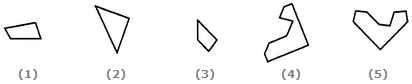
Answer: D. 234 — ConceptIn shape-construction (figure-fitting) questions, three of the five given pieces must have edges of matching length and angle so they can be joined…
- A.
123
- B.
345
- C.
245
- D.
234
Attempted by 24 students.
Show answer & explanation
Correct answer: D
Concept
In shape-construction (figure-fitting) questions, three of the five given pieces must have edges of matching length and angle so they can be joined side by side without gaps or overlaps, exactly recreating the target outline — here, a complete square. The two unused pieces will always have at least one edge or angle that cannot align with the rest.
Application
Figure (2) is a straight-edged triangle that supplies one full half of the square along its diagonal. Figure (4)'s stepped outline and figure (3)'s narrow kite share a matching notch, so figure (3) nests exactly into the recess of figure (4); together figure (3) and figure (4) supply the other half of the square. Placing figure (2) against the combined figure (3)-figure (4) piece traces all four straight sides of the square with no gaps or overlaps.

So figures (2), (3), and (4) together form the complete square.
Cross-check
Figure (1)'s shallow parallelogram and figure (5)'s double-peaked chevron are left over: neither has an edge that matches the boundary the other three pieces create once assembled. Swapping either of them in for one of figures (2), (3), (4) — as in the combinations (1,2,3), (3,4,5), or (2,4,5) — leaves a zigzag or mismatched edge instead of a straight side, confirming figures (1) and (5) must be the ones excluded.