In each of the following questions, a set of five alternative figures 1, 2, 3,…
2023
In each of the following questions, a set of five alternative figures 1, 2, 3, 4 and 5 followed by a set of four alternatives (A), (B), (C) and (D) is provided. It is required to select the alternative which represents three out of the five alternative figures which when fitted into each other would form a complete square.
Select the alternative which represents three out of the five alternative figures which when fitted into each other would form a complete square.
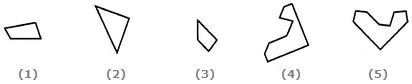
Answer: D. 234 — Concept: In figure-formation / assembling reasoning problems, a target figure (here, a square) is mentally split into three non-overlapping pieces, and each…
- A.
123
- B.
345
- C.
245
- D.
234
Attempted by 13 students.
Show answer & explanation
Correct answer: D
Concept: In figure-formation / assembling reasoning problems, a target figure (here, a square) is mentally split into three non-overlapping pieces, and each answer choice offers a different trio of candidate shapes. A trio is correct only if the outline of each candidate shape (its side lengths, angles, and sequence of turns or notches) exactly matches one region of the target figure, so that together the three pieces retrace the square's boundary and internal cuts with no gap and no overlap.
Application:
Shape 2 is a simple triangle. Its three sides exactly trace the large triangular region at the bottom-left of the square, bounded by two of the square's own edges and one internal diagonal cut.
Shape 3 is a small, elongated quadrilateral. Its four sides exactly trace the parallelogram-shaped piece embedded near the middle of the square, cut out along part of that same diagonal.
Shape 4 is a larger irregular polygon carrying a single notch. Its outline exactly traces the remaining region in the upper right of the square, notch and all.

Placed together this way - the triangle filling the bottom-left, the small quadrilateral filling the middle cut-out, and the notched polygon wrapping the upper right - the three outlines share matching edges throughout and reconstruct the complete square.
Cross-check: None of the other trios can do this:
123 - shape 1 is a plain quadrilateral whose long slanted edge matches no boundary of the square's breakdown, so it leaves a gap and an overlap when paired with shapes 2 and 3.
345 - shape 5 is a symmetric chevron needing a matching notch on both sides, but the square's construction has only one notch, so shape 5 cannot be placed alongside shapes 3 and 4 without an unmatched extra notch.
245 - the same mismatch with shape 5 applies here too, so shapes 2, 4 and 5 overlap rather than tiling the square cleanly.
Only shapes 2, 3, and 4 tile the square exactly, confirming the value 234 is correct.