Find the number of triangles in the given figure.
2024
Find the number of triangles in the given figure.

Answer: B. 10 — When a figure is built from several straight lines crossing inside a bounding shape, count its triangles level by level: first every “simple” triangle — one…
- A.
8
- B.
10
- C.
11
- D.
12
Attempted by 11 students.
Show answer & explanation
Correct answer: B
When a figure is built from several straight lines crossing inside a bounding shape, count its triangles level by level: first every “simple” triangle — one whose interior is not cut by any other drawn line — then every “composite” triangle formed by merging two or more adjacent simple triangles into one larger triangle whose own boundary is entirely made of lines actually drawn in the figure. The total number of triangles is the sum across both levels, and no triangle can be formed through a vertex or side that the figure's drawn lines do not actually enclose.
Label the given figure as shown, with G marking where diagonals AC and BE cross.
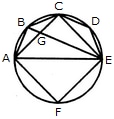
The simplest (non-subdivided) triangles are:
ABG
BCG
CGE
CDE
AGE
AEF
That gives six simple triangles. Merging exactly two adjacent simple triangles that share a diagonal segment through G gives further, larger triangles:
ABE (= ABG + AGE)
ABC (= ABG + BCG)
BCE (= BCG + CGE)
ACE (= AGE + CGE)
No further merging is possible: D is joined to C and E only along the outer boundary, with no diagonal to a non-adjacent vertex, so it cannot close off any triangle beyond CDE already counted.
Total triangles = 6 simple + 4 composite = 10.
Cross-check by regrouping the same triangles a different way — by whether G lies on their boundary. The triangles touching G are ABG, BCG, CGE, AGE, ABE, ABC, BCE and ACE — eight in all — while CDE and AEF are the only two that do not involve G at all. 8 + 2 = 10, the same total, confirming nothing has been double-counted or missed.