Find the number of triangles in the given figure.
2025
Find the number of triangles in the given figure.

Answer: D. 28 — To count every triangle in a complex figure formed by several intersecting lines, first identify every point where the lines cross, then group the triangles…
- A.
22
- B.
24
- C.
26
- D.
28
Attempted by 11 students.
Show answer & explanation
Correct answer: D
To count every triangle in a complex figure formed by several intersecting lines, first identify every point where the lines cross, then group the triangles by how many of the smallest bounded regions each one spans, from single-region triangles up to the largest formed by merging many regions, and add the counts from every group. This systematic level-by-level scan ensures no triangle is missed or counted twice.
The figure is labelled as shown:
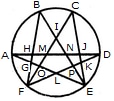
Triangles made of a single (simplest) region: AGH, GFO, LFO, DJK, EKP, PEL and IMN, 7 triangles.
Triangles formed by merging two adjoining regions: GFL, KEL, AMO, NDP, BHN, CMJ, NEJ and HFM, 8 triangles.
Triangles formed by merging three regions: IOE, IFP, BIF and CEI, 4 triangles.
Triangles formed by merging four regions: ANE and DMF, 2 triangles.
Triangles formed by merging five regions: FCK, BGE and ADL, 3 triangles.
Triangles formed by merging six regions: BPF, COE, DHF and AJE, 4 triangles.
Adding these groups: 7 + 8 + 4 + 2 + 3 + 4 = 28 triangles.
Cross-check: no triangle name repeats across the six groups, and re-scanning the figure level by level (single-region triangles, then two-region, and so on) reproduces the same six counts — confirming that no triangle in the figure has been missed or counted twice.
Hence, the figure contains 28 triangles in total.