Direction : Match the column I and II based on the given questions. If height…
2020
Direction : Match the column I and II based on the given questions.
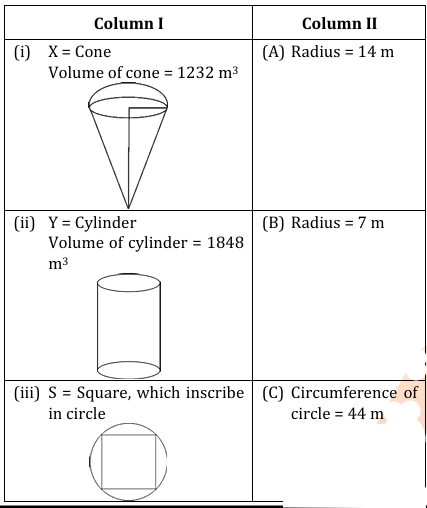
If height of X is greater than height of Y.
Answer: B. (i) Either B or C (ii) Only A (iii) Only A, either B or C — ConceptTo match Column I with Column II, find the unknown dimension (height of each solid) from its volume formula, then apply the rule that the cone's height…
- A.
(i) Only A, either B or C
(ii) Only A
(iii) Only A - B.
(i) Either B or C
(ii) Only A
(iii) Only A, either B or C - C.
(i) Only B
(ii) Only A
(iii) Only A - D.
(i) Only C
(ii) Only B
(iii) Only B - E.
None of these
Attempted by 3 students.
Show answer & explanation
Correct answer: B
Concept
To match Column I with Column II, find the unknown dimension (height of each solid) from its volume formula, then apply the rule that the cone's height must exceed the cylinder's height. Use π = 22/7.
Matching convention: in a "match the column" item like this, each Column-II entry is understood to back exactly one Column-I row (no value is reused across rows, and none is left unused) - this is the standard convention for this question format, and it is also the only reading under which the five answer choices are mutually exclusive, well-formed matches rather than overlapping partial descriptions.
Volume of a cone = (1/3)π r2 h, so h = 3V / (π r2).
Volume of a cylinder = π r2 h, so h = V / (π r2).
Also circumference = 2 π r, so a circumference of 44 m fixes r = 44 / (2 x 22/7) = 7 m - identical to option (B). A square inscribed in a circle is fixed by that circle's radius, so it is compatible with any given radius.
Application
Test each radius (A = 14 m, B = 7 m, C -> r = 7 m) against the two volumes:
Solid / radius | r = 14 m (A) | r = 7 m (B and C) |
|---|---|---|
Cone, V = 1232 | h = 3x1232 / (22/7 x 196) = 6 m | h = 3x1232 / (22/7 x 49) = 24 m |
Cylinder, V = 1848 | h = 1848 / (22/7 x 196) = 3 m | h = 1848 / (22/7 x 49) = 12 m |
Now assign radii so that height of cone > height of cylinder, each radius value serving one solid:
Cylinder (ii): take r = 14 m (A) -> height = 3 m.
Cone (i): with A used by the cylinder, the cone takes r = 7 m - stated as 7 m (B) or as circumference 44 m (C), since both give r = 7. Its height is 24 m.
Check the rule: 24 m (cone) > 3 m (cylinder) holds. So the cone matches either B or C and the cylinder matches only A.
Square (iii): a square inscribes in a circle of any radius, so it is consistent with r = 14 m (A) and with r = 7 m (B or C) - i.e. only A, either B or C.
Cross-check
If instead the cylinder took r = 7 m (h = 12 m) and the cone r = 14 m (h = 6 m), the cone height 6 m would be less than the cylinder height 12 m, violating the rule. So the cylinder must be the r = 14 m case and the cone the r = 7 m case - confirming (i) -> either B or C, (ii) -> only A, (iii) -> only A, either B or C.