Direction : Match the column I and II based on the given questions. If the…
2020
Direction : Match the column I and II based on the given questions.
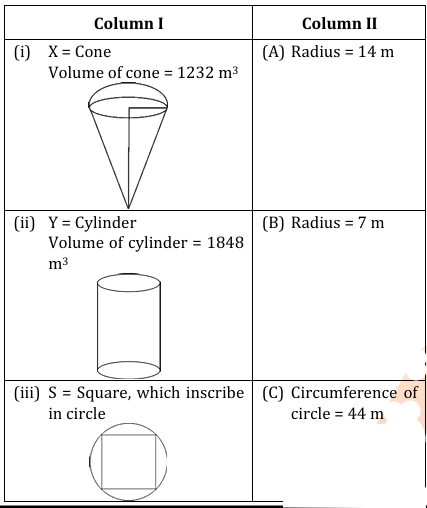
If the difference of the height of Y and side of S is greater than 20 m.
Answer: E. None of these — ConceptFor a cone, Volume = (1/3)πr2h; for a cylinder, Volume = πr2h — both use the base radius r and the height h. A square inscribed in a circle (all four…
- A.
(i) Only A, either B or C
(ii) Only A
(iii) Only A - B.
(i) Only C
(ii) Only B
(iii) Only A - C.
(i) Only B
(ii) Only A
(iii) Only A - D.
(i) Only C
(ii) Only B
(iii) Only B - E.
None of these
Attempted by 1 students.
Show answer & explanation
Correct answer: E
Concept
For a cone, Volume = (1/3)πr2h; for a cylinder, Volume = πr2h — both use the base radius r and the height h. A square inscribed in a circle (all four corners on the circle) has its diagonal equal to the circle's diameter, so its side = r√2. A circle's circumference relates to its radius by Circumference = 2πr.
Application (using π = 22/7)
Cone, Volume = 1232 m3: with radius 14 m, r2h = 1176 gives h = 6 m; with radius 7 m, h = 24 m.
Cylinder (Y), Volume = 1848 m3: with radius 14 m, r2h = 588 gives h = 3 m; with radius 7 m, h = 12 m.
Circumference = 44 m gives 2πr = 44, so r = 7 m — the same radius as the 7 m option.
Square (S) inscribed in the circle: with radius 14 m, side = 14√2 ≈ 19.8 m; with radius 7 m, side = 7√2 ≈ 9.9 m.
Pairing the cylinder's height (Y) with the square's side (S) across every possible radius assignment (14 m or 7 m, however obtained) gives differences of about 16.8 m, 7.8 m, 6.9 m, or 2.1 m, depending on the pairing.
Cross-check
The LARGEST of these differences — pairing a 14 m radius on both the cylinder and the square — is only about 16.8 m. Every other pairing gives an even smaller difference. So no assignment of the given radius/circumference values to the cylinder and the square ever produces a difference greater than 20 m.
Since the question's stated condition (“difference of the height of Y and side of S is greater than 20 m”) is never satisfied by any possible matching, none of the specific matchings offered can be correct — the answer is None of these.