If a number cube is rolled once and coin is tossed once. What is the…
2024
If a number cube is rolled once and coin is tossed once. What is the probability that the coin will show tail and composite number on the cube ?
Answer: B. 1/6 — ConceptFor two independent events, the probability that both occur together equals the product of their individual probabilities: P(A and B) = P(A) × P(B). A…
- A.
1/8
- B.
1/6
- C.
1/2
- D.
1/4
Attempted by 8 students.
Show answer & explanation
Correct answer: B
Concept
For two independent events, the probability that both occur together equals the product of their individual probabilities: P(A and B) = P(A) × P(B). A composite number is a natural number greater than 1 that has more than two factors (that is, it is not prime and not equal to 1).
Application
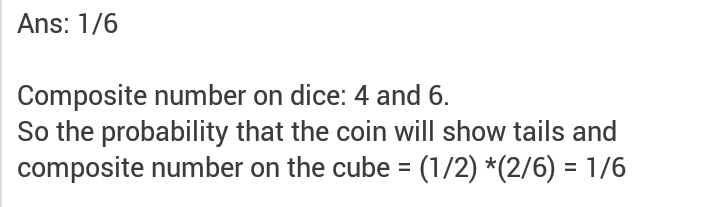
A fair coin has 2 equally likely outcomes (heads, tails), so P(tail) = 1/2.
A number cube (die) has faces 1 to 6. Checking each: 1 is neither prime nor composite; 2, 3, 5 are prime; 4 and 6 are composite. So exactly 2 of the 6 faces are composite, giving P(composite) = 2/6.
The coin toss and the die roll are independent events, so the probability of both a tail and a composite number is P(tail) × P(composite) = (1/2) × (2/6) = 2/12 = 1/6.
Cross-check
Listing the full sample space confirms this: the coin-die combination has 2 × 6 = 12 equally likely outcomes. Only 2 of them satisfy the condition - (tail, 4) and (tail, 6). So the probability is 2/12 = 1/6, matching the result above.