In each question below,there are two or three statements followed by four…
2024
In each question below,there are two or three statements followed by four conclusions numbered I, II, III and IV. Take the given statements to be true even if they seem to be at variance with commonly known facts and then decide which of the given conclusions logically follow(s) from the given statements.
Statements:
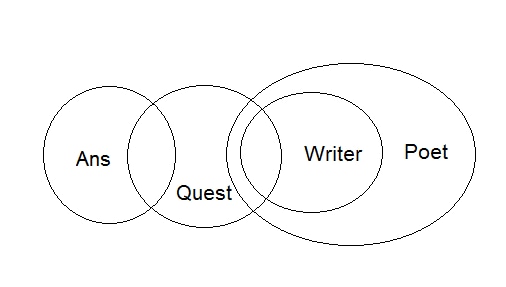
A. Some answers are questions.
B. Some questions are writers.
C. All writers are poets.
Conclusions:
I. Some writers are answers.
II. Some poets are questions.
III. All questions are poets.
IV. Some poets are answers.
Answer: C. Only II follows — Answer: Only Conclusion II follows. Key inference: From "Some questions are writers" and "All writers are poets" we can conclude that some questions are poets…
- A.
Only I and II follow
- B.
Only I, II and IV follow
- C.
Only II follows
- D.
Only II and IV follow
Attempted by 52 students.
Show answer & explanation
Correct answer: C
Answer: Only Conclusion II follows.
Key inference: From "Some questions are writers" and "All writers are poets" we can conclude that some questions are poets (so Conclusion II follows).
Conclusion I: Some writers are answers — Does not follow. Reason: "Some answers are questions" and "Some questions are writers" do not guarantee that the specific writers overlap with the specific answers; the two "some" groups could be different.
Conclusion II: Some poets are questions — Follows. Reason: the questions that are writers become poets because all writers are poets, so there is at least some overlap between poets and questions.
Conclusion III: All questions are poets — Does not follow. Reason: only the portion of questions that are writers are guaranteed to be poets; other questions may not be poets.
Conclusion IV: Some poets are answers — Does not follow. Reason: although some questions are poets and some answers are questions, there is no guarantee that the specific poets include any of the specific answers (the relevant "some" groups may not overlap).
Final conclusion: Only Conclusion II follows.