Directions: Based on the data given on the pie-chart. Solve the questions…
2023
Directions: Based on the data given on the pie-chart. Solve the questions which follow :
Percentage Sales of different models of Computers in Kolkata in two different years .
Given total sales in 1998 is 7890 and increase 16.5% in 1999.
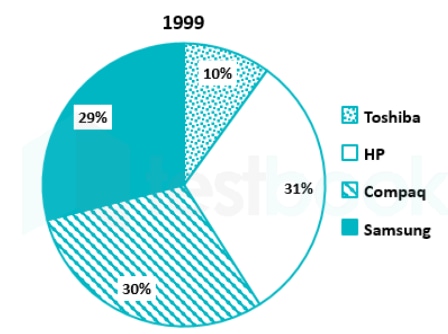
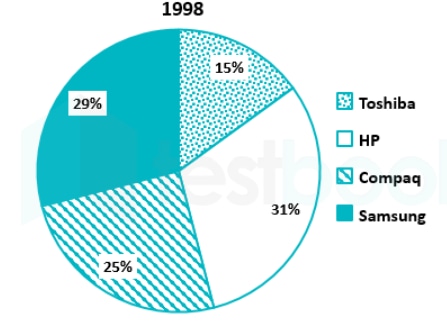
The percentage change in the sales of Toshiba in 1999 is approximately :
Answer: C. 22% — ConceptA percentage change is always measured against the quantity’s own earlier value: change % = (New − Old) ÷ Old × 100. In a pie chart every slice is a…
- A.
16%
- B.
61%
- C.
22%
- D.
68%
Attempted by 5 students.
Show answer & explanation
Correct answer: C
Concept
A percentage change is always measured against the quantity’s own earlier value: change % = (New − Old) ÷ Old × 100.
In a pie chart every slice is a share of that year’s total, not an absolute amount. Two years can be compared only after each share is multiplied by its own year’s total. That is why a brand’s share can shrink even while the overall market grows.
Application
Year | Total sales | Toshiba’s share | Toshiba’s sales |
|---|---|---|---|
1998 | 7,890 | 15% | 1,183.5 |
1999 | 9,191.85 | 10% | 919.185 |
Total sales in 1998 = 7,890 and the 1998 pie chart gives Toshiba a 15% share, so Toshiba (1998) = 0.15 × 7,890 = 1,183.5 units.
Total sales rise by 16.5%, so total (1999) = 7,890 × 1.165 = 9,191.85 units.
The 1999 pie chart gives Toshiba a 10% share, so Toshiba (1999) = 0.10 × 9,191.85 = 919.185 units.
Absolute change = 919.185 − 1,183.5 = −264.315 units.
Percentage change = (−264.315 ÷ 1,183.5) × 100 = −22.33%, that is a decrease of about 22%.
Cross-check
The same result follows from ratios alone: volume ratio = share ratio × total ratio = (10 ÷ 15) × 1.165 = 0.7767. A 1999 volume that is 0.7767 times the 1998 volume means a drop of 1 − 0.7767 = 0.2233, that is 22.33%.
The trap is to reason from the market total alone: overall sales grew 16.5%, but Toshiba’s share fell from 15% to 10%, and that share loss outweighs the market growth. The options are stated as magnitudes, so the answer is 22%, representing a fall of about 22%.