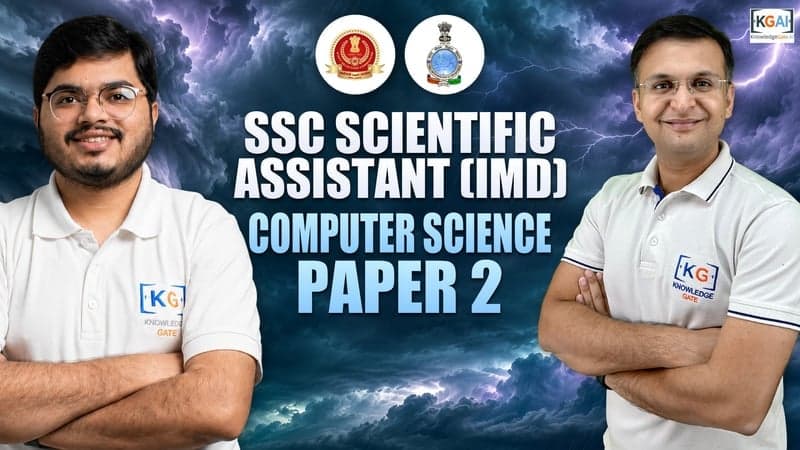
SSC JE 2026 Scientific Assistant (IMD) – Computer Science Paper 2
(Final Merit Paper · 300 Marks)
Need help choosing this course?
Our counsellor will help with pricing, syllabus, and enrollment.
About SSC JE 2026 Scientific Assistant (IMD) – Computer Science Paper 2
SSC JE 2026 Scientific Assistant (IMD) Computer Science Paper 2: PYQs with solutions, practice, mock tests, Goal Slider and Syllabus Hotspots.
Compare SSC JE 2026 Scientific Assistant (IMD) – Computer Science Paper 2 with all courses🎯 SSC JE IMD Scientific Assistant CS Videos help you understand a concept, but watching videos alone isn't enough to get selected. The competition is very high. KnowledgeGate is built on a few simple ideas that give you the edge: 🤖 How the platform helps you Goal Slider: set your target score, get an exact daily plan. Syllabus Hotspots: see which topics SSC JE IMD Scientific Assistant asks most, from real PYQ data. Progress Monitor: find where you lose marks. Leaderboard: see where you stand. Battles: compete live with other aspirants. Community: prepare together. One-to-one chat: ask your doubts directly. Course Captain: a mentor who keeps you on track. Why this matters: most coaching institutes still don't use technology in education. KnowledgeGate is very aggressive on AI and technology, and updates the platform regularly. 📚 What's inside Paper 2 technical preparation: Engineering Mathematics, Digital Logic, Computer Organization, Programming & Data Structures, Algorithms, Theory of Computation, Compiler Design, Operating Systems, DBMS and Computer Networks. Practice: topic-wise previous year questions on the AI-powered Knowledge Gate platform, with Leaderboard, Battles, personalised roadmap and progress analytics. 💳 Plan Pro: every question, PYQ, test and AI tool, the community, your Course Captain and the course videos.
Choose your course
| Included features | Trial Course | Complete Course |
|---|---|---|
| Notes & PDFs | All notesView only | Download |
| Concept Videos | Demo videos | All videos |
| PYQs | 5 / day | Unlimited |
| Practice Questions | 5 / day | Unlimited |
| Video Solutions | Not included | Unlimited |
| Test Series | Up to 1 mock | Scheduled + personalised tests |
| Question Battles | 1 / day | Unlimited |
| Progress Monitor | Not included | Included |
| Leaderboard | Not included | Included |
| Course Community | Read | Post |
| Goal Slider | Included | Included |
| Syllabus Hotspots | Included | Included |
| Doubt Solver | Standard | Fastest |
| Tell Me Anything | Not included | Priority |
| Course Captain | Not included | Priority |
What you get
- Validity
- 365 days
Course Curriculum
Engineering Mathematics441 lessons
- Set Theory25 lessons
- Relations43 lessons
- Functions16 lessons
- Graph Theory71 lessons
- Group Theory38 lessons
- Propositional and Predicate Logic36 lessons
- Linear Algebra74 lessons
- Calculus110 lessons
- Probability24 lessons
- Statistics4 lessons
- Signal Space and Optimum Detection
- Probability
- Statistics
Digital Logic189 lessons
- Digital Systems & Boolean Basics8 lessons
- Logic Gates & Hardware14 lessons
- Boolean Expression26 lessons
- Boolean Minimization27 lessons
- Combinational Circuit40 lessons
- Sequential Circuits41 lessons
- Number System7 lessons
- Number Representation14 lessons
- Floating Point Rep12 lessons
- Number Systems and Codes
- Registers and Counters
- Boolean Algebra and Logic Gates
- Microprocessors and Microcontrollers
- Logic Families and CMOS Logic
- Microprocessors
- Logic Gates and Boolean Algebra
- Minimization of Boolean Functions
- Timing, Hazards and Testing
- Logic Families
- Combinational Logic Design
- Arithmetic Circuits
- Waveform Generators and Timer Circuits
- Semiconductor Memories and Programmable Logic Devices
- Combinational Logic Circuits
- Latches and Flip-Flops
- Finite State Machines
- Sequential Circuits and State Machines
- Minimization of Boolean Functions
- Arithmetic Circuits
- Latches and Flip-Flops
- Number Systems and Codes
- Registers and Counters
Computer Organisation & Architecture151 lessons
- Basics of COA28 lessons
- Cache Memory Organization38 lessons
- Input Output Organisation24 lessons
- Pipelining22 lessons
- Instr Formats & Modes21 lessons
- Control Unit Design12 lessons
- Programming the Basic Computer6 lessons
- Register Transfer and Microoperations
- Semiconductor Memories and Programmable Logic
- Processor Organization and Instructions
- Memory Hierarchy and Input/Output
- Registers and Counters
Programming & Data Structures413 lessons
- C Fundamentals32 lessons
- Control Flow12 lessons
- Functions6 lessons
- Arrays & Pointers20 lessons
- Storage Classes, Structures & Enums10 lessons
- DMA, Macros, Scoping & File Handling14 lessons
- Introduction to DS8 lessons
- Array24 lessons
- Stack44 lessons
- Queue16 lessons
- Linked List20 lessons
- Tree63 lessons
- Graphs17 lessons
- Hashing15 lessons
- HTML Basics30 lessons
- OOPS with C++35 lessons
- Java47 lessons
- Object Oriented Technology
Databases250 lessons
- Basics of DBMS13 lessons
- ER Diagram18 lessons
- Relational Model & Functional Dependencies21 lessons
- Keys & Integrity Constraints11 lessons
- Normalization (1NF - BCNF)18 lessons
- Decomposition Properties & 4NF11 lessons
- File Organization & Indexing25 lessons
- Relational Algebra20 lessons
- SQL45 lessons
- Relational Calculus9 lessons
- Transaction Management32 lessons
- Concurrency Control16 lessons
- Database Recovery9 lessons
- Database Security & Authorization2 lessons
Algorithms169 lessons
- Algorithm Analysis26 lessons
- Time Complexity Analysis58 lessons
- Sorting Algorithms44 lessons
- Greedy Algorithms12 lessons
- Dynamic Programming12 lessons
- Minimum Spanning Trees6 lessons
- Shortest Path Algos11 lessons
Theory of Computation220 lessons
- Introduction to TOC17 lessons
- Deterministic FA (DFA)49 lessons
- Non-Deterministic FA31 lessons
- Regular Expressions27 lessons
- Grammar22 lessons
- Regular Language Properties14 lessons
- Moore & Mealy Machines10 lessons
- Pushdown Automata & CFG29 lessons
- Turing Machines19 lessons
- Complexity Theory2 lessons
Compiler Design148 lessons
- Intro to Compilers14 lessons
- Lexical Analysis5 lessons
- Grammar & CFG37 lessons
- Syntax Analysis: Top-Down20 lessons
- Syntax Analysis: Bottom-Up23 lessons
- Semantic Analysis & SDT11 lessons
- Intermediate Code Gen20 lessons
- Code Optimization15 lessons
- Run Time Environment3 lessons
Operating System286 lessons
- Introduction to OS24 lessons
- Process Management14 lessons
- CPU Scheduling28 lessons
- Process Synchronization26 lessons
- Threads & Process Creation5 lessons
- Deadlock21 lessons
- Memory Management35 lessons
- Virtual Memory23 lessons
- Disc Scheduling12 lessons
- File Management21 lessons
- Security
- Windows OS17 lessons
- Distributed Systems13 lessons
- Unix OS19 lessons
- Linux OS28 lessons
Computer Networks328 lessons
- Introduction to CN36 lessons
- DLL: Access Control28 lessons
- DLL: Flow Control14 lessons
- DLL: Error Control19 lessons
- DLL: Framing6 lessons
- Data Link Layer - Ethernet10 lessons
- Net Layer: IPv4 & Proto28 lessons
- Net Layer: IP Addressing31 lessons
- Net Layer:Routing Protocol15 lessons
- Transport Layer Services22 lessons
- TL: Congestion & UDP19 lessons
- Application Layer30 lessons
- Hardware Basics10 lessons
- Data Communication2 lessons
- Website, Browser & Services8 lessons
- Web Design & Development8 lessons
- Network Security21 lessons
- Cyber Threats and Malware Attacks7 lessons
- Cyber Safety and Security14 lessons
Paper 2 - Full-length Mock Tests10 lessons
Instructors
Yash Jain, Sanchit Jain
Latest from the Blog
MPPSC Assistant Professor Computer Science Syllabus: Paper 1, Paper 2 and Study Order
Separate MPPSC Assistant Professor Computer Science from MP SET, map both preparation lanes, and use worked checks to decide what to revise next.
Updated 31 Oct 20266 min read230 viewsMPPSC Teaching
SSC JE Cutoff Trends: Compare Branches and Set a Practical Target Score
Clearing the qualifying minimum and reaching the shortlisting cutoff are different goals. Compare SSC JE Paper-I results, then turn a historical reference into a mock target and an error-ledger plan.
Updated 2 Nov 20265 min read108 viewsSSC JE
SSC JE Last 60 Days Plan: Revision and Mock Strategy
Repeated mocks help only when their mistakes get repaired. Build a 60-day SSC JE revision routine around branch recall, reviewed tests, recovery time and a lighter final stretch.
Updated 1 Nov 20265 min readSSC JE
Frequently Asked Questions
This course prepares you for SSC JE 2026 Scientific Assistant (IMD) Paper 2, the Computer Science & IT paper. It covers Engineering Mathematics, Digital Logic, Computer Organization, Programming and Data Structures, Algorithms, Theory of Computation, Compiler Design, Operating Systems, DBMS and Computer Networks, with concept videos, topic-wise previous-year questions and practice questions.
No. From 2026, Paper 1 is only qualifying and its marks are not added to the final merit. This course focuses fully on Paper 2, the 300-mark Computer Science & IT paper that decides your final selection.
Paper 2 has 100 MCQs for 300 marks (+3 for a correct answer, −1 for a wrong one) in 2 hours. The final merit list for the Scientific Assistant (IMD) post is made only from normalised Paper 2 marks.
Yes. The course has 10 full-length Paper 2 mock tests in the real exam pattern, along with topic-wise previous-year questions with solutions. Leaderboard and Battles show where you stand among other aspirants.
CS/IT candidates who appeared in SSC JE 2026 Paper 1 for the Scientific Assistant (IMD) post and want to prepare seriously for Paper 2. Validity is one year from the date of purchase.
The Goal Slider allows you to set your target and automatically personalizes your learning plan. Based on your goal, the platform adjusts the number of lessons, practice questions, and difficulty level, helping you prepare more efficiently.
Paper I evaluates candidates on General Knowledge & Awareness, General Intelligence & Reasoning, Numerical Ability, and English Language. These sections assess a candidate's aptitude and problem-solving abilities.
Paper II focuses on professional Computer Science knowledge. It tests candidates on core technical subjects relevant to Computer Science and Information Technology, making technical preparation an essential part of the recruitment process.
A balanced approach works best. Understanding theory is essential, but applying those concepts through questions helps strengthen retention and exam readiness. Many aspirants find it helpful to study a topic and immediately solve related problems before moving ahead.
KnowledgeGate AI is an AI-powered learning platform designed for Computer Science students preparing for competitive exams, placements, and career growth. The platform combines expert guidance, structured learning paths, practice questions, mock tests, and performance analytics to help learners prepare more effectively.
What Our Students Say
Real results, in our students' own words.