Wipro Coding Questions and Written Communication Test: What Each Section Expects
Wipro candidates often prepare coding and neglect the graded essay. Learn what hidden test cases demand, what the writing rubric rewards and how to practise both.
KnowledgeGate Team
Exam prep & CS education
1 Aug 20267 min read
Candidates often over-prepare Wipro's coding round and walk into the essay with no plan. That is risky because the Written Communication Test is graded, while the coding section rewards complete logic rather than flashy framework knowledge.
Prepare the whole assessment. Your program must survive hidden inputs, and your essay must stay clear, correct and coherent under a tight clock.
Wipro's online assessment: where coding and the essay sit
Wipro recruits freshers through drives such as Elite NTH, Turbo and WILP. Across those routes the assessment draws on quantitative, logical and verbal aptitude, a coding section, and a Written Communication Test, in a combination that varies by drive and cycle. The section names, durations, language choices, cutoffs and eligibility that apply to you are settled by the notification for your own slot at careers.wipro.com, so a pattern remembered from a friend's earlier drive is not evidence about yours.
The route-by-route breakdown of those sections is in the Wipro placement preparation guide. Coding and the Written Communication Test are the two that behave unlike the aptitude sections. Coding is graded by machine, on inputs you never see, so a wrong answer is silent. The essay is graded on written English, which makes it the one section a week of honest practice can visibly move.
The coding section and what it expects
The coding section usually presents a small set of programming problems that can be attempted in an allowed language such as C, C++, Java or Python. An online judge runs the submitted program against test cases you cannot see. Depending on the drive's platform and rules, passing some cases may earn partial credit, but you should prepare for complete correctness.
The questions tend to reward programming fundamentals and standard data handling:
read input exactly as specified;
translate the requirement into a simple algorithm;
handle strings, arrays, loops and conditions cleanly;
consider boundary and unusual inputs;
print exactly the required output, with no debugging text.
A framework does not rescue incorrect logic. The strongest habit is to state the input, output and edge cases before you type a line. Under a shared clock that habit has to share room with triage, deciding which problem to open first and when to abandon a half-working one, which the coding round strategy for placements works through in order.
Two concrete Wipro-style coding questions
Question 1: count the vowels in a string
The requirement is as plain as it gets: count the vowels in a given string and print the count.
For the input:
KnowledgeTrace every character:
Character | Vowel? | Running count |
|---|---|---|
K | No | 0 |
n | No | 0 |
o | Yes | 1 |
w | No | 1 |
l | No | 1 |
e | Yes | 2 |
d | No | 2 |
g | No | 2 |
e | Yes | 3 |
The vowels are o, e and e, so the output is:
3A clean Python solution is:
text = input()
vowels = set("aeiouAEIOU")
count = 0

for character in text:
    if character in vowels:
        count += 1

print(count)
This is easy on the sample, but the hidden cases determine whether it is complete. An empty string should produce zero. An all-consonant string should also produce zero. A mixed-case input must count both A and a. Spaces and punctuation should pass through without changing the count.
A solution that checks only lowercase vowels fails mixed case. A solution that assumes at least one character may fail the empty input. A solution that prints “The answer is 3” can fail if the judge expects only 3. “Works on the example” is not the same as “passes the section.”
Question 2: the second largest distinct value in an array
The second prompt reads just as easily, and it is the one where the sample input actively misleads you: read n, then n integers, and print the second largest distinct value, or -1 if there is none.
For the input:
5
12 35 1 10 35
Carry two values as you scan, the largest seen so far and the best value strictly below it:
Value read | Largest | Second largest | Why |
|---|---|---|---|
12 | 12 | none | first value, nothing sits below it yet |
35 | 35 | 12 | 35 beats 12, so 12 drops into second place |
1 | 35 | 12 | below second place, ignored |
10 | 35 | 12 | below second place, ignored |
35 | 35 | 12 | equal to the largest, so not a distinct runner-up |
The second largest distinct value is 12, so the output is:
12Sorting descending gives 35, 35, 12, 10, 1, and reading the second element of that returns 35, the winner again. The duplicate has to be skipped, not sorted away.
A clean Python solution is:
n = int(input())
values = list(map(int, input().split()))

largest = second = None

for value in values:
    if largest is None or value > largest:
        second = largest
        largest = value
    elif value != largest and (second is None or value > second):
        second = value

print(second if second is not None else -1)
Now the hidden cases. A single value has no runner-up, so n = 1 with the value 7 must print -1. Three equal values, 4 4 4, must also print -1, because 4 is the only distinct value present. All-negative input is the one that catches people: on -9 -3 -3 the answer is -9, since the distinct values are -9 and -3.
Three specific ways this goes wrong. Sorting and reading the second element returns the duplicated maximum on this very sample, and raises an index error on a one-element array. Initialising both trackers to zero returns 0 on all-negative input, a value that was never in the array. And dropping the -1 guard makes Python print the word None, which a judge comparing text marks wrong even though the scan was correct.
Before submitting any coding answer, run this checklist:
Did I interpret every input line correctly?
Does the smallest valid input work?
Do repeated, mixed-case or boundary values work where relevant?
Is the output format exact?
Is the algorithm efficient enough for the stated limits?
The Written Communication Test and its rubric
The Written Communication Test asks for a short English essay within the allotted window. It is commonly evaluated for grammar, sentence structure, coherence, vocabulary and relevance, often with automated writing evaluation supporting the assessment.
The mistake is treating it as an unscored formality. A strong coder can still be filtered if the writing is hard to follow or consistently incorrect. You do not need ornamental vocabulary. You need controlled English.
Use a three-part structure:
Introduction: answer the prompt and state your main position.
Body: develop two or three connected reasons, with a relevant example where it helps.
Conclusion: return to the position without introducing a new argument.
Prefer a correct short sentence to a complicated sentence you cannot control. Keep each paragraph focused on one job. Use linking words such as “however”, “therefore” and “for example” only when the relationship is real. Stay on the prompt instead of forcing a memorised essay into it.
Leave a final review pass. Check subject-verb agreement, tense, articles, punctuation, repeated words and incomplete sentences. KnowledgeGate's question bank carries more than 5,000 Verbal Ability questions, and drilling the grammar and usage sets there is the fastest way to stop making the very errors this pass is meant to catch.
Preparing coding and writing in parallel
Coding and written communication are different skills. A plan that practises only one leaves a predictable weakness.
Use two separate loops during the week:
Coding loop: solve one standard problem, list its edge cases, submit it against tests, and rewrite any fragile logic.
Writing loop: take one neutral prompt, plan the position and supporting points, write under a practice timer, and edit for grammar and flow.
Do not measure coding practice only by the number of problems attempted. Track whether your first submission passed boundary cases and whether output formatting caused errors. Do not measure essay practice only by word count. Track whether every paragraph supports the prompt and whether the same grammar error repeats.
A useful combined drill is to explain your coding solution in a short paragraph after it passes. This does not replace essay practice, but it reveals vague thinking and helps later in a technical interview.
Before your Wipro slot: the short version
The night before, re-read the section list on your own assessment mail rather than trusting a senior's memory of last year, then solve one problem end to end and write one timed essay, so neither muscle is cold when the clock starts.
The short version is simple. Coding is judged through hidden test cases, so solve for boundaries, duplicates and exact output rather than the sample in front of you. The Written Communication Test is judged on written English, so use a clear introduction, body and conclusion, then spend the last minutes editing for correctness.
Build both sides with the Wipro Preparation course, and use the wider placement-preparation catalogue for aptitude, communication and coding support. Prepare the whole test, because either neglected section can decide the outcome.
Keep learning

Resume Checklist: What Must Be Included and What Must Be Left Out
3 Oct 20264 min readPlacement Preparation
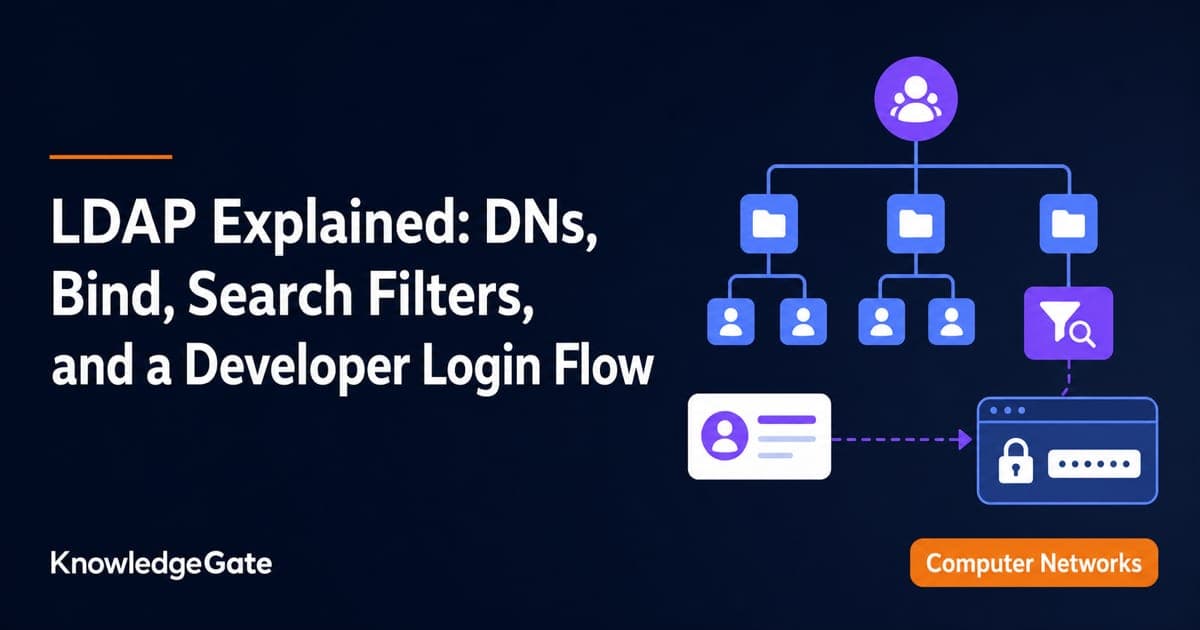
LDAP Explained: DNs, Bind, Search Filters, and a Developer Login Flow
Build one LDAP mental model from directory tree to login. Trace a service bind, escaped user search, password-verifying user bind, and group-based role check.
Updated 13 Aug 20265 min readPlacement Preparation

Group Discussion Rounds for Placements: How GD Is Scored and How to Prepare Topics
Speaking more is not the same as scoring more in a GD. Learn what panels observe, how to prepare topic notes, and how to practise useful contributions.
11 Aug 20266 min readPlacement Preparation

Off-Campus Placement Strategy for 2026 Graduates: Drives, Portals and Referrals That Work
Turn off-campus hiring into a weekly operating system that keeps drives, portals, referrals, follow-ups, and skill preparation moving together.
9 Aug 20267 min readPlacement Preparation