Turing Machine Variations and UTM: Equivalence, Simulation and Worked Examples
Compare major Turing machine variants, trace a two-tape decider, and decode one transition of a universal Turing machine without confusing simulation with decidability.
KnowledgeGate Team
Exam prep & CS education
Updated 25 Oct 20265 min read
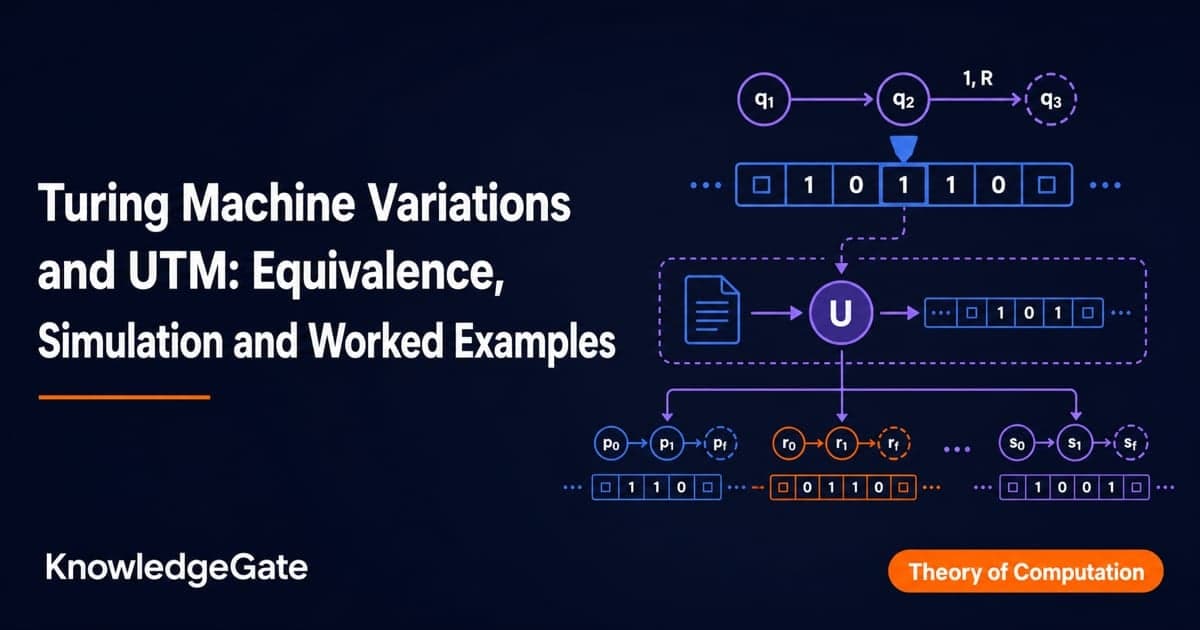
Multi-tape, nondeterministic, and universal machines sound stronger, but usually change representation or speed, not computability. Trace a two-tape decider on 000111 and decode one encoded transition. CS Fundamentals for Exams & Placements supplies the subject map.
1. Fix the standard Turing machine baseline before comparing variants
Take M=(Q, Sigma, Gamma, delta, q0, q_accept, q_reject) as baseline. Sigma excludes blank B and lies within Gamma. The partial function is delta:(Q-{q_accept,q_reject}) x Gamma -> Q x Gamma x {L,R}. One step changes state, writes once, and moves the head once. A recogniser may loop on a non-member; a decider always halts.
Comparison axis | Question to ask |
|---|---|
Language power | Do the models recognise and decide the same language classes? |
Running time | How many model-specific steps are required? |
Descriptive convenience | How simply can the algorithm and tape layout be expressed? |
Power equivalence ignores state and step counts. For configurations, practise with Turing Machines: Design, Worked Trace, Decidability.
2. Map the major TM variations and state exactly what changes
Variant | One transition reads/writes | Why it is convenient | Language power versus a standard TM |
|---|---|---|---|
Stay-put moves with | One symbol, one head | Head may stay | Same |
Tape infinite in both directions | One symbol, one head | No left boundary | Same |
Multi-track tape | One aligned tuple, one head | Align annotations | Same |
|
| Separate work areas | Same |
Nondeterministic TM | One symbol, permitted successors | Choice tree | Same |
Every listed unrestricted variant has deterministic one-tape TM computability, though simulation costs time. An NTM accepts if one branch accepts; rejection requires every branch to halt and reject. A deterministic simulator explores breadth-first, or dovetails, avoiding an infinite branch.
Do not overextend equivalence. Enumerators print Turing-recognisable languages. An LBA is input-space-bounded; an oracle machine gets extra information. Neither is unrestricted.
3. Worked two-tape decider for L = {0^n 1^n | n >= 1}
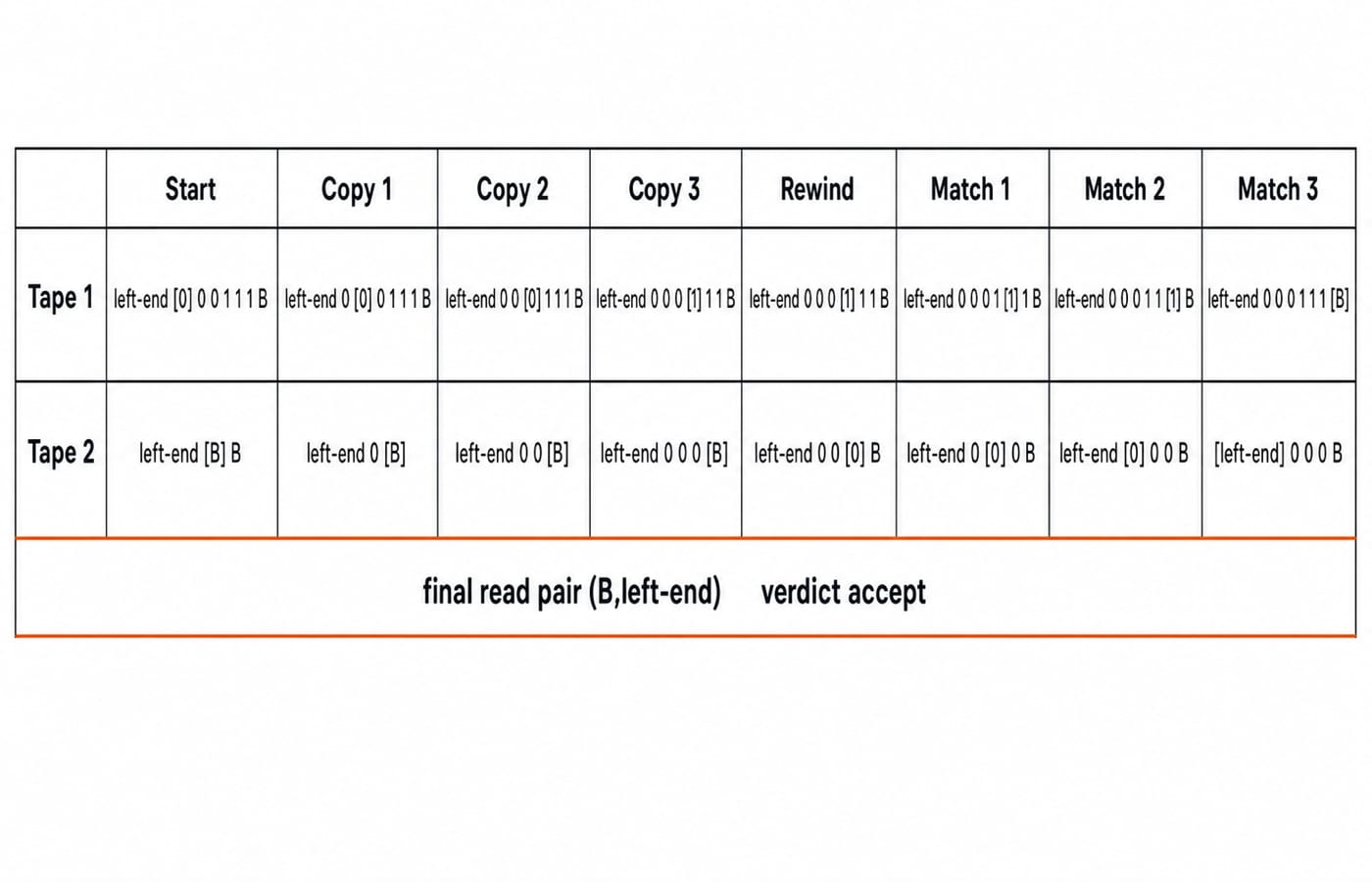
Tape 1 holds input between left-end and B. Tape 2 starts as left-end [B] B at the first blank. Each Tape 1 0 writes one 0 on Tape 2; both heads move right. At the first 1, Tape 1 stays and Tape 2 moves left once. Each (1,0) moves Tape 1 right and Tape 2 left. Accept only on (B,left-end). Reject a leading 1, a later 0, (1,left-end), or (B,0).
For 000111, start: T1=left-end [0] 0 0 1 1 1 B and T2=left-end [B] B. After three copies: T1=left-end 0 0 0 [1] 1 1 B and T2=left-end 0 0 0 [B]. Rewind gives T2=left-end 0 0 [0] B. Matches 1, 2, and 3 produce (second 1, second stored 0), (third 1, first stored 0), and (B,left-end); the final pair accepts.
Rejection rules expose imbalance:
00111reaches(1,left-end)after two matches.00011reaches(B,0)after two matches.001011encounters a Tape 10after the match phase begins.
4. Why the two-tape machine is convenient, not more computable
A one-tape simulator encodes the Rewind configuration as two blocks separated by #:
left-end 000 [1] 11 B # left-end 00 [0] B
A sweep stores (1,0) and state in finite control; another writes and repositions both head markers. After one simulated match:
left-end 0001 [1] 1 B # left-end 0 [0] 0 B
That matches Match 1. A simulator may shift separators for space, but bookkeeping cannot change the verdict.
The two-tape algorithm uses O(n) steps for input length n. Straightforward one-tape simulation of a t(n)-step multi-tape computation can take O(t(n)^2) time. Speed and convenience change; language power does not.
5. Universal Turing machine: decode one machine, then simulate it
A universal Turing machine is a fixed U receiving encoding(M)#encoding(w) and behaving like M on w. It stores the transition table, state, tape, and head position, then applies one encoded rule at a time.
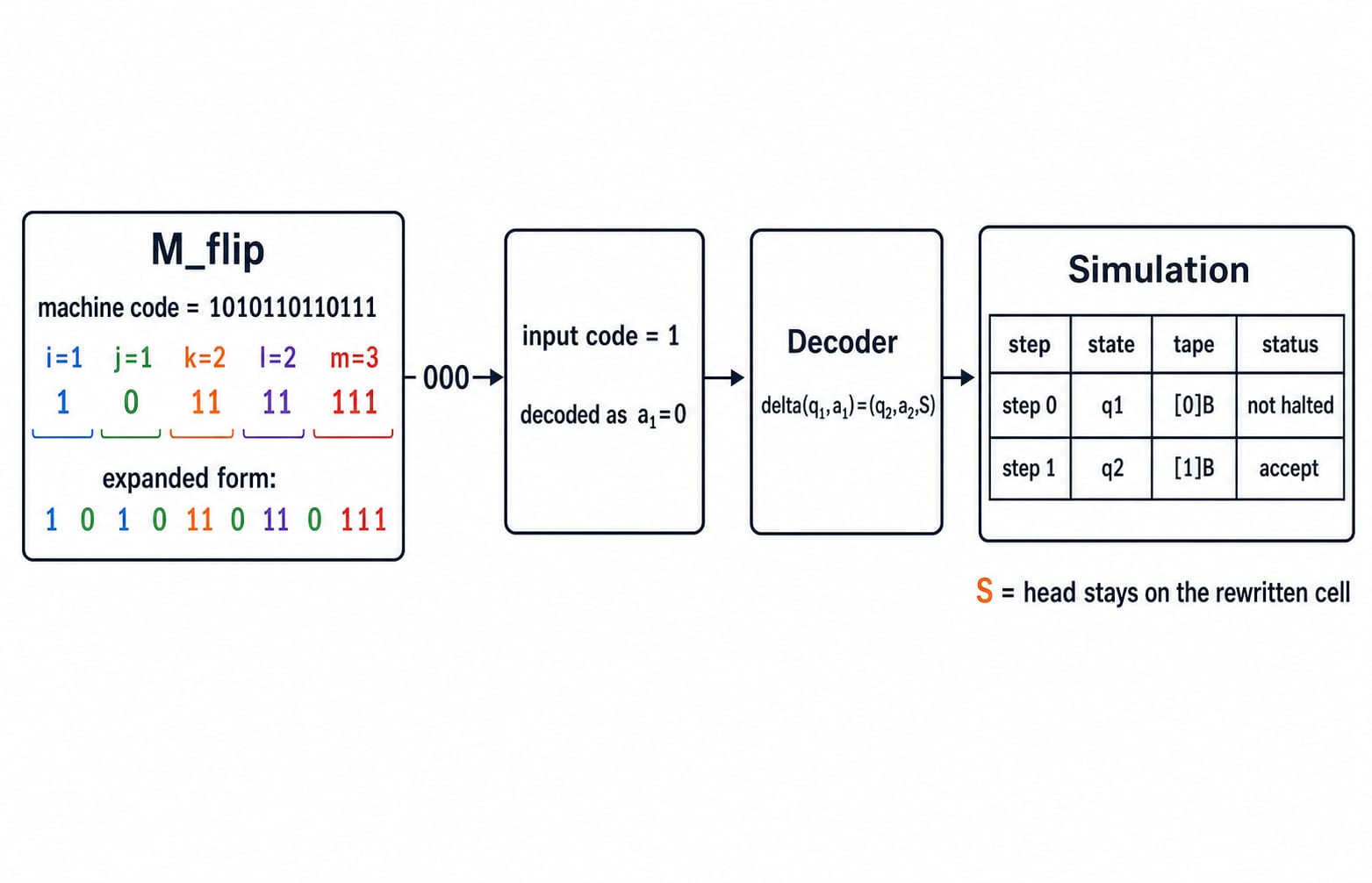
No single binary encoding is canonical, so fix this illustrative convention. Number states q1=start, q2=accept; symbols a1=0, a2=1, a3=B; directions d1=L, d2=R, d3=S. Encode (i,j,k,l,m) as 1^i 0 1^j 0 1^k 0 1^l 0 1^m, using 00 between transitions and 000 between machine and input.
For the one-rule machine M_flip, delta(q1,a1)=(q2,a2,S). The tuple is (1,1,2,2,3), so its expanded code is 1 0 1 0 11 0 11 0 111, compactly 1010110110111. Input 0=a1 has code 1. The complete tokenised pair is 1010110110111 000 1.
Simulation row | State | Tape | Decoded action or verdict |
|---|---|---|---|
0 |
|
| Rule |
1 |
|
| Head stays; accept |
A real UTM handles arbitrary valid transition sets; this case isolates decoding and dispatch.
6. Universal simulation does not solve acceptance or halting
Let A_TM={encoding(M,w) | M accepts w}. A universal recogniser mirrors simulated M: it accepts, rejects, or keeps running. Thus U neither decides A_TM nor supplies a general halt detector.
Three outcomes matter. U(encoding(M_flip,0)) accepts after one simulated step. Entering q_reject rejects. A machine with delta(q1,0)=(q1,0,S) repeats forever. Waiting for the third simulation is not a decision procedure.
For proof, read Turing Machines and Decidability: Halting Problem Proof. For semantic properties, read Rice's Theorem for GATE: Two-Part Undecidability Test.
7. How exam-style questions test TM variations and UTM
Questions compare power, k-tape configurations, multi-track versus multi-tape, NTM acceptance, rule decoding, and recognition versus decision.
Statement | Verdict | Reason |
|---|---|---|
A two-tape TM is more powerful than a one-tape TM. | False | Same language power. |
One two-tape step equals one one-tape simulation step. | False | Simulation has overhead. |
An NTM accepts when one branch accepts. | True | One branch suffices. |
A UTM decides | False | Simulation may loop. |
An LBA is an unrestricted TM with convenient tape layout. | False | Usable tape is input-bounded. |
Watch four traps:
(B,0)fails because a stored zero remains.One single-tape step cannot move both simulated heads; use sweeps and markers.
Decode
1010110110111only under the fixed convention.Uis fixed; its encoded input changes withM.
8. Short version and next study step
Variants change time and convenience.
Unrestricted multi-tape and nondeterministic models retain standard-TM power.
Single-tape simulation encodes tape blocks and head markers.
A UTM interprets
encoding(M,w).Universal simulation is not a universal decider.
The two-tape machine accepts 000111 at (B,left-end). U reads 1010110110111 000 1, rewrites 0 as 1, and enters q2. Continue with Theory Of Computation / Automata Theory. Choose Zero to Hero, Complete CS Course for broader rebuilding. Use 10+ tagged questions; reconstruct eight configurations and decode (1,1,2,2,3) unaided.
Keep learning
Regex Design and Algebra Explained: Identities, Arden's Theorem, and Worked Examples
Build regular expressions from language constraints, simplify them with safe identities, prove the result, and solve a recursive equation with Arden's theorem.
Updated 24 Oct 20265 min readTheory of Computation
Regex Basics and Definitions: Operators, Worked Examples and Exam Patterns
Learn how regular expressions denote languages, how their three core operators bind, and how to build and check expressions with exact binary examples.
Updated 21 Oct 20265 min readTheory of Computation
Regex and Finite Automata Equivalence: Conversions, Worked Examples and Exam Traps
Build and verify equivalent regex, NFA and DFA descriptions step by step. The worked conversions show what each state means and how to catch a false match.
Updated 17 Oct 20266 min readTheory of Computation
PDA Design and Basics: Worked Stack Traces and Exam Question Patterns
Learn how a pushdown automaton uses its stack, then design and trace a complete machine for a^n b^n. The worked CFG conversion and rejection checks make every move testable.
Updated 13 Oct 20266 min readTheory of Computation