Java Streams API Tutorial: Filter, Map, Reduce and Collect with Runnable Examples
Learn Java streams from the source-to-terminal mental model, then trace operations, reductions and collectors through runnable examples and practice tasks.
KnowledgeGate Team
Exam prep & CS education
Updated 24 Sep 20265 min read
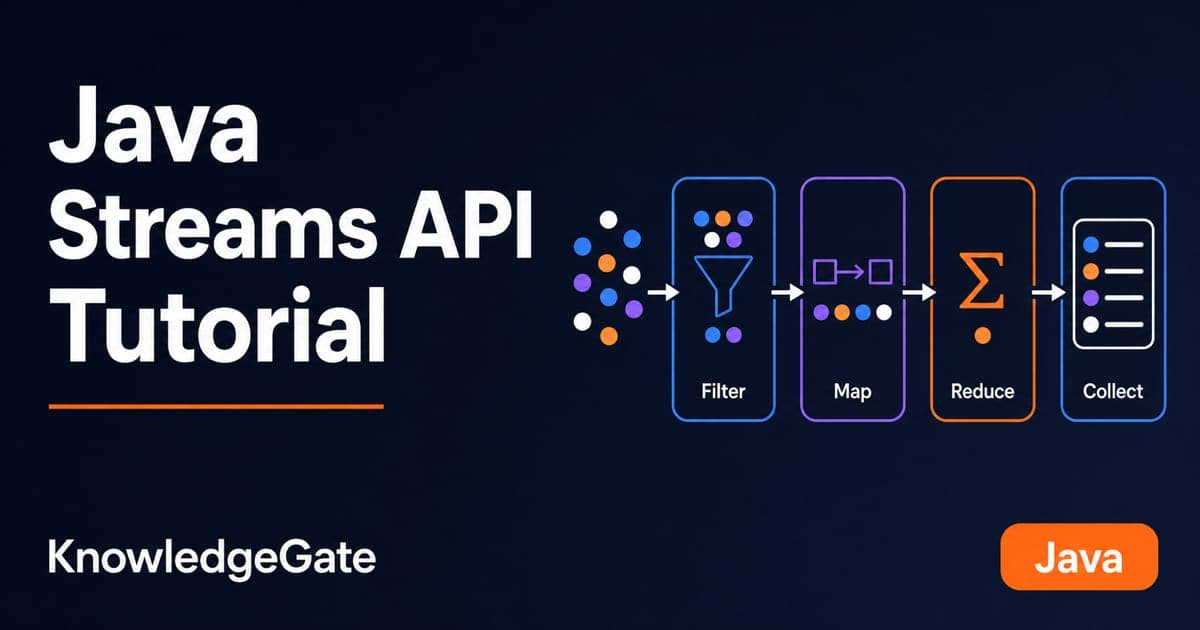
You can read a stream chain of filter, map, sorted and collect, yet still be unable to predict what each stage produces or debug where the result goes wrong. Trace any pipeline stage by stage to see what each operation produces and which operation to use. Once you master tracing, continue your wider Java practice through the Coding & Skills courses.
Java Streams API: what a stream is and is not
A stream is a one-way pipeline that processes elements from a source. A List<Integer> stores values, while list.stream() describes how those values will be processed. Creating the stream neither copies the list nor turns it into an indexable container.
Use this three-part model:
A source, such as a list
Zero or more intermediate operations
One terminal operation
filter, map, distinct and sorted are intermediate operations. collect, count, reduce, max and forEach are terminal operations.
For a first example, start with [3, 6, 7, 10]:
List<Integer> numbers = Arrays.asList(3, 6, 7, 10);
List<Integer> even = numbers.stream()
    .filter(n -> n % 2 == 0)
    .collect(Collectors.toList());
The lambda is a predicate. It keeps 6 and 10, so even is [6, 10]. The original list remains [3, 6, 7, 10].
Build and trace one complete stream pipeline
This runnable program traces filter and map, collects the transformed values, then reduces the original passing scores to one sum:
import java.util.*;
import java.util.stream.*;

public class StreamPipelineDemo {
    public static void main(String[] args) {
        List<Integer> scores = Arrays.asList(42, 75, 63, 88, 75, 51, 39);

        List<Integer> finalScores = scores.stream()
            .filter(score -> score >= 60)
            .map(score -> score + 5)
            .distinct()
            .sorted(Comparator.reverseOrder())
            .collect(Collectors.toList());

        int passingTotal = scores.stream()
            .filter(score -> score >= 60)
            .reduce(0, Integer::sum);

        System.out.println(finalScores); // [93, 80, 68]
        System.out.println(passingTotal); // 301
    }
}
Trace it from left to right:
Stage | Value |
|---|---|
Source |
|
After |
|
After |
|
After |
|
After descending |
|
After | A new |
The duplicate 80 disappears only after mapping because the two source values of 75 both become 80. The list is the source, the four transformations are intermediate operations, and collect is the terminal operation that starts traversal and materialises the result.
![Six-stage Java stream diagram showing source scores, filtering, a box labelled 'man score + 5', duplicate removal, descending sorting and collection into [93, 80, 68].](https://cdn.knowledgegate.ai/blog-assets/blog_asset_1784220189091_e3z43h.jpg)
Intermediate operations: filter, map, flatMap, distinct and sorted
Intermediate operations are lazy. Defining a pipeline does not traverse the source. Traversal begins only when a terminal operation is called. filter and map work element by element, while distinct and sorted may need to remember elements while processing.
Suppose the source is [ ["Java", "SQL"], ["Java", "DSA"] ]. This pipeline flattens the nested lists, removes the repeated value, and sorts the result:
List<String> topics = nested.stream()
    .flatMap(List::stream)
    .distinct()
    .sorted()
    .collect(Collectors.toList());
Flattening first gives ["Java", "SQL", "Java", "DSA"]. The final result is ["DSA", "Java", "SQL"]. map(List::stream) would produce a stream of streams, but flatMap(List::stream) produces one stream of strings.
Order also changes meaning. On [1, 2, 3, 4], filtering even numbers and then squaring gives [4, 16]. Squaring first and then keeping values greater than 4 gives [9, 16]. Those pipelines answer different questions.
Terminal operations, reduction and primitive streams
Create a fresh stream for each result from the original scores:
long count = scores.stream().filter(s -> s >= 60).count();
int sum = scores.stream().filter(s -> s >= 60).reduce(0, Integer::sum);
Optional<Integer> max = scores.stream().filter(s -> s >= 60).max(Integer::compareTo);
OptionalDouble average = scores.stream().filter(s -> s >= 60)
    .mapToInt(Integer::intValue).average();
The four passing scores are 75, 63, 88 and 75. Therefore, count is 4, sum is 75 + 63 + 88 + 75 = 301, max is Optional[88], and average is 301 / 4 = 75.25, represented as OptionalDouble[75.25].
An empty input has no maximum or average, which is why these operations return optional results. max.orElse(0) supplies a deliberate fallback. For numeric work, mapToInt also gives direct access to sum() and average() without unnecessary boxing.
A stream object can be consumed only once. After stream.count(), calling stream.findFirst() on the same object throws IllegalStateException. Call scores.stream() again for a new traversal.
Collect results into lists, strings and groups
Collectors build useful result containers. Given skills = ["Java", "SQL", "DSA", "Java", "Spring", "SQL"]:
Map<String, Long> frequency = skills.stream().collect(
    Collectors.groupingBy(skill -> skill, Collectors.counting()));

String names = skills.stream()
    .distinct()
    .sorted()
    .collect(Collectors.joining(", "));
The logical frequency entries are Java=2, SQL=2, DSA=1 and Spring=1. A default Map does not guarantee any particular key order when printed. The joined string is exactly "DSA, Java, SQL, Spring".
Use toList or toSet for collections, joining for one string, and groupingBy for a map of groups. Use reduce when combining elements into one value, such as the score sum 301. It is not a replacement for every collector.
Common Java stream mistakes and what to do instead
Do not reuse a consumed stream. Create a fresh stream from its collection. Also avoid adding to or removing from the source list during traversal, because that interferes with the pipeline. Produce a new result instead.
Mutating an external list inside forEach is another tempting pattern. It is harder to reason about and becomes fragile with parallel execution. Let the pipeline return its result:
List<String> cleaned = words.stream()
    .filter(Objects::nonNull)
    .map(String::trim)
    .collect(Collectors.toList());
Filtering with Objects::nonNull before String::trim also prevents a null dereference.
Finally, parallelStream() is not an automatic speed switch. Small inputs, ordered work, shared mutable state and cheap per-element operations can erase any benefit. Prefer a clear sequential stream until measurement identifies a real bottleneck.
How exercises and interviews test stream reasoning
For words = ["gate", "java", "api", "stream", "java"], filter for length at least 4, convert to uppercase, remove duplicates, sort naturally, and collect. The stages are:
After filtering:
["gate", "java", "stream", "java"]After mapping:
["GATE", "JAVA", "STREAM", "JAVA"]After
distinct:["GATE", "JAVA", "STREAM"]After sorting:
["GATE", "JAVA", "STREAM"]
The sum of the final string lengths is 4 + 4 + 6 = 14.
Now take [5, 12, 7, 12, 20, 3]. Retain values greater than 5, square them, remove duplicates and sort ascending:
After filter:
[12, 7, 12, 20]After square:
[144, 49, 144, 400]After
distinct:[144, 49, 400]Final result:
[49, 144, 400]
Pipeline judgement includes cost as well as output. Once you can trace the result, use time complexity and asymptotic notation to reason about how the work changes with the input size, and sorting algorithms: complexity and comparison to understand why sorting requires broader reasoning than element-wise transformation. Since sorted() is stateful, include it only when the output order is required.
The short version and the next Java step
Identify the source, read intermediate operations from left to right, compute each stage, and finish with one terminal operation. Create a fresh stream if you need another result. Use the final list [93, 80, 68] and the filtered-score sum 301 as quick self-checks.
For structured language practice, continue with the Java course with concepts, MCQs and coding questions. When you are ready to apply Java alongside data structures and problem solving, move to DSA using Java.
Keep learning
Abstraction and Interfaces in Java: Abstract Classes, Contracts and Runnable Examples
Learn when Java needs an abstract class, when it needs an interface, and how both work together in one runnable charge-calculation program with exact outputs.
Updated 6 Oct 20266 min readJava
Wrapper Classes and Autoboxing in Java: Worked Examples and Null Traps
Learn why Java wrapper classes exist, how boxing and unboxing work, and where nulls, reference identity, and overload selection create surprises.
Updated 1 Oct 20265 min readJava
Synchronization in Java: Monitors, Race Conditions and Runnable Examples
Learn why Java threads lose updates, what each synchronized form locks, and how to build safe counters, inventory checks and condition-waiting code.
Updated 26 Sep 20266 min readJava
Optional in Java: Null-Safe Patterns with Runnable Examples
Learn Java Optional from creation to stream pipelines through one user lookup. Trace present and empty paths, compare fallbacks, and repair common mistakes.
Updated 23 Sep 20265 min readJava