Euler Formula for Planar Graphs MCQs: 12 Solved Applications and Derived Relations
Solve 12 Euler Formula MCQs step by step, from direct substitution and bounded faces to degree sums, components and careful planarity screening.
KnowledgeGate Team
Exam prep & CS education
Updated 12 Aug 20268 min read

V - E + F = 2 is short enough to memorise in a minute and still costs marks. The outer face is easy to forget, a disconnected graph breaks the constant, and a degree sum is twice the edge count rather than the edge count itself. Work each of the twelve questions below before reading its solution: the early ones fall to a single substitution, while the later ones need a degree sum first, a bounded-face adjustment, or the E≤3V-6 screen that can rule a graph out but never prove one planar. More Euler questions with worked solutions sit in the Euler Formula practice hub, and GATE CS Exam Preparation is the wider route through the subject.
Euler's formula and the outer face in one worked refresher
For a connected planar embedding,
V - E + F = 2,
where F includes the unbounded outer face. Useful rearrangements are F = E - V + 2, E = V + F - 2, and bounded faces = F - 1 = E - V + 1. With c connected components, use V - E + F = 1 + c.
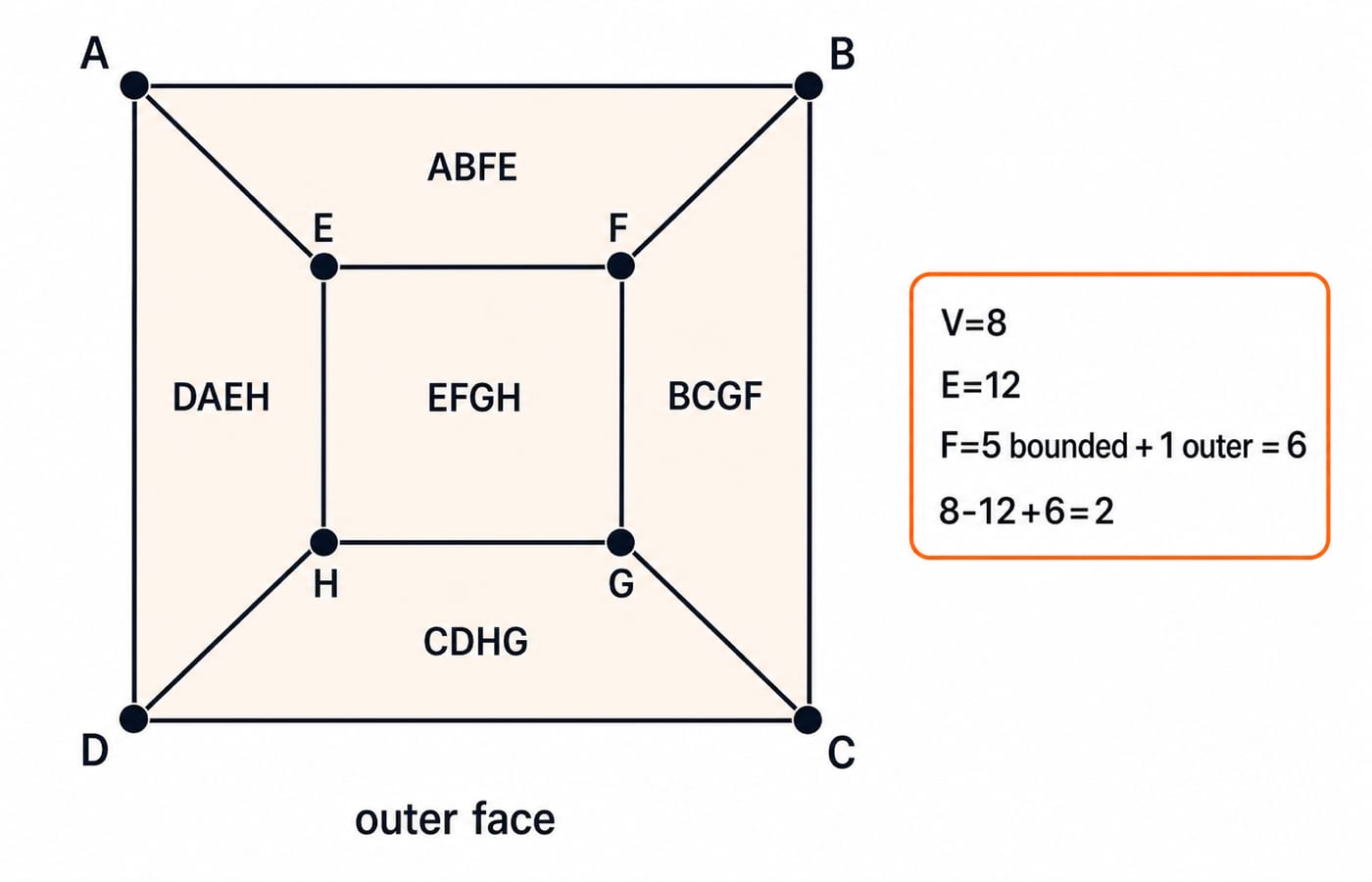
Draw a cube as an outer square A-B-C-D-A, an inner square E-F-G-H-E, and connectors A-E, B-F, C-G, D-H. It has V=8 and E=12. Its five bounded faces plus the outer face give F=6, so 8-12+6=2. Omitting the outer face gives the false value 8-12+5=1.
The handshaking lemma gives 2E = Σdeg(v), while a simple connected planar graph with V≥3 satisfies E≤3V-6. That inequality is necessary for planarity, not sufficient, so it can only rule a graph out. Check connectedness before substituting anything. The counting results these steps rest on are taught in the Discrete Mathematics module.
MCQs 1-3: formula recall and direct substitution
Write the formula, isolate the unknown, and count the outer face.
Question 1
In a planar graph, according to Euler's formula, the relationship between the number of vertices (V), edges (E), and faces (F) is:
A. V - E + F = 1
B. V - E + F = 2
C. V + E - F = 2
D. V + E + F = 1
Answer: option B, V - E + F = 2.
This is Euler's formula for a connected planar embedding. The cube above checks it numerically: 8-12+6=2. Option A is the familiar wrong result from omitting the unbounded face.
Question 2
Source: GATE 2005, Computer Science
Let G be a simple connected planar graph with 13 vertices and 19 edges. Then, the number of faces in the planar embedding of the graph is
A. 6
B. 8
C. 9
D. 13
Answer: option B, 8.
Substitute into Euler's formula: 13-19+F=2, hence F=8. All eight faces include the outer face. The value 6 comes from stopping at 19-13 and forgetting the +2.
Question 3
Source: Indian Space Research Organization 2023, Computer Science
If there are five faces and nine vertices in an undirected planar graph, then the number of edges is
A. 14
B. 16
C. 12
D. none of the above
Answer: option C, 12.
Use E=V+F-2=9+5-2=12. Euler's F already includes the outer face unless the question asks for bounded faces, so do not subtract one. Thus the answer is not option D, none of the above.
MCQs 4-6: polyhedra and bounded faces
Convex polyhedra obey V-E+F=2. Planar questions may ask for bounded rather than total faces.
Question 4
Source: CTET 2021, Paper 2
The number of edges of a polyhedron, which has 7 faces and 10 vertices, is
A. 13
B. 14
C. 15
D. 17
Answer: option C, 15.
Substitute V=10 and F=7: 10-E+7=2, so E=15. The quicker route is E=V+F-2=10+7-2=15. Both select option C.
Question 5
Source: Bihar STET 2025, Computer Science
The number of vertices (V), edges (E), and faces (F) of a polyhedron are respectively 6, 10, and x. What is the value of 3x − 12?
A. 6
B. 14
C. 18
D. 7
Answer: option A, 6.
First find the topology variable: 6-10+x=2, so x=6. Then evaluate the requested expression: 3x-12=3(6)-12=18-12=6. Option C is only the intermediate value 3x, not the final expression.
Question 6
Source: GATE 2012, Computer Science
Let G be a simple undirected planar graph on 10 vertices with 15 edges. If G is a connected graph, then the number of bounded faces in any embedding of G on the plane is equal to
A. 3
B. 4
C. 5
D. 6
Answer: option D, 6.
Euler gives F=2-10+15=7 total faces. The question asks for bounded faces, so remove the one unbounded face: 7-1=6. Keep the distinction visible: total faces =7, bounded faces =6.
For Euler paths, coloring and trees rather than planarity, work through Graph Theory MCQs: 12 solved questions on Euler paths, coloring and trees as well.
MCQs 7-9: degree sums, regions and two-step counting
Use 2E=Σdeg(v) for edges, then Euler's formula for faces or bounded regions.
Question 7
A connected planar graph has nine vertices with degrees 2, 2, 2, 3, 3, 3, 4, 4, 5. The number of edges and the number of faces are, respectively:
A. 14 and 7
B. 5 and 7
C. 7 and 15
D. 3 and 7
Answer: option A, 14 and 7.
Add the degrees: 2+2+2+3+3+3+4+4+5=28, so E=28/2=14. Then F=2-V+E=2-9+14=7. The degree sum is 28, not the edge count, because each edge contributes two incidences.
Question 8
Source: UGC NET 2019, Computer Science, Paper 2 (June)
Suppose that a connected planar graph has six vertices, each of degree four. Into how many regions is the plane divided by a planar representation of this graph?
A. 6
B. 8
C. 12
D. 20
Answer: option B, 8.
The degree sum is 6×4=24, so E=24/2=12. Euler then gives F=2-6+12=8. Here, regions means every face of the planar representation, including the outer region.
Question 9
Source: Indian Space Research Organization 2025, Computer Science
There are 20 shopping malls in a city interconnected by roads. Each shopping mall can be reached through 3 different roads. It is assumed that:
1. Only one park is planned to be constructed in a region
2. Roads do not cross each other
3. Road(s) do not pass through a park
What is the maximum number of parks that can be constructed in the regions enclosed by roads?
A. 12
B. 30
C. 60
D. 11
Answer: option D, 11.
Translate malls to V=20, roads to edges and parks to bounded faces. Degree sum =20×3=60, so E=30; then F=2-20+30=12 total regions. Only enclosed regions hold parks, so remove the outer region to get 12-1=11.
MCQs 10-12: derived bounds and planarity screening
Separate maximum edge counts, face bounds from minimum degree, and E≤3V-6 as a necessary screen.
Question 10
Source: Indian Space Research Organization 2009, Computer Science
A simple graph (a graph without parallel edges or loops) with n vertices and k components can have at most
A. n edges
B. n-k edges
C. (n − k)(n − k + 1) edges
D. (n − k)(n − k + 1)/2 edges
Answer: option D, (n − k)(n − k + 1)/2 edges.
For the maximum with exactly k components, put n-k+1 vertices in one complete component and leave k-1 isolated. This gives C(n-k+1,2)=(n-k+1)(n-k)/2. Option B, n-k, is the minimum for a forest with k components, not the maximum here.
Question 11
Source: GATE 2014, Computer Science, Set 3
Let δ denote the minimum degree of a vertex in a graph. For all planar graphs on n vertices with δ ≥ 3, which one of the following is TRUE?
A. In any planar embedding, the number of faces is at least n/2 + 2
B. In any planar embedding, the number of faces is less than n/2 + 2
C. There is a planar embedding in which the number of faces is less than n/2 + 2
D. There is a planar embedding in which the number of faces is at most n/(δ + 1)
Answer: option A, the number of faces is at least n/2 + 2 in any planar embedding.
Since the minimum degree is at least 3, 2E=Σdeg(v)≥3n, so E≥3n/2. For c components, F=E-n+1+c≥n/2+1+c≥n/2+2. Equality holds for K4: n=4, E=6, F=4, and n/2+2=4.
Question 12
Any graph G is a set of vertices and edges, G=(V,E). Which of the following graphs are planar?
1. K5
2. G1=(12,18)
3. G2=(25,56)
A. 1,2,3
B. 1,2
C. 2,3
D. 1,3
Answer: option C, 2,3.
Apply E≤3V-6 to each. For K5, E=10>3(5)-6=9, so K5 is not planar. G1 passes because 18≤30, and G2 passes because 56≤69, which leaves 2 and 3. Note the limit of the test: clearing the inequality only means the graph is not ruled out, it does not establish planarity. The pairs (12,18) and (25,56) carry no adjacency information, so deciding planarity rigorously needs the graph structure or an explicit embedding.
Five traps these Euler-formula MCQs are testing
Trap | One-line correction |
|---|---|
Forgetting the outer face | The cube has |
Confusing total and bounded faces | Question 6 has |
Forgetting to halve the degree sum | Question 7 has degree sum |
Assuming every graph is connected | With |
Treating | Question 12's count only screens; it does not prove planarity. |
Read Graph Theory: Euler and Hamiltonian Paths, Coloring and Connectivity next for the concept-level connections behind these checks.
Short version and the next practice step
Use this four-line method:
Identify
V,E,Fandc.Decide whether faces are total or bounded.
Use the degree sum before Euler when edges are missing.
Treat planar edge bounds as filters, not proofs.
Now redo all 12 without looking at the options, with one visible equation per question. For structured CS coverage beyond this set, follow GATE Guidance by Sanchit Sir.
Keep learning

Graph Traversal MCQs: 12 Solved Questions on Walks, Paths, Trails, Circuits and Connectivity
Attempt 12 graph traversal and connectivity questions, then check each answer through definitions, reachability, degree conditions and edge-count arguments.
Updated 3 Oct 20267 min readDiscrete Mathematics MCQs
Planar Graphs MCQs: 12 Solved Questions on Kuratowski’s Theorem, Homeomorphism and Edge Bounds
Solve 12 planar graph questions, then check each answer through a forbidden-subdivision argument, a crossing-free redraw, or a short calculation.
Updated 28 Sep 20268 min readDiscrete Mathematics MCQs

Power Set and Cardinality MCQs: 12 Solved Questions with Explanations
Solve 12 power set questions, from direct enumeration and nested sets to inclusion chains, ordered pairs and recurrence-based counting.
25 Sep 20267 min readDiscrete Mathematics MCQs

Null Set, Universal Set, Subset and Proper Subset MCQs: 12 Solved Questions
Practise 12 MCQs on null sets, universal sets, subsets, proper subsets, complements and nested inclusion, with clear reasoning for every answer.
Updated 24 Sep 20267 min readDiscrete Mathematics MCQs