Circular Queue MCQs: 12 Solved Questions with Step-by-Step Explanations
Solve 12 Circular Queue MCQs in sequence, with exact options and concise explanations for pointer conventions, wrap-around arithmetic and linked queues.
KnowledgeGate Team
Exam prep & CS education
Updated 22 Sep 20268 min read
Circular queue questions look like short pointer exercises, yet they often produce neat but wrong answers when you mix two FRONT/REAR conventions. The deciding clues are the pointer convention, the full/empty state model, modular movement and whether the implementation uses an array or linked list.
KnowledgeGate has over 30 practice questions on circular queues. Before reading each explanation, choose an option and write the pointer update yourself. For wider topic coverage, explore Coding & DSA Courses for Placements. First identify what FRONT and REAR mean in that question, then apply a formula. That habit prevents most errors in the set itself.
Related reading: Circular queues and deques and Queue and stack questions.
Circular queue rules to fix before solving the MCQs
Fix the convention before choosing a formula. Model A reserves one of n cells, so usable capacity is n - 1. Here, REAR == FRONT means empty, while (REAR + 1) mod n == FRONT means full.
In Model B, FRONT points to the first occupied cell and REAR to the last. Empty is FRONT = REAR = -1; the first insertion sets both to the first index. Later movement uses modulo, and full is tested with (REAR + 1) mod n == FRONT. The wording decides which model applies.
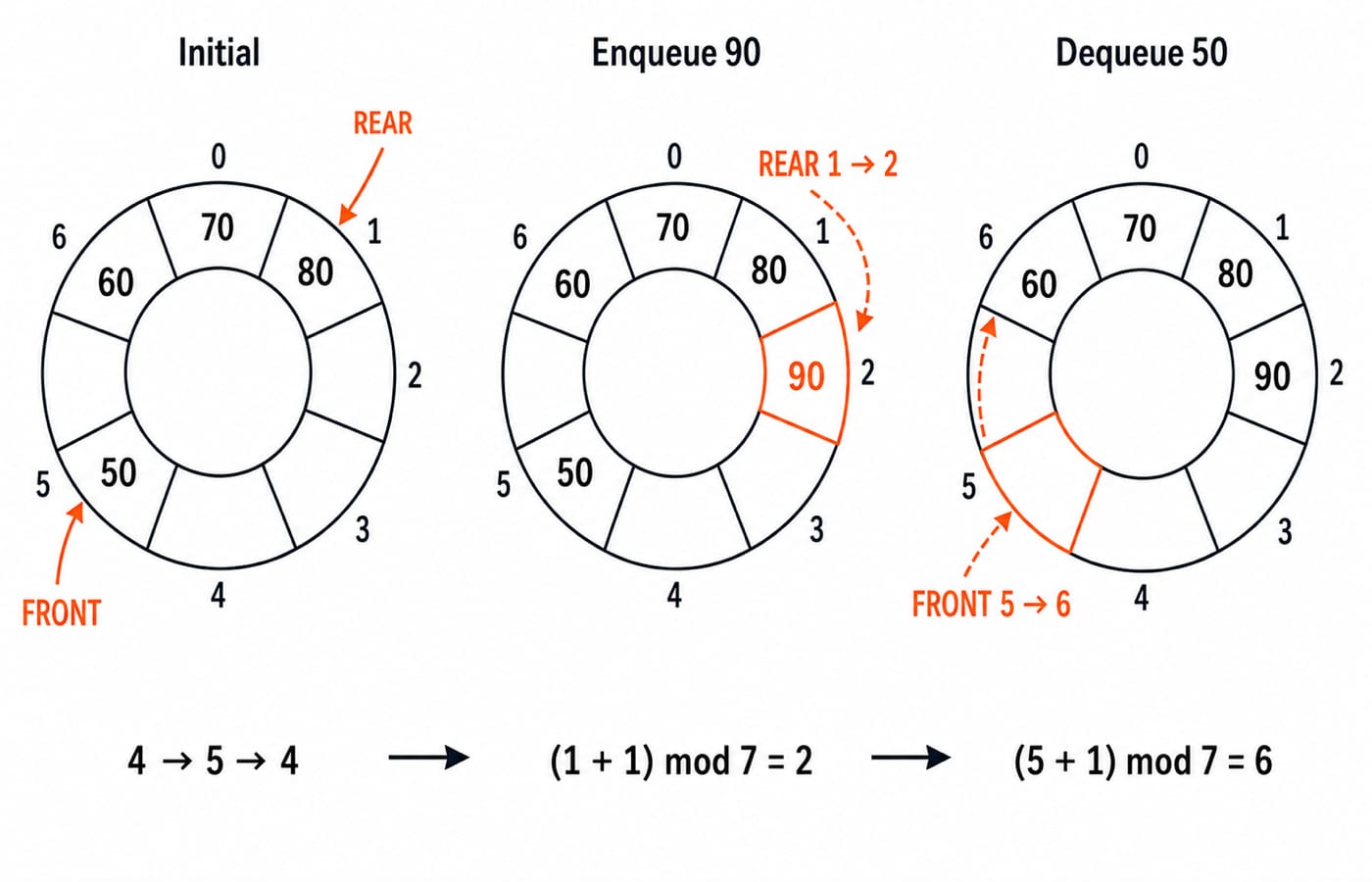
Calibrate Model B with n = 7, indices 0..6, FRONT = 5 and REAR = 1. Values occupy 5:50, 6:60, 0:70, 1:80. The count is ((1 - 5 + 7) mod 7) + 1 = 4. Enqueue 90 at (1 + 1) mod 7 = 2; REAR becomes 2 and the count becomes 5. Dequeue removes 50 at index 5; FRONT becomes (5 + 1) mod 7 = 6, returning the count to 4.
Three checks travel well: move pointers modulo the array size, do not call a wrapped index overflow, and count elements only after fixing the FRONT/REAR roles.
Circular Queue MCQs 1-3: purpose, ring-buffer identity and structure
Question 1 (BPSC 2023, TGT)
Which of the following determines the need for the circular queue?
A. Access the queue using priority
B. Avoid wastage of memory
C. Follow the FIFO principles
D. More than one of the above
E. None of the above
Correct answer: B. Avoid wastage of memory.
A linear array can strand freed cells before FRONT; wrapping reuses them. Priority is a different queue type, while FIFO belongs to both.
Question 2 (BPSC 2023, TGT)
What is another name for the circular queue among the following options?
A. Rectangle buffer
B. Square buffer
C. Ring buffer
D. More than one of the above
E. None of the above
Correct answer: C. Ring buffer.
The last position reconnects to the first, forming a ring. Rectangle and square buffer have no queue meaning.
Question 3 (TPSC 2025, Assistant Programmer)
Which of the following is true about a circular queue ?
A. It uses a linear data structure for storing elements
B. It is based on a linked list
C. It does not allow for the queue to be full
D. The last position is connected to the first position
Correct answer: D. The last position is connected to the first position.
Storage can be an array or linked list, and a bounded queue can fill. Circularity makes the first position follow the last.
Circular Queue MCQs 4-6: full, empty and position arithmetic
Question 4 (GATE 2012)
Suppose a circular queue of capacity n − 1 elements is implemented with an array of n elements. Assume that the insertion and deletion operations are carried out using REAR and FRONT as array index variables, respectively. Initially, REAR = FRONT = 0. The conditions to detect queue full and queue empty are
A. full: (REAR+1) mod n == FRONT
empty: REAR == FRONT
B. full: (REAR+1) mod n == FRONT
empty: (FRONT+1) mod n == REAR
C. full: REAR == FRONT
empty: (REAR+1) mod n == FRONT
D. full: (FRONT+1) mod n == REAR
empty: REAR == FRONT
Correct answer: A. Full when (REAR + 1) mod n == FRONT; empty when REAR == FRONT.
Capacity n - 1 signals a reserved cell. With n = 5, equality at 0 is empty. Four insertions make REAR 4; (4 + 1) mod 5 = 0 = FRONT detects full.
Question 5 (ISRO 2014)
Consider a standard circular queue Q implementation (which has the same condition for queue full and queue empty) whose size is 11 and whose elements are Q[0], Q[1], Q[2], ..., Q[10]. The front and rear pointers are initialized to point at Q[2]. In which position will the 9th element be added?
A. Q[0]
B. Q[1]
C. Q[9]
D. Q[10]
Correct answer: A. Q[0].
Advance REAR before placement. Insertions 1 to 9 land at Q[3], Q[4], Q[5], Q[6], Q[7], Q[8], Q[9], Q[10], Q[0]. Starting at Q[2] switches conventions.
Question 6 (TPSC 2026, Programmer)
In a circular queue implemented using an array of size 5, if front = 2 and rear = 4, how many elements are currently in the queue ?
A. 2
B. 3
C. 4
D. Cannot be determined
Correct answer: B. 3.
FRONT is occupied, so cells 2, 3 and 4 hold three elements. Check: ((4 - 2 + 5) mod 5) + 1 = 3.
Circular Queue MCQs 7-9: operation traces and boundary states
Question 7 (BEL 2023, Probationary Engineer)
Consider the following character queue implemented using an array of seven memory cells. FRONT = 3, REAR = 4, and the queue is: –, –, A, B, –, –, –, where ‘–’ denotes an empty cell. What are the values of FRONT and REAR after these operations?
Enqueue C, D
Dequeue
Enqueue E, F
Dequeue
A. Front = 3 Rear = 6
B. Front = 4 Rear = 7
C. Front = 5 Rear = 1
D. Front = 1 Rear = 4
Correct answer: C. Front = 5 Rear = 1.
On this one-based ring, start F = 3, R = 4. Two enqueues give R = 6; dequeue gives F = 4; two enqueues wrap R = 1; dequeue gives F = 5.
Question 8 (eLitmus 2025)
Which one of the following is the correct way to increment the rear end in a circular queue?
A. rear =rear+1
B. (rear+1) % max
C. (rear % max) + 1
D. None of the above
Correct answer: B. (rear+1) % max.
At rear = max - 1, B gives max % max = 0. A and C reach invalid index max because C adds after modulo.
Question 9 (KVS 2018)
When a circular queue is implemented in an array, then which of the following condition holds when there is only one element in the queue?
A. Front = Rear = null
B. Front = Rear ≠ null
C. Front = Rear + 1
D. Front = Rear − 1
Correct answer: B. Front = Rear ≠ null.
FRONT and REAR address the single cell. At index 3, FRONT = REAR = 3; deletion resets both to empty.
Circular Queue MCQs 10-12: wrap-around insertion, linked lists and wrapped counts
Question 10 (TCS 2025)
In a circular queue implementation using array of size 5, the array index starts with 0 where front and rear values are 3 and 4 respectively. Determine the array index at which the insertion of the next element will take place.
A. 5
B. 0
C. 1
D. 2
Correct answer: B. 0.
The next candidate is (4 + 1) % 5 = 0; index 5 is outside 0..4. A full test must still pass.
Question 11 (GATE 2017, Set 2)
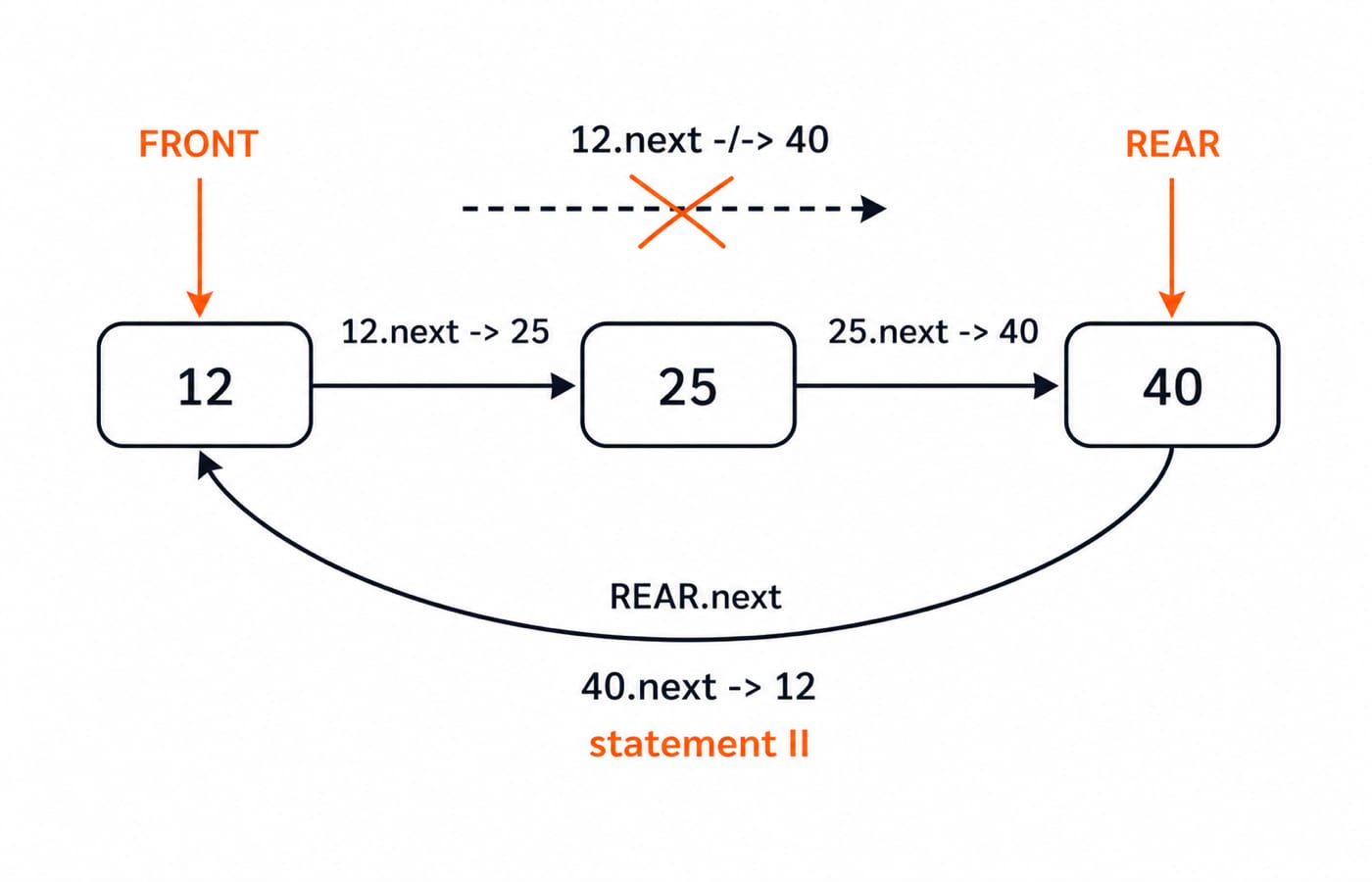
A circular queue has been implemented using a singly linked list where each node consists of a value and a single pointer pointing to the next node. We maintain exactly two external pointers FRONT and REAR pointing to the front node and the rear node of the queue, respectively. Which of the following statements is/are CORRECT for such a circular queue, so that insertion and deletion operations can be performed in O(1) time?
I. Next pointer of front node points to the rear node.
II. Next pointer of rear node points to the front node.
A. (I) only
B. (II) only
C. Both (I) and (II)
D. Neither (I) nor (II)
Correct answer: B. (II) only.
For FRONT -> 12 -> 25 -> 40, FRONT's next is 25, so I is false. REAR is 40 and 40.next -> 12, so II closes the ring in O(1).
Question 12: practice hub (TPSC 2026, System Analyst)
If a queue is implemented using the circular array QUEUE[0..14], how many elements are present when FRONT = 11 and REAR = 4?
A. 4
B. 5
C. 6
D. 8
Correct answer: D. 8.
FRONT precedes the first element. Cells 12, 13, 14, 0, 1, 2, 3, 4 are occupied. Thus (4 - 11 + 15) mod 15 = 8, without Question 6's + 1.
The convention traps these questions are testing
Trap | Wording clue | Demonstration |
|---|---|---|
FRONT occupied vs preceding | Does FRONT name an item or a slot? | Q6 adds 1; Q12 does not |
Reserved cell vs sentinel/count | Does capacity equal | Q4 reserves a cell |
Advance vs insert first | Where is the initial pointer? | Q5 advances first |
A twenty-second check: write valid indices (0..4 for size 5), label pointer roles and apply (index + 1) % n. If doubtful, list occupied cells. Q10 gives 4 -> 0; Q12 gives 12, 13, 14, 0, 1, 2, 3, 4.
Never import a memorised formula before the question defines capacity and pointer roles.
Short version and the next practice step
Circularity reuses positions freed near the start of the array.
Modulo performs the wrap from the last index to the first.
Full and empty conditions depend on the chosen state model.
FRONT and REAR roles must be fixed before counting.
For a concept reset, read Stacks and Queues: Operations and Uses. For another mixed set, solve Stacks and Queues MCQs: 12 Solved (GATE). Then redo Questions 4, 7 and 12 without the explanations. Continue the broader sequence now with DSA using Java or Coding for Placements.
Keep learning
Stack Basics and Operations MCQs: 12 Solved Questions with Step-by-Step Explanations
Test stack fundamentals through 12 exam MCQs on LIFO, TOP, array bounds, queue transfers and permutations. Complete traces make every state and answer checkable.
Updated 3 Oct 20268 min readData Structures MCQs
Evaluation of Expressions MCQs: 12 Solved Questions with Stack Traces
Solve 12 expression MCQs step by step. Trace postfix and prefix evaluation, nesting depth, precedence and notation conversion without reversing operands.
Updated 27 Sep 20267 min readData Structures MCQs
Priority Queue MCQs: 12 Solved Questions on Heaps, Deques and Variants
Attempt 12 verified priority queue and queue-variant MCQs, then learn from concise heap, array, circular queue and deque traces.
Updated 25 Sep 20267 min readData Structures MCQs
Infix, Postfix and Prefix MCQs: 12 Solved Questions with Step-by-Step Explanations
Solve 12 expression-notation MCQs in increasing difficulty, from basic stack use to conversions, associativity and maximum operand-stack depth.
Updated 24 Sep 20268 min read53 viewsData Structures MCQs