Top-Down Parsing in Compiler Design: Parser Basics and a Worked LL(1) Example
Follow one expression grammar from left-recursion removal to a complete LL(1) table. Then trace a valid token stream to acceptance and stop an invalid stream at its first error cell.
KnowledgeGate Team
Exam prep & CS education
Updated 9 Sep 20266 min read
A grammar may look simple, yet a parser must choose one production from the next token and reject a string at the first impossible move. One minimal expression grammar exposes decisions from left-recursion removal through FIRST and FOLLOW, four LL(1) table entries, acceptance of id + id $, and rejection of id + + id $ at M[T,+]. The compilation pipeline starts with lexical analysis and continues through parsing, semantic analysis, intermediate-code generation, optimisation, and code generation; Compiler Design connects those stages.
Related reading: FIRST and FOLLOW and predictive parsing tables.
Parser basics: from tokens to a syntax tree
A parser is the syntax-analysis stage. It consumes the token stream from lexical analysis and checks whether a context-free grammar can generate it. In id + id $, id and + are terminals, E, E', and T are non-terminals, and $ is the end marker, not a source-language token.
The grammar states legal structure. A derivation lists production applications, a parse tree records their hierarchy, and the algorithm chooses a production or reports an error. The parser neither rescans characters nor assigns runtime values.
Top-down parsing expands from the start symbol until the leaves match the input, constructing a leftmost derivation here. Bottom-up parsing reduces the input towards the start symbol.
Recursive descent, predictive parsing and grammar conditions
A recursive-descent parser has one procedure per non-terminal and may backtrack. A predictive parser selects a production using one lookahead token, so the terms are not synonymous.
This expression grammar breaks a naive top-down procedure:
E -> E + T | T
T -> id
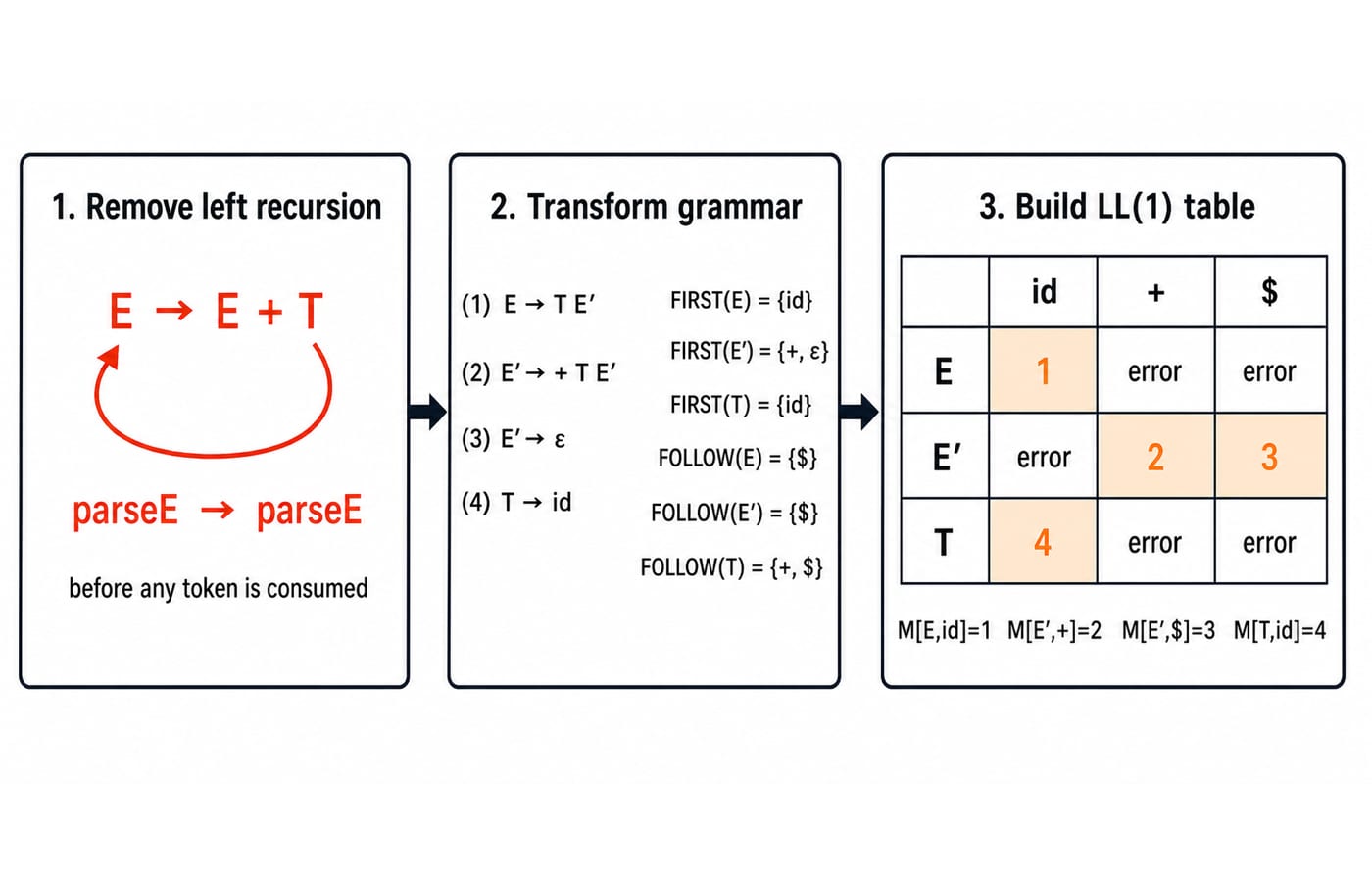
Choosing E -> E + T makes parseE() recurse before consuming a token. Remove the left recursion and number the result:
(1) E  -> T E'
(2) E' -> + T E'
(3) E' -> epsilon
(4) T  -> id
This grammar generates id (+ id)*, including id, id + id, and id + id + id.
Left factoring repairs another problem. Factor S -> id ( E ) | id = E as S -> id R and R -> ( E ) | = E. Left-recursion removal prevents looping; factoring delays the choice. Neither guarantees LL(1), which still needs a conflict-free table.
FIRST and FOLLOW for the worked grammar
From T -> id, FIRST(T) = {id}. Since E -> T E', FIRST(E) = {id}. The two alternatives for E' give FIRST(E') = {+, epsilon}.
Put $ in FOLLOW(E) because E is the start symbol. Since E' ends production (1), copy FOLLOW(E) to FOLLOW(E'). For T in E -> T E', add FIRST(E') - {epsilon} = {+}. Because E' can vanish, also add FOLLOW(E) = {$}.
FIRST(E)   = {id}
FIRST(E')  = {+, epsilon}
FIRST(T)   = {id}
FOLLOW(E)  = {$}
FOLLOW(E') = {$}
FOLLOW(T)  = {+, $}
The larger grammar in First and Follow in Compiler Design: Solved Examples demonstrates fixed-point propagation across nullable chains. In this grammar, epsilon belongs to FIRST, while FOLLOW(E') tells the table when to select production (3).
LL(1) table construction, cell by cell
For A -> alpha, place the production under each non-epsilon terminal in FIRST(alpha). If alpha can derive epsilon, also use every symbol in FOLLOW(A). One production per cell is deterministic; multiple productions form a conflict, so that grammar form is not LL(1). With only id, +, and $, the table exposes the entire chain from left-recursion repair to an acceptance trace and a rejection cell.
Non-terminal | Lookahead | Lookahead | Lookahead |
|---|---|---|---|
|
| error | error |
| error |
|
|
|
| error | error |
M[E,id]=1 comes from FIRST(T E')={id}. The leading + gives M[E',+]=2. Since $ is in FOLLOW(E'), epsilon gives M[E',$]=3. FIRST(id)={id} gives M[T,id]=4. No cell has two productions, so the grammar is LL(1).
Every LL(1) grammar is unambiguous. A non-LL(1) grammar is not automatically ambiguous or impossible to parse another way.
Parse id + id $ from the stack to acceptance
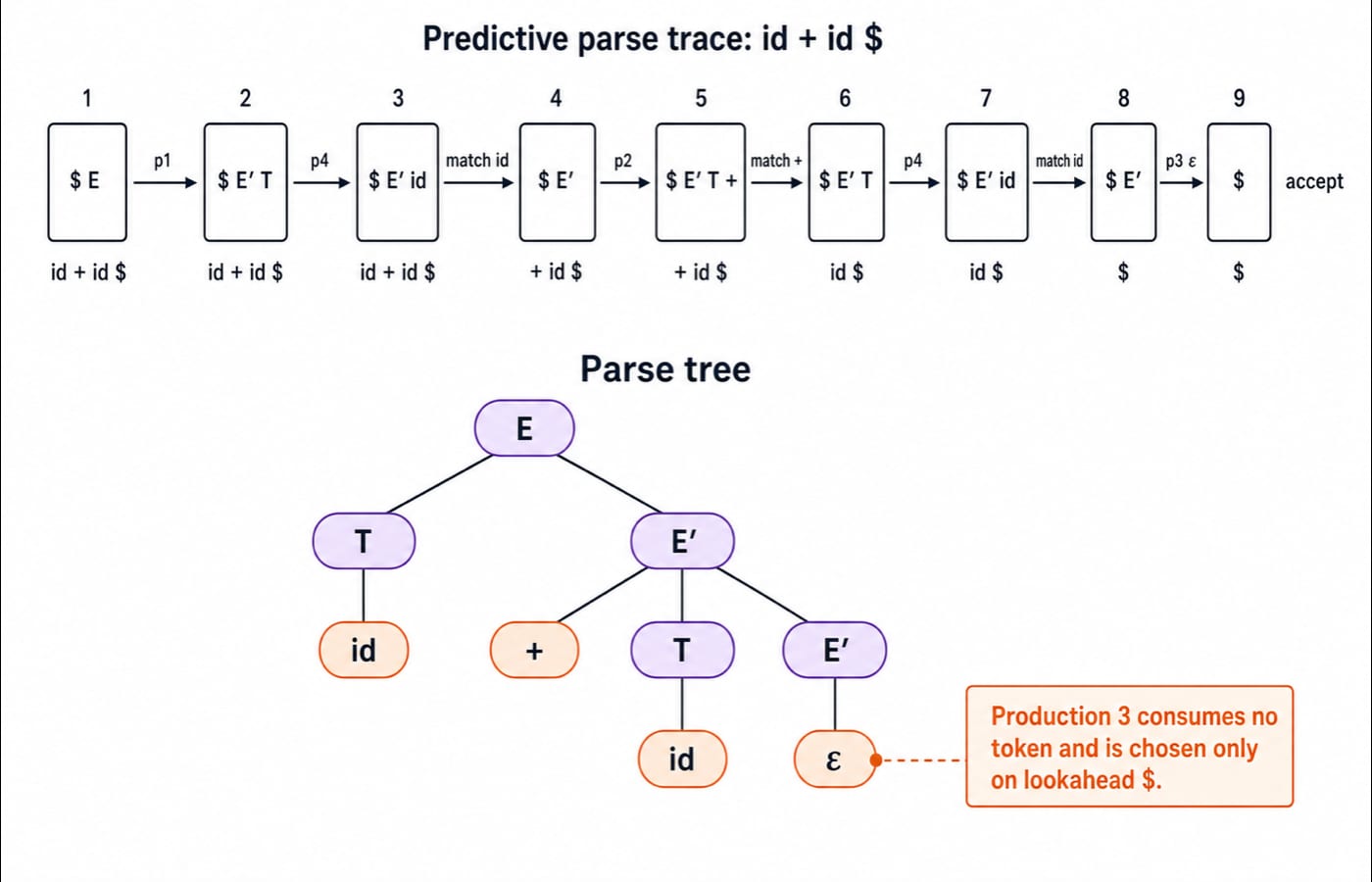
Write the stack top at the right and start with $ E. Pop a selected non-terminal and push its right-hand side in reverse. A terminal match pops and advances; epsilon pushes and consumes nothing.
Step | Stack before action | Remaining input | Table choice or match | Stack after action |
|---|---|---|---|---|
0 |
|
|
|
|
1 |
|
|
|
|
2 |
|
| match |
|
3 |
|
|
|
|
4 |
|
| match |
|
5 |
|
|
|
|
6 |
|
| match |
|
7 |
|
|
|
|
8 |
|
| both end markers agree | accept |
The leftmost derivation is E => T E' => id E' => id + T E' => id + id E' => id + id. The tree leaves are id, +, id, epsilon. Epsilon is not an input token; $ remains the end marker.
Top-down parsing rejection and common traps
For id + + id $, the steps through the first id and + are unchanged. Stack $ E' T then faces input + id $. Its top is T, but M[T,+]=error, so reject at the second +. Never delete it or choose T -> id against the table.
Trap | Why it fails | Correction |
|---|---|---|
Keep direct left recursion | The routine recurses without consuming input | Remove left recursion |
Push | With the top on the right, | Push the right-hand side in reverse |
Treat epsilon as input | Epsilon is not a token | Push and consume nothing |
Choose epsilon on | Production (3) belongs under FOLLOW, not | Select it only on |
Forget | Acceptance and final FOLLOW choices become unclear | Keep |
Call an error cell a conflict | An empty cell has no production | Reserve conflict for multiple productions in one cell |
Verify grammar repairs with id, id + id, and id + id + id. Failure here only means another grammar or parsing method may be needed.
How practice questions test top-down parsing
Typical practice tasks ask you to identify a top-down parser or leftmost derivation, repair a grammar, compute sets, fill a cell, locate a conflict, trace a string, or find the first error cell. Each task tests a distinct decision: grammar suitability, set propagation, table determinism, stack order, or rejection.
Rapid top-down parsing checks test FIRST/FOLLOW calculations, table entries, stack order, and rejection.
FIRST(E')={+,epsilon}because its alternatives start with+or vanish.FOLLOW(T)={+,$}becauseE'may begin with+or vanish at the end ofE.M[E',$]=3because production (3) is epsilon and$followsE'.Production (2) is selected on
+because its right-hand side begins with+.After expanding
E -> T E', stack$ E' ThasTon top.id + + id $fails inM[T,+]becauseTcan begin only withid.
Normalise the grammar, complete FIRST, stabilise FOLLOW, fill the table, check for multiple productions in any cell, and only then trace the input.
Top-down parsing: the short version and next step
Recall the chain: tokens -> grammar repair -> FIRST/FOLLOW -> LL(1) table -> stack trace -> accept or error. Here its decisive entries are M[E,id]=1, M[T,id]=4, M[E',+]=2, and M[E',$]=3.
As a retrieval exercise, trace id $. The sequence is p1, p4, match id, p3, accept; after matching id, lookahead $ selects E' -> epsilon. In contrast, + id $ fails immediately because M[E,+]=error.
Choose Zero to Hero for broad core-CS learning, GATE Guidance by Sanchit Sir for structured GATE preparation, or browse related topics in the CS Fundamentals category. Rebuild this table without looking and trace one valid and one invalid string.
Keep learning
Intermediate Code Generation in Compiler Design: TAC, Backpatching and DAGs
Connect expressions, short-circuit control flow and local optimisation through a single worked translation, from source code to resolved TAC and a reusable DAG.
Updated 5 Oct 20265 min readCompiler Design
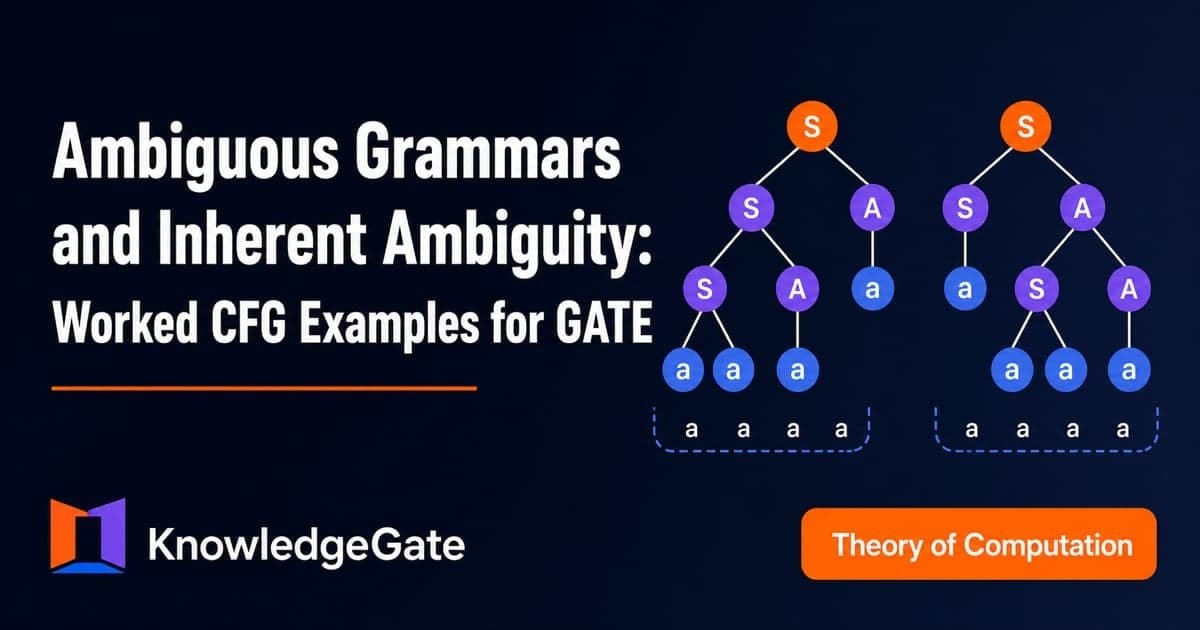
Ambiguous Grammars and Inherent Ambiguity: Worked CFG Examples for GATE
Learn what two derivations really prove, resolve expression ambiguity with precedence, and trace the classic inherently ambiguous language through aabbcc.
Updated 1 Oct 20266 min readCompiler Design
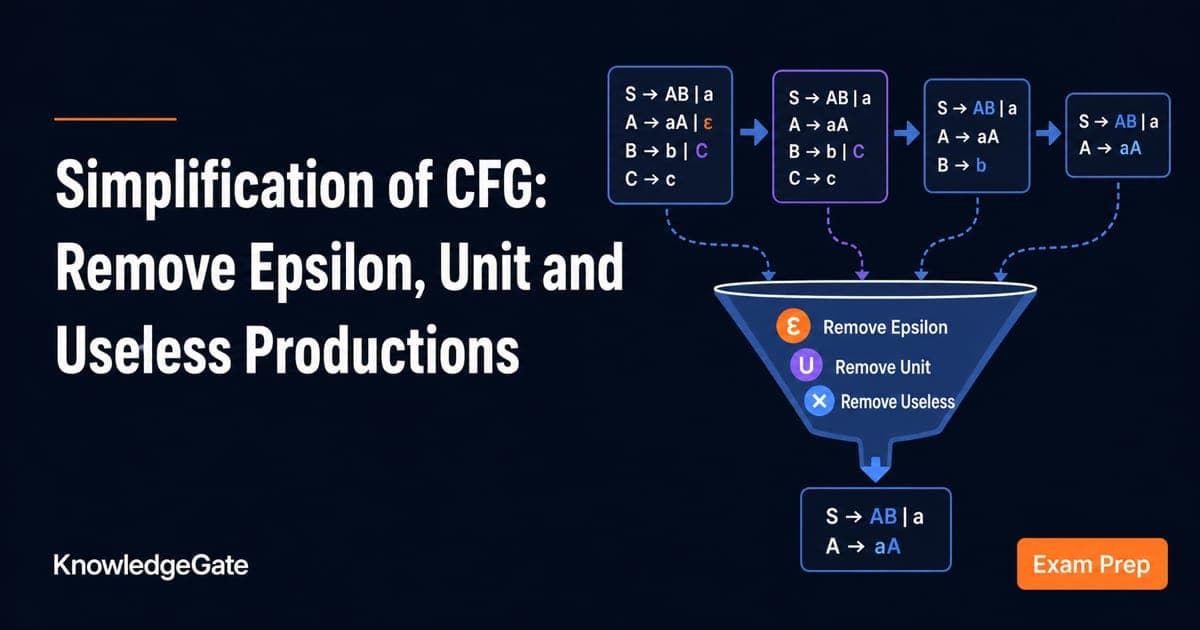
Simplification of CFG: Remove Epsilon, Unit and Useless Productions Step by Step
Simplify one context-free grammar from nine nonterminals to six. See each intermediate grammar, complete unit closures, symbol checks and final derivations.
Updated 26 Sep 20266 min readCompiler Design
Phases of Compiler Explained: Worked Example from Tokens to Target Code
Follow one four-line program through lexical, syntax and semantic analysis, then see its intermediate code optimized to a final stored value of 24.0.
Updated 24 Sep 20266 min readCompiler Design