

Minimum Spanning Tree Properties: Cut, Cycle, Uniqueness and a Worked Example
Build and certify an MST on one six-vertex graph, then use exchange rules to find second-best trees, handle weight changes, and understand uniqueness.
KnowledgeGate Team
Exam prep & CS education
Updated 23 Nov 20266 min read

Remembering the steps of Prim's or Kruskal's algorithm is not enough when a question asks whether an edge must appear, can never appear, or changes the answer after its weight is edited. Cut and cycle certificates determine whether an edge is forced or excluded, while exchange cycles reveal the next-best tree and the effect of one weight change. The fixed six-vertex graph supports each conclusion with stated weights and an explicit calculation.
Minimum spanning tree basics: the structure before the properties
Let G=(V,E) be a connected, undirected, weighted graph. A spanning tree touches every vertex, stays connected, and contains no cycle. On n vertices it has exactly n-1 edges. A minimum spanning tree, or MST, is the spanning tree with the smallest total edge weight, not merely a collection of several cheap edges.
A connected graph with n-1 edges is a tree, as is an acyclic graph with n-1 edges. Adding one non-tree edge creates exactly one cycle. Removing one tree edge creates two components and a cut.
Negative weights are allowed because MST comparisons use finite tree totals. A disconnected graph has no spanning tree; its components instead give a minimum spanning forest. Directed arborescences are a different problem.
Cut and cycle properties: tests for safe and impossible edges
A cut (S, V-S) partitions the vertices. An edge crosses it when its endpoints are on opposite sides. A lightest crossing edge is safe for some MST. If uniquely lightest, it belongs to every MST. Add it to an MST that lacks it, then remove the other crossing edge from the resulting cycle. The total cannot increase.
The cycle property gives the matching exclusion test. If an edge is strictly heavier than every other edge on some cycle, it belongs to no MST. When maximum weights tie, the named edge may appear in an MST, so strictness matters.
These exchange arguments justify the local choices in Kruskal and Prim. Minimum Spanning Trees: Kruskal, Prim, Cut Property, and Worked Examples for GATE CS gives the full algorithm-to-exam introduction, while Minimum Spanning Tree for GATE: Kruskal and Prim Numericals with Unique-MST Questions supplies a shorter Kruskal-versus-Prim numerical drill. The certificate problem begins after those introductions: on the fixed graph below, every accepted or rejected edge receives a cut or cycle proof, and exchange cycles compute second-best trees and one-edge updates.
Worked MST example: run Kruskal on one six-vertex graph
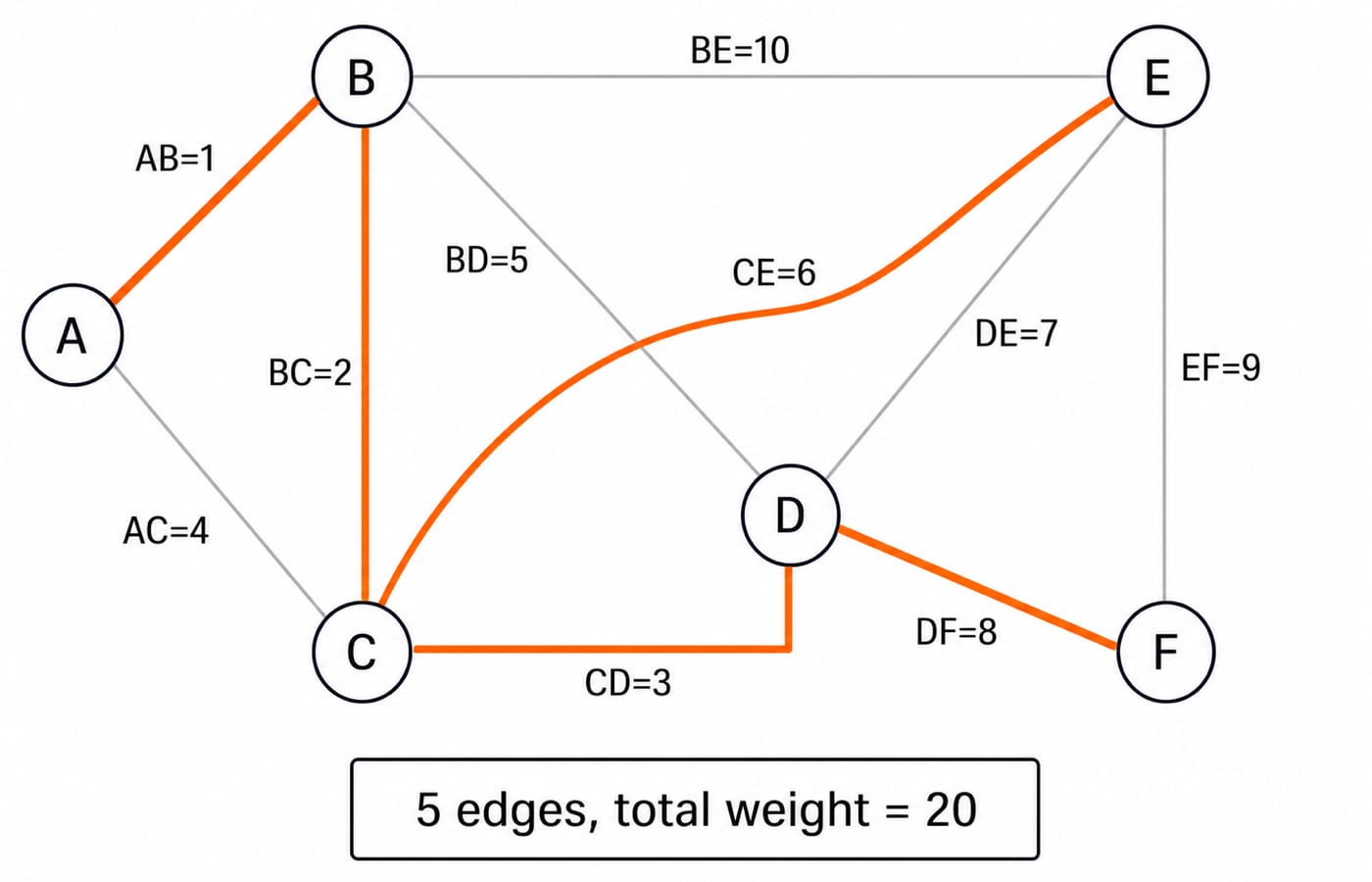
Take V={A,B,C,D,E,F} and the edges AB=1, BC=2, CD=3, AC=4, BD=5, CE=6, DE=7, DF=8, EF=9, and BE=10. Kruskal processes them in ascending order while joining different components.
Edge | Action | Reason | Components after action |
|---|---|---|---|
| Accept | Different components |
|
| Accept | Different components |
|
| Accept | Different components |
|
| Reject | Already connected |
|
| Reject | Already connected |
|
| Accept | Different components |
|
| Reject | Already connected |
|
| Accept | Joins final component |
|
| Reject | Would form a cycle |
|
| Reject | Would form a cycle |
|
The algorithm may stop after DF, but EF and BE are cycle-forming rejections. The result is T={AB,BC,CD,CE,DF}, and
w(T)=1+2+3+6+8=20.
Certify the worked MST with cuts and cycles
Each selected edge is forced by a unique-lightest cut certificate:
AB=1crosses{A}with crossing weights{1,4}.BC=2crosses{A,B}with{2,4,5,10}.CD=3crosses{A,B,C}with{3,5,6,10}.CE=6crosses{E}with{6,7,9,10}.DF=8crosses{F}with{8,9}.
Each rejected edge is also the strict maximum on a cycle: AC=4 on A-B-C-A with {1,2,4}; BD=5 on B-C-D-B with {2,3,5}; DE=7 on D-C-E-D with {3,6,7}; EF=9 on E-C-D-F-E with {6,3,8,9}; and BE=10 on B-C-E-B with {2,6,10}.
The cuts force every chosen edge, while the cycles exclude every rejected edge. This proves both optimality and uniqueness. All ten edge weights are also distinct, which is a shorter sufficient proof that this graph's MST is unique.
Exchange rules, second-best trees and one-edge weight updates
For a non-tree edge e=(u,v), add e to T. Find the maximum-weight edge on the unique u-v path in T, then remove it.
Added edge | Candidate total |
|---|---|
|
|
|
|
|
|
|
|
|
|
Thus, the next larger spanning-tree weight is 21. It comes from replacing CE with DE, or DF with EF.
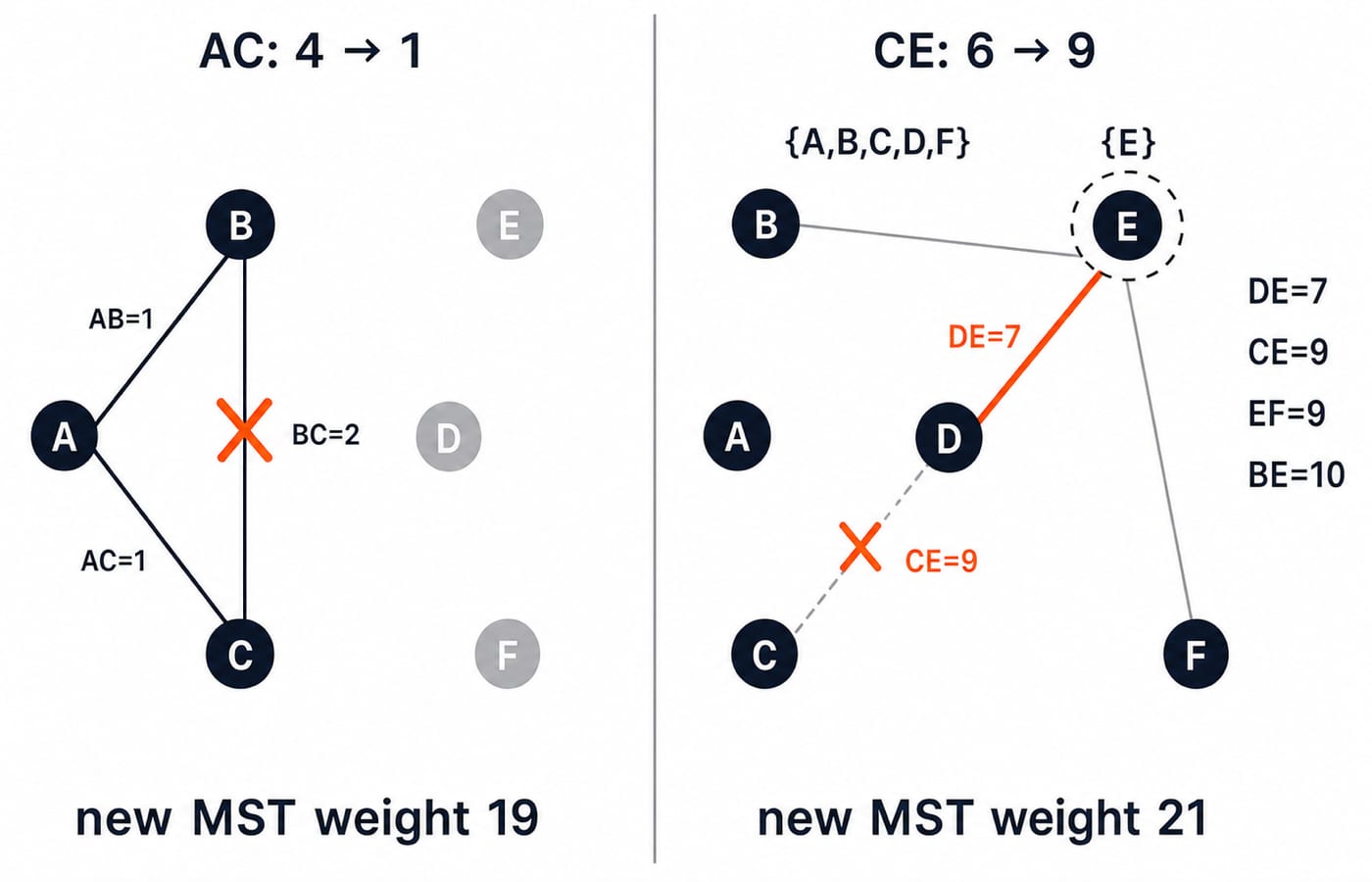
Now decrease non-tree edge AC from 4 to 1. Its cycle A-B-C-A has weights 1,2,1, so remove BC=2. The updated MST is {AB,AC,CD,CE,DF}, with weight 20+1-2=19.
Restore the original graph, then increase tree edge CE from 6 to 9. Removing it isolates E. The crossing candidates are DE=7, updated CE=9, EF=9, and BE=10. Replace CE with DE to get {AB,BC,CD,DE,DF}, with weight 20-6+7=21.
MST uniqueness, ties and properties that are often confused
Distinct edge weights are sufficient for a unique MST, but they are not necessary. In the graph AB=1, BC=2, CD=1, AC=4, BD=5, equal weights occur, yet {AB,BC,CD} is the unique MST, with weight 4. In contrast, triangle XY=1, YZ=2, XZ=2 has two MSTs, {XY,YZ} and {XY,XZ}, each weighing 3.
That triangle also separates minimum total weight from minimum bottleneck. Tree {YZ,XZ} has bottleneck 2, the smallest possible, but total weight 4. It is a minimum-bottleneck spanning tree, not an MST. Every MST is minimum-bottleneck, but the converse fails.
An MST is not necessarily a shortest-path tree either. In triangle PQ=2, PR=3, QR=2, rooted at P, MST {PQ,QR} totals 4 but gives distance P to R as 4. Shortest-path tree {PQ,PR} totals 5 but gives distances 2 and 3. Graph Algorithms: BFS, DFS and Shortest Paths develops that different path objective.
Minimum spanning tree traps and how questions test the properties
Claim or trap | Why it fails | Correction |
|---|---|---|
Cheapest edges form an MST | They may cycle or not span | Check components, cuts, and cycles |
The maximum edge is never used | A heavy bridge is forced | Test its cut and cycle role |
A tied cycle maximum is excluded | It is not strictly heavier | It may appear |
Equal weights mean several MSTs | No valid exchange may exist | Test alternatives |
Minimum total gives shortest paths | The objective differs | Track root distances separately |
A tree accepts | That creates a cycle | Accept |
A disconnected graph has a spanning tree | It cannot span every vertex | Build a minimum spanning forest |
Questions may ask for an edge in every or no MST, the next greedy edge, uniqueness, a second-best tree, a weight update, an objective comparison, or mixed statements.
For more practice on these properties, work through the GATE CS Exam Preparation Courses and Test Series category or the GATE Test Series.
Minimum spanning tree properties in the short version and the next step
For n vertices, a tree needs n-1 edges. A unique lightest cut edge is forced; a unique heaviest cycle edge is excluded. Add a non-tree edge to expose an exchange cycle, and remove a tree edge to expose a replacement cut. The certificate and exchange calculations give T={AB,BC,CD,CE,DF}, weight 20. Next, change one rejected edge so it ties the maximum edge on its cycle, then determine whether the optimum stays unique.
Go deeper with the full courseDSA using Java
Keep learning

Prim's Algorithm and Minimum Spanning Tree: Worked Example, Complexity and Exam Traps
Learn what makes Prim's greedy choice safe, trace every key update on a six-vertex graph, and avoid the mistakes that derail MST questions.
Updated 13 Nov 20266 min read91 viewsDSA & Algorithms

Minimum Spanning Tree for GATE: Kruskal and Prim Numericals with Unique-MST Questions
Run Kruskal and Prim on the same weighted graph, verify their common cost, and use cut, cycle, and equal-weight reasoning to answer uniqueness questions.
Updated 30 Oct 20266 min read60 viewsDSA & Algorithms
Minimum Spanning Trees: Kruskal, Prim, Cut Property, and Worked Examples for GATE CS
Build MST intuition from first principles, trace Kruskal and Prim on the same graph, count tied MSTs, and avoid common GATE CS traps.
Updated 18 Sep 20266 min read86 viewsDSA & Algorithms

Spanning Tree and Spanning Forest: Definitions, Construction and Worked Examples
Learn how to construct and verify spanning trees and forests, why their edge counts are n - 1 and n - c, and when edge weights change the question.
Updated 31 Oct 20266 min readEngineering Mathematics