How the MERN Stack Fits Together: One Request Traced from a React Click to MongoDB and Back
Follow one Enroll action through React, HTTP, Express, Mongoose, and MongoDB, then trace the JSON response back to the browser and its updated state.
KnowledgeGate Team
Exam prep & CS education
Updated 8 Aug 20266 min read
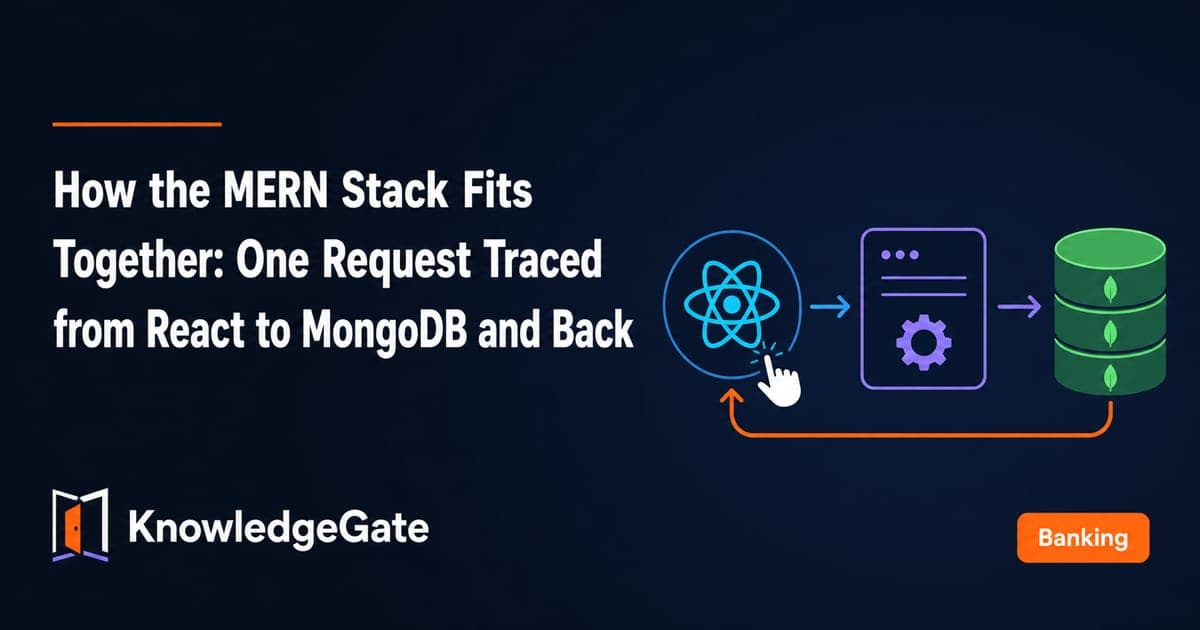
Plenty of learners can expand the four letters in MERN and still freeze when asked what happens after a user clicks a button. Knowing each tool separately is not the same as seeing one request cross every layer and return. One Enroll click on a course page becomes an HTTP POST, an Express middleware chain, a Mongoose model call, a MongoDB update, and a JSON response that flips the button to Enrolled.
The four MERN layers and their jobs
MERN names four technologies, but they do not all do the same kind of work.
MongoDB is the datastore. It stores documents with fields and nested values in a JSON-like form.
Express is the server framework. It matches routes and runs middleware and controllers.
React is the user-interface library. It renders components in the browser, handles the click, and updates the screen when state changes.
Node.js is the JavaScript runtime on the server. It executes the Express application but is not, by itself, the route or controller.
There is usually an important fifth piece: Mongoose, the object data modelling library between the Express controller and MongoDB. It gives the application schemas and models, then translates model operations into database commands. Mongoose schemas and models covers validation and population in depth.
The location of each piece matters. React runs in the browser. Node, Express, and Mongoose run on the server. MongoDB runs as the datastore. The MERN Stack course brings these layers together, though the mental model that matters while building is a single request crossing all of them.
One React click traced to MongoDB and back
Suppose a signed-in learner is viewing course C123 and clicks Enroll. The React component calls this handler:
async function enroll() {
  const response = await fetch('/api/enroll', {
    method: 'POST',
    headers: {
      'Content-Type': 'application/json',
      'Authorization': 'Bearer <jwt>'
    },
    body: JSON.stringify({ courseId: 'C123' })
  });

  const result = await response.json();
  if (response.ok && result.enrolled) setEnrolled(true);
}
The round trip has six stops, and each one hands off to exactly one other layer.
React handles the click. The handler serialises
{ courseId: 'C123' }as JSON and prepares an HTTP POST request. The bearer token represents the user's authenticated session.HTTP crosses the browser boundary. The request leaves the browser for the Express server. During local development, a frontend proxy may forward
/api/enrolltolocalhost:5000. In production, a gateway or server route sends it to the deployed backend.Express runs its middleware chain. A route can be wired as
app.post('/api/enroll', express.json(), authenticate, enrollController).express.json()parses the body,authenticateverifies the token and attaches trusted user data to the request, and only then does the controller run.The controller calls the model. It executes
await User.findByIdAndUpdate(req.user.sub, { $addToSet: { enrolledCourses: 'C123' } }).$addToSetadds the course only if it is not already present.Mongoose talks to MongoDB. Mongoose casts values according to the schema and translates the model call into a MongoDB update operation using
$addToSet. MongoDB applies the update and reports the result.The response returns. After the awaited write succeeds, the controller sends
res.status(200).json({ enrolled: true }). HTTP carries that JSON to the browser. React setsenrolledtotrue, re-renders, and shows Enrolled.
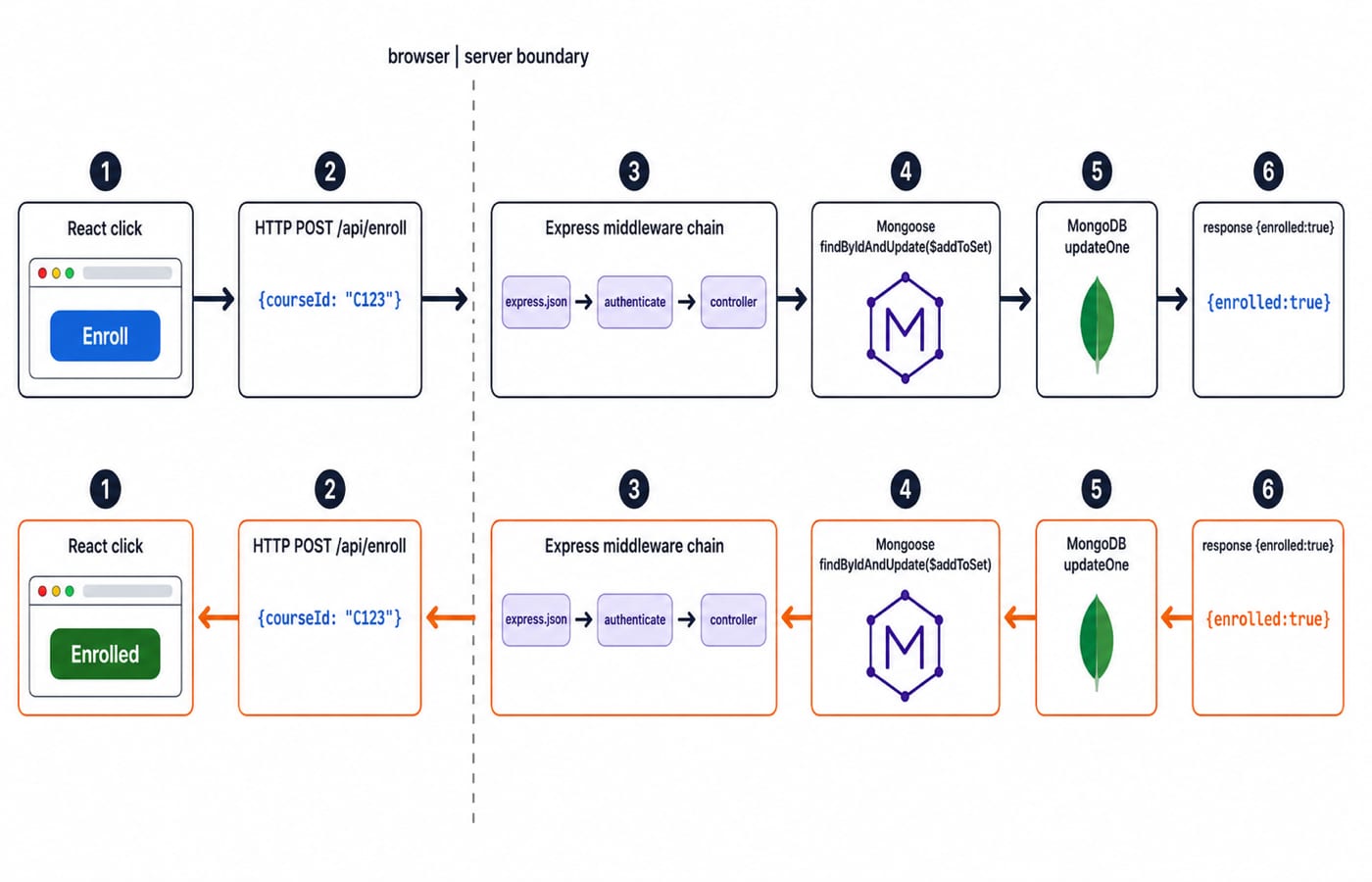
The response follows the same connection in the opposite logical direction, but responsibility changes at every stop. React owns visible state. Express owns request handling. Mongoose owns application-level data modelling. MongoDB owns the stored document.
The browser and database boundaries
Two boundaries explain many bugs that look mysterious when MERN is learned as four separate tutorials.
Browser to server: CORS
Browsers enforce the same-origin policy. If the frontend and API use different origins, the API must return the appropriate Cross-Origin Resource Sharing headers. The handler above sends Content-Type: application/json and an Authorization header, and neither is on the CORS safelist, so the browser sends a preflight OPTIONS request before the POST and only issues the POST if that preflight is allowed.
This is why a call can work in Postman but fail in a browser. Postman is not applying browser CORS rules. During development, a proxy can make the request appear same-origin. In production, configure the API to allow only the intended frontend origins, methods, and headers.
Express to MongoDB: asynchronous work
Database operations take time and return promises or promise-like queries. The controller must wait for the write before claiming success:
app.post('/api/enroll', express.json(), authenticate, async (req, res, next) => {
  try {
    await User.findByIdAndUpdate(
      req.user.sub,
      { $addToSet: { enrolledCourses: req.body.courseId } }
    );
    res.status(200).json({ enrolled: true });
  } catch (error) {
    next(error);
  }
});
Without await, the handler can send a success response before the operation is confirmed, and errors can escape the intended error path. The client then displays state that the server has not reliably committed.
Traps in the MERN round trip
Each common failure belongs to a particular layer.
Missing
express.json(). Express does not parse the JSON body, soreq.bodymay beundefined. Mount the parser before any middleware or controller that reads the body.Trusting client identity. The browser can modify its payload. Derive the user id from a server-verified token, not from a submitted
userIdfield.Confusing client rendering with server rendering. A standard React single-page application builds the visible view in the browser from component state and API data. Server-side rendering exists, but only when the architecture explicitly adds it.
Keeping stale client state. The database is the durable source of truth. After a successful write, update local state from the response or refetch the relevant query. Do not assume an old cached list has changed by itself.
Ignoring non-200 responses.
fetchresolves even when the server returns a 400 or 500 response. Checkresponse.okbefore showing success.Sending two fast clicks. The example uses
$addToSet, which prevents a duplicate array entry. The UI should still disable the button while the request is pending.
For a focused treatment of route order, middleware, and errors, read Express.js REST API routing, middleware, and error handling. The complete Node.js, Express.js, and MongoDB course then lets you practise the server half without treating it as a black box.
How interviews test the lifecycle
An interviewer may ask, "What happens when a user submits a form?" A strong answer names both the sequence and the boundaries: React creates a request, HTTP carries it, Express parses and authenticates it, the controller awaits a Mongoose model operation, MongoDB writes, and the JSON response updates React state.
Other common follow-ups include where Mongoose fits, why Node is not the database, why a Postman request can pass while a browser request fails, and where a JWT must be verified. KnowledgeGate's question bank holds well over 600 MERN-stack practice questions across HTML/CSS, JavaScript, React, Node.js, Express, and MongoDB. That spread matters because the architecture answer crosses every module. The MERN Stack learning modules walk the same layers in order, from HTML and CSS through Express and MongoDB.
The short version and your next step
A MERN request travels from React through HTTP to Express middleware, then through Mongoose to MongoDB, and returns as an HTTP response that changes React state. CORS breaks the browser boundary, while missing await breaks the database boundary.
Build the same flow once with logging at every stop, then rebuild it from memory. Watching one request cross every layer is what turns four separate tools into a stack you understand.
Keep learning
Queue Data Structure: Operations, Circular Queues and Worked Examples for GATE
Learn queue operations through a five-slot circular queue trace, then connect the same FIFO rule to linked lists, BFS and the two-stack implementation.
Updated 4 Oct 20266 min readDSA & Algorithms
Linked List Data Structure: Complete Guide with Pointer Traces and Worked Examples
Learn how linked lists work by tracing every pointer change in core operations, then apply the same invariants to reversal, middle-node search, and cycle detection.
Updated 29 Sep 20266 min readDSA & Algorithms
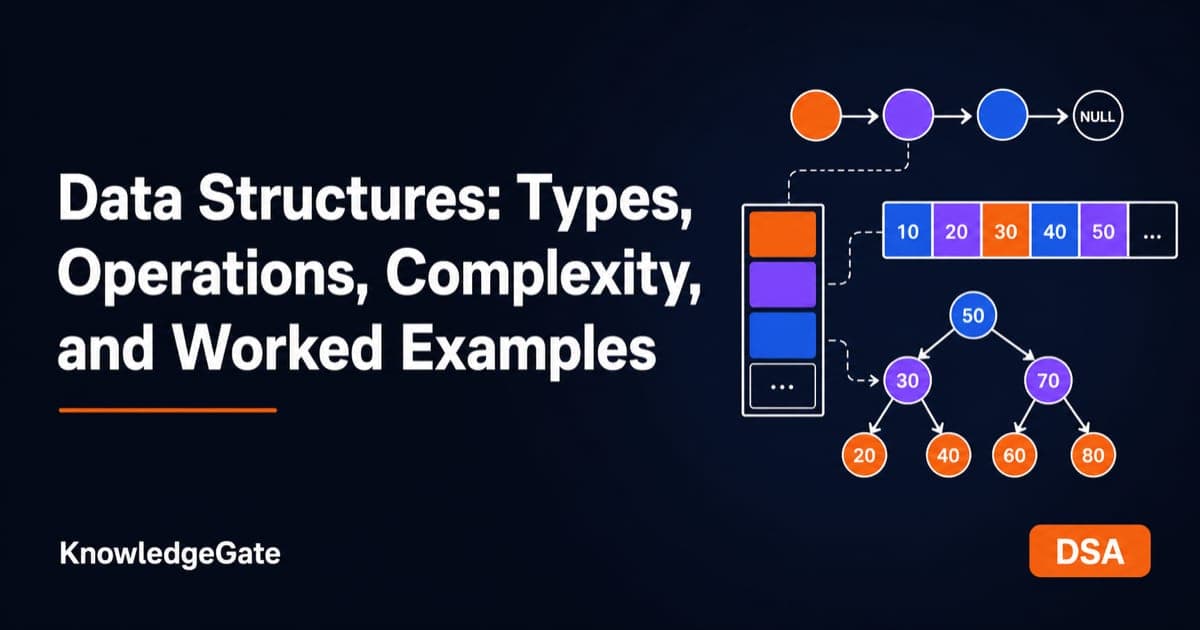
Data Structures: Types, Operations, Complexity, and Worked Examples
Learn how representations and operation costs shape data-structure choices. Follow one array and linked-list edit sequence, then apply the reasoning to stacks, queues, trees, and hashing.
Updated 25 Sep 20265 min readDSA & Algorithms
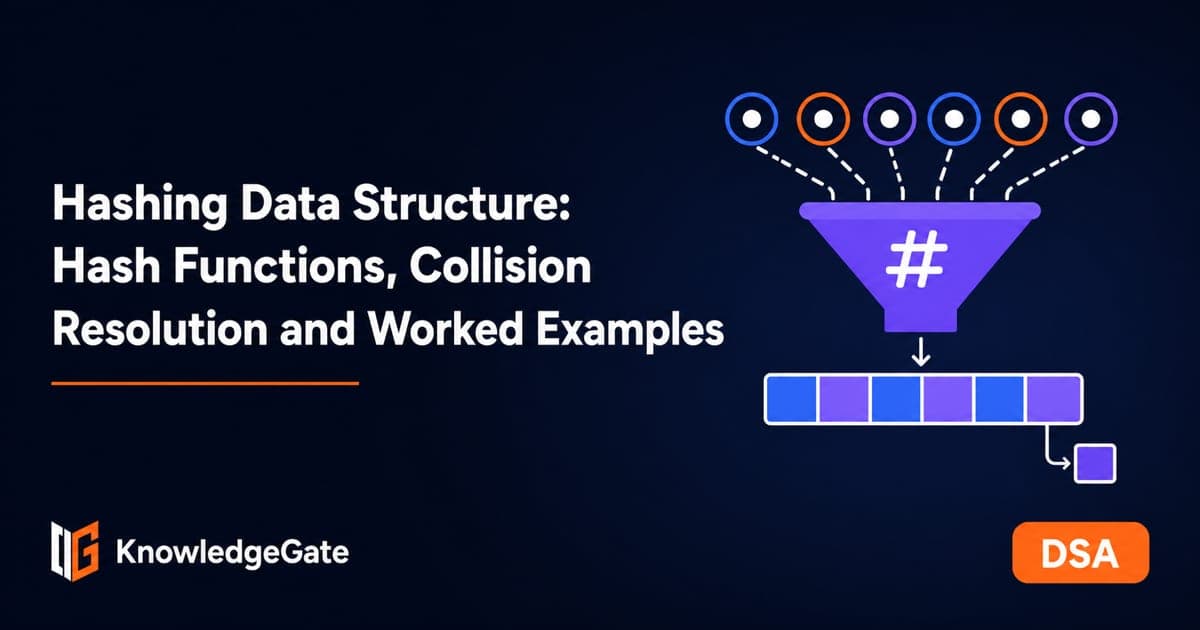
Hashing Data Structure: Hash Functions, Collision Resolution and Worked Examples
Trace the same eight keys through separate chaining and linear probing, then learn how tombstones, load factor and rehashing affect correctness and speed.
Updated 24 Sep 20266 min readDSA & Algorithms