Magnetic Disk Numericals for GATE: Capacity, Seek Time and Transfer Rate Solved
Turn disk geometry into four reliable calculations. One fully specified disk is solved for capacity, rotation time, transfer rate and sector access time.
KnowledgeGate Team
Exam prep & CS education
Updated 29 Jul 20266 min read
Magnetic-disk numericals hide a short calculation inside a long paragraph of geometry and timing data. Most errors come from using a full rotation instead of half for average latency, or from mixing bytes per sector with bytes per track. The cure is to label every given value by its level before multiplying anything.
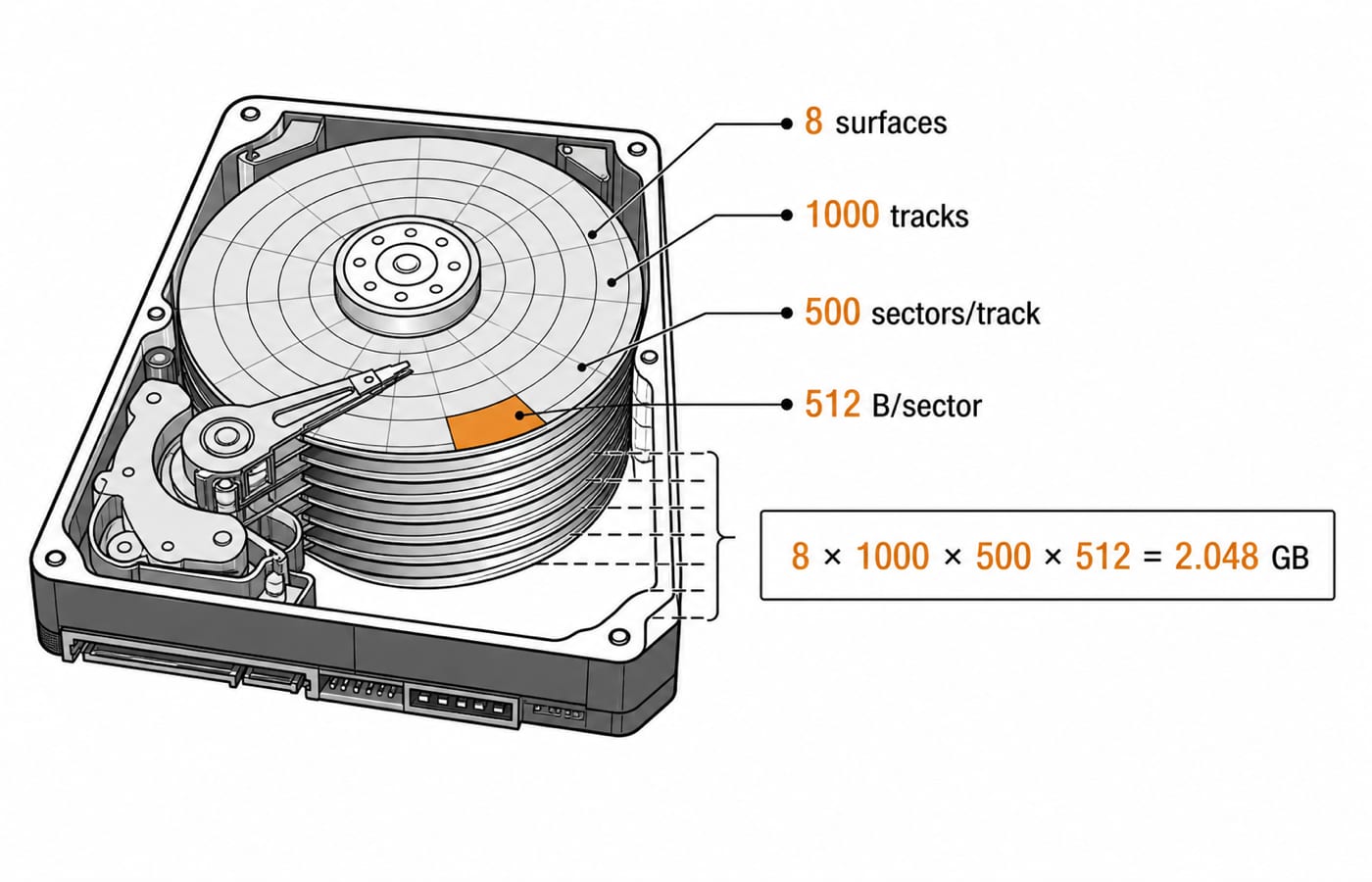
Six numbers fix a disk completely: 8 recording surfaces, 1,000 tracks per surface, 500 sectors per track, 512 bytes per sector, 6,000 RPM and a 4 ms average seek. Capacity, rotation period, transfer rate and the average time to read one sector all follow from those six.
Disk geometry in GATE terminology
A magnetic disk contains one or more platters. Under the usual idealised question model, each platter has two recording surfaces. Each surface contains concentric tracks, and each track is divided into sectors. A sector stores a stated number of bytes.
A cylinder is the set of tracks at the same radius across all recording surfaces. If there are eight surfaces, a cylinder contains eight tracks, one from each surface. It is not one track and it is not the set of all tracks on a surface.
The raw capacity product is:
surfaces * tracks per surface * sectors per track * bytes per sector
Write the units under the product. Surfaces cancel with tracks per surface, tracks cancel with sectors per track, and sectors cancel with bytes per sector, leaving bytes. That unit check catches a missing factor quickly.
Access time: seek, rotation, and transfer
Reading data from a magnetic disk has three timing components.
Seek time: the time for the arm to place the head over the required track. It depends on arm mechanics rather than on geometry, so a question supplies it, either as a single average figure or through a stated seek-time model. It is never derived from the disk's dimensions.
Rotational latency: time waiting for the target sector to rotate under the head. With a uniformly located target, the average is half a revolution.
Transfer time: time during which the required bytes pass under the head and are read.
Therefore:
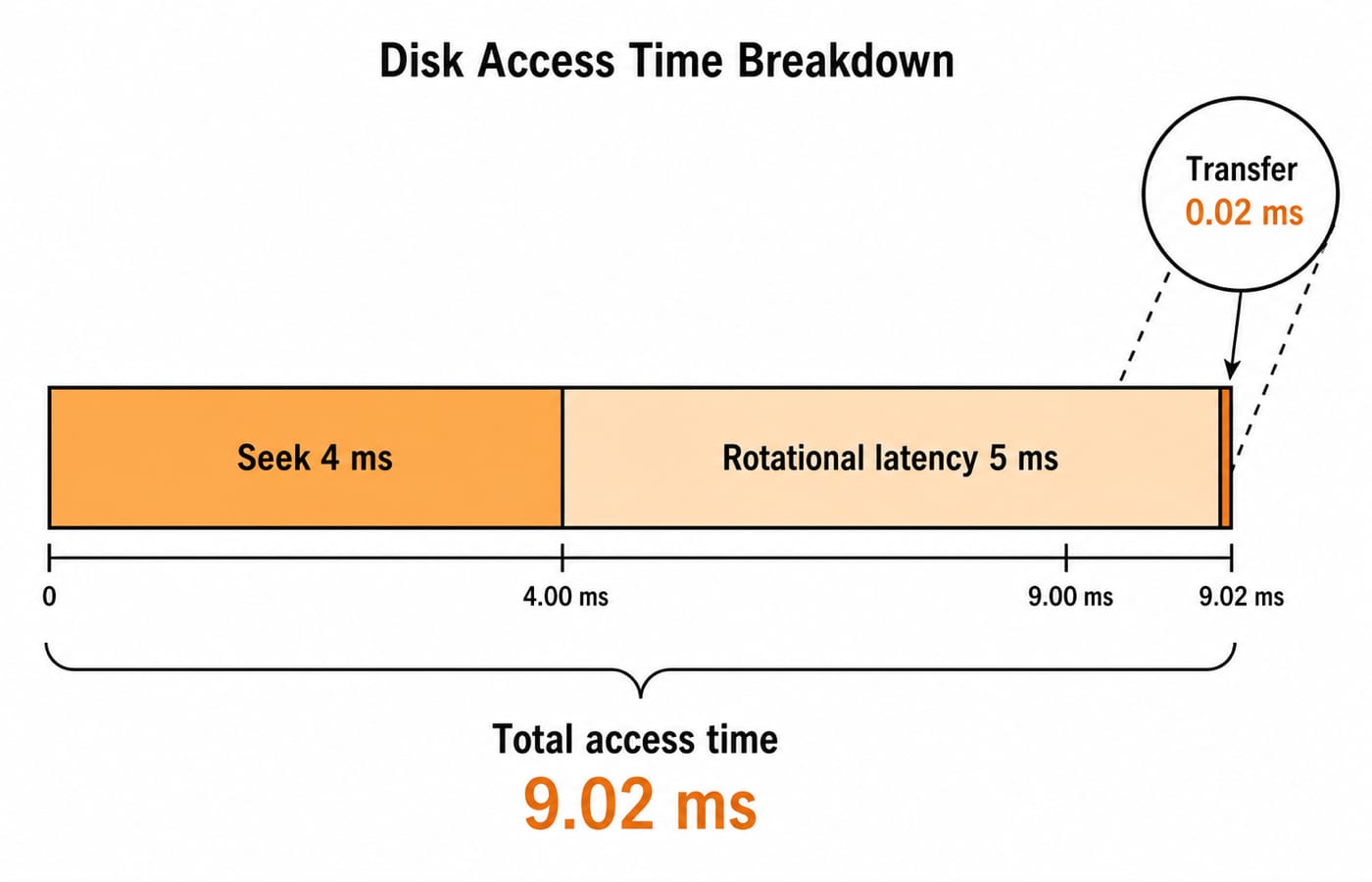
average access time = average seek time + average rotational latency + transfer time
At RPM revolutions per minute, the full rotation time in seconds is 60 / RPM. The average rotational latency is half of that. Convert into milliseconds before adding it to a seek time stated in milliseconds.
These device timings often appear beside scheduling questions. File Systems and Disk Scheduling explains what happens when several pending requests compete for head movement.
Worked example: one disk, every number
Suppose a disk has:
4 platters, giving 8 recording surfaces
1,000 tracks per surface
500 sectors per track
512 bytes per sector
6,000 RPM rotation speed
4 ms average seek time
Decimal storage units apply unless a question states otherwise: 1 KB is 10^3 bytes, 1 MB is 10^6 bytes, and 1 GB is 10^9 bytes.
Capacity
Multiply all four geometry levels:
capacity = 8 * 1,000 * 500 * 512 bytes
First, one track holds:
500 * 512 = 256,000 bytes
One surface holds:
1,000 * 256,000 = 256,000,000 bytes
All eight surfaces hold:
8 * 256,000,000 = 2,048,000,000 bytes
That is 2.048 GB because decimal gigabytes divide by 10^9. In binary units it is 2,048,000,000 / 1,073,741,824, which is about 1.907 GiB, commonly rounded to 1.9 GiB.
Rotation time and average latency
Convert 6,000 RPM to rotations per second:
6,000 / 60 = 100 rotations per second
One rotation therefore takes:
1 / 100 second = 0.01 second = 10 ms
The target sector is assumed equally likely to be anywhere around the track, so the average wait is half a revolution:
average rotational latency = 10 / 2 = 5 ms
Transfer rate
One full 256,000-byte track passes under the head in one 10 ms rotation. Since 10 ms = 0.01 s:
transfer rate = 256,000 / 0.01 = 25,600,000 bytes/s
That is 25.6 MB/s in decimal units.
Time to transfer one sector
There are 500 equal sectors around the track, so one sector takes one five-hundredth of a rotation:
one-sector transfer time = 10 ms / 500 = 0.02 ms
Since 1 ms = 1,000 microseconds, this is 20 microseconds.
Now add the three components for an average one-sector access:
4 ms + 5 ms + 0.02 ms = 9.02 ms
The average time to read one sector is therefore 9.02 ms under the assumptions in the question.
As an independent transfer check, 512 bytes / 25,600,000 bytes/s = 0.00002 s = 0.02 ms. Both routes give the same one-sector transfer time.
Read the quantity actually requested
A correct formula can still answer the wrong level of the disk.
Disk capacity uses surfaces, tracks per surface, sectors per track, and bytes per sector.
One-surface capacity omits the number of surfaces.
One-track capacity is sectors per track times bytes per sector.
Transfer rate uses bytes per track divided by the full rotation time.
Average access time adds seek, half a rotation, and the required transfer time.
For a contiguous file of N sectors on one track, seek and average latency are normally paid once, followed by N sector-transfer times. In the worked disk, a 10-sector contiguous transfer would take 10*0.02 = 0.20 ms, so the idealised average total would be 4 + 5 + 0.20 = 9.20 ms. If the file crosses a track boundary, use whatever additional seek, head-switch, or rotational assumptions the question supplies. Do not invent them.
Traps that change the answer
Check these before selecting an option:
Full versus half rotation: full rotation gives the period; average rotational latency is half the period.
GB versus GiB:
10^9bytes form a decimal GB, while2^30bytes form a GiB. Follow the convention stated in the question.Track versus sector: transfer rate uses the bytes passing in a full revolution, which is one track, not one sector.
Formatted versus raw capacity: headers, error-correction data, and gaps can reduce usable capacity when the stem supplies such overhead.
Cylinder confusion: multiply one-track capacity by the number of surfaces to get cylinder capacity under uniform geometry.
Use Operating Systems Disk Scheduling MCQs to practise separating mechanical access time from the order in which requests are served.
How GATE tests disk numericals
Common questions ask for total capacity, capacity per track or surface, average access time, sustained transfer rate, or the time required for a file. Start by listing geometry values separately from timing values. Then convert RPM, calculate the track size, and only combine quantities carrying compatible units.
The weightage of storage and operating-system I/O can move between years, so confirm the current paper pattern on the official GATE portal of the organising IIT. The formulas do not change. The KnowledgeGate question bank carries more than 2,000 Operating System questions covering capacity, seek time, transfer rate and disk scheduling.
Short version and next step
Capacity is the full geometry product. Average access time is seek plus half a rotation plus transfer. Transfer rate is track capacity divided by one rotation time. Keep decimal and binary storage units explicit.
Recalculate the worked disk from blank paper, then use the GATE Test Series for timed numericals and GATE Guidance by Sanchit Sir for the concept sequence. The wider GATE category connects this topic to the rest of storage and operating systems.
Keep learning

Paging and TLB Explained: Address Translation, EMAT and Exam Traps
Follow one virtual address from its VPN through the TLB to a physical frame, then calculate page-table size, TLB reach and effective memory access time.
Updated 4 Oct 20266 min readOperating Systems
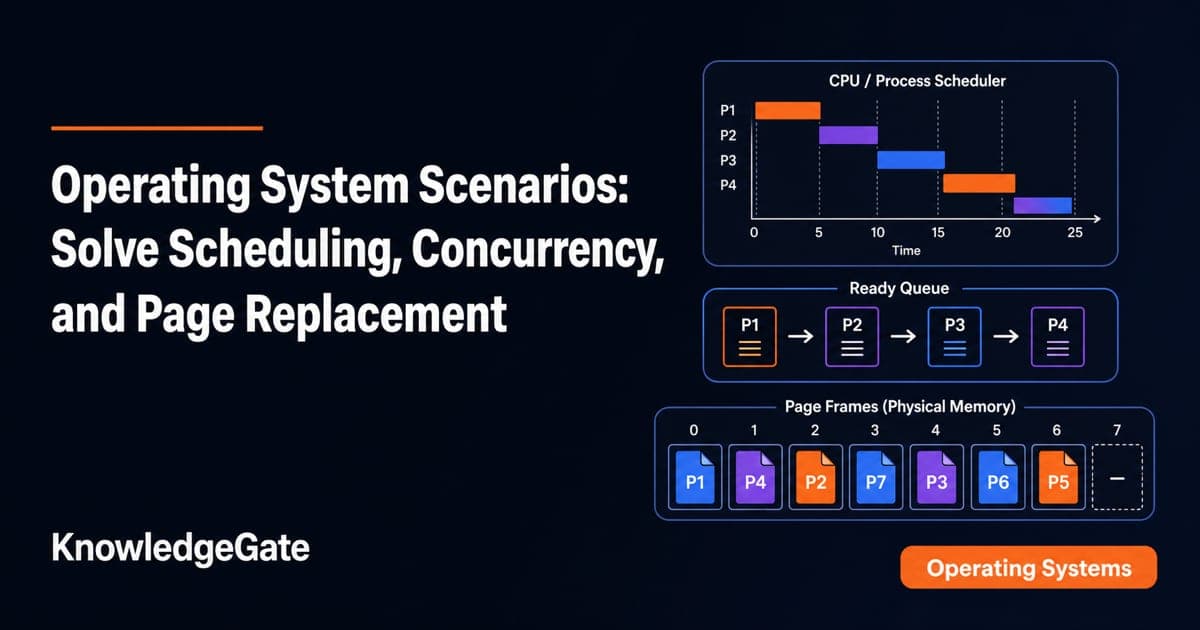
Operating System Scenarios: Solve Scheduling, Concurrency, and Page Replacement
Learn one state-trace method for three common OS problem families, then apply it to complete Round Robin, concurrency, FIFO, and LRU examples.
Updated 29 Sep 20265 min readOperating Systems

Tower Research Hiring Process: Stage-by-Stage Prep for Quant and Dev Roles
Prepare for a Tower Research application without treating one online account as a universal process. Use this role-led map, worked drills, and seven-day plan.
Updated 25 Sep 20265 min readOperating Systems

Capital One Recruitment Process: Stage-by-Stage Guide for India Applicants
Prepare for a Capital One India application with a cautious five-stage map, worked technical and case drills, and a practical 14-hour schedule.
Updated 24 Sep 20265 min readOperating Systems