Liveness Analysis in Compiler Design: Data-Flow Equations and a Worked Example
A step-by-step guide to computing USE, DEF, IN and OUT on a looping control-flow graph, then tracing the result to one safe dead-store candidate.
KnowledgeGate Team
Exam prep & CS education
Updated 12 Sep 20265 min read

A variable can hold a value yet be dead. Another may be live without appearing in the current statement because a later path reads it. Liveness analysis uses a control-flow graph, the USE, DEF, IN and OUT sets, and a fixed-point calculation to identify a genuinely dead assignment.
Related reading: liveness MCQs and SSA and control flow.
Liveness means a future use can still see the current value
A variable is live at a program point if at least one path uses its current value before redefining it. It is dead if no path can do so. Liveness concerns possible future use, not whether the variable contains a value or whether that value is non-zero.
This has two compiler uses. An assignment may be a dead store if its variable is not live immediately afterwards, provided removal preserves required side effects. Variables live at the same point also compete for registers, so liveness helps register allocation.
Liveness is a backward, may analysis. Backward means information travels from successors to predecessors. May means any successor path can keep a variable live. It belongs to later optimization, unlike top-down and bottom-up parsing in the compiler front end.
Liveness equations: compute USE, DEF, IN and OUT in order
A basic block is a straight-line sequence with one entry and one exit. A control-flow graph, or CFG, connects blocks that may execute consecutively. For every block B, liveness uses:
OUT[B] = union of IN[S] for every successor S of B
IN[B] = USE[B] union (OUT[B] - DEF[B])
USE[B] contains variables read before any definition in B. DEF[B] contains variables assigned in B. Statement order matters. In x = x + 1, the old x is read before the new one is written, so x belongs to both USE and DEF. In x = 1, it belongs to DEF but not USE.
Start with every IN and OUT set empty. Recompute all blocks from the previous round, then repeat until a complete round changes nothing. Code Optimization in Compiler Design: Basic Blocks, Data Flow and Worked Examples connects data flow to transformations and loop rewrites; liveness itself requires fixed-point propagation followed by statement-level tracing.
Worked example: solve a loop to a fixed point
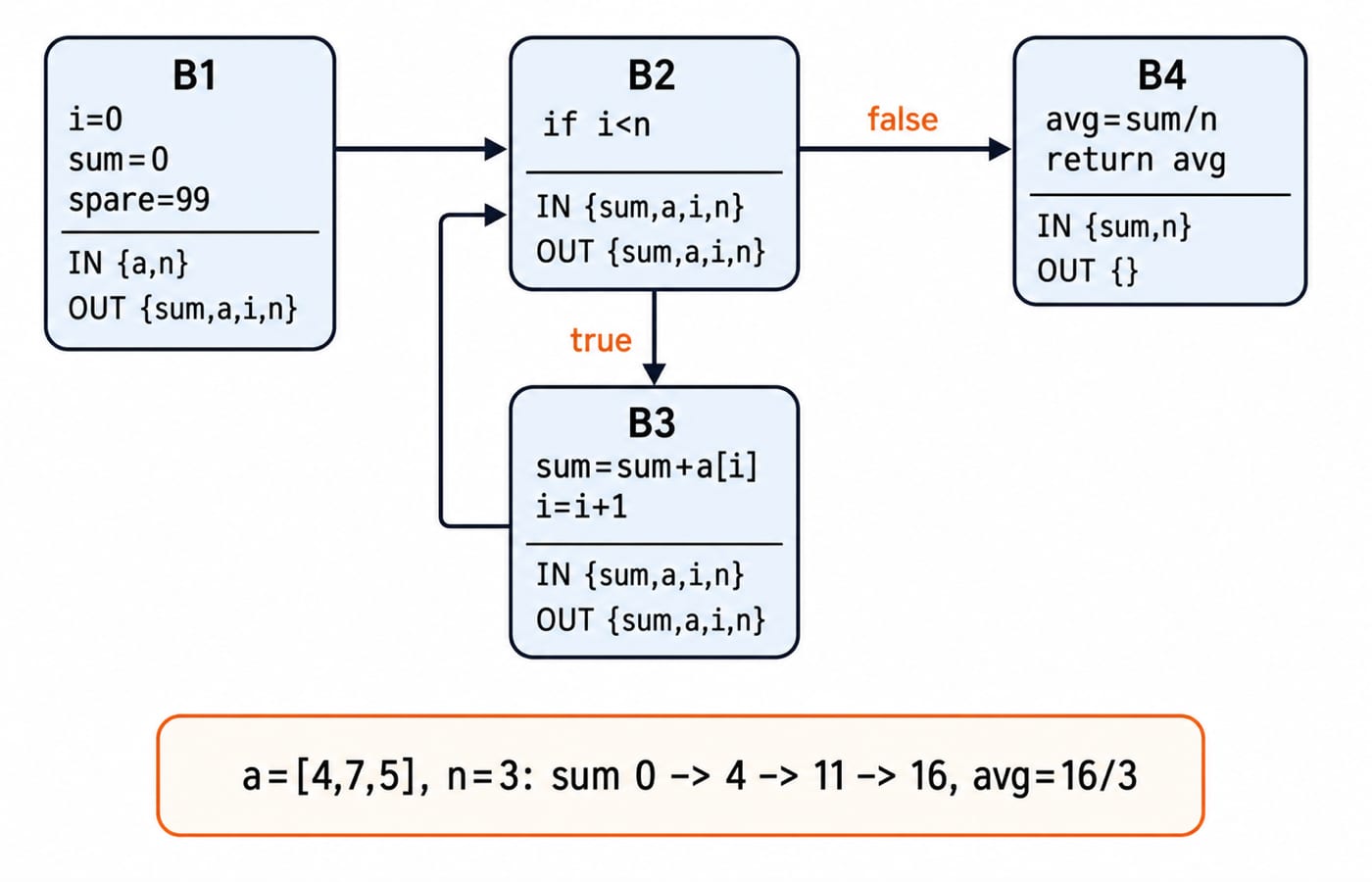
Use this four-block program:
B1:
  i = 0
  sum = 0
  spare = 99
  goto B2

B2:
  if i < n goto B3 else goto B4

B3:
  sum = sum + a[i]
  i = i + 1
  goto B2

B4:
  avg = sum / n
  return avg
For a = [4, 7, 5] and n = 3, runtime takes sum from 0 to 4, then 11, then 16, and returns avg = 16/3. Liveness depends on uses and definitions, not these values.
The CFG edges are B1 -> B2, B2 -> B3, B2 -> B4 and B3 -> B2. B4 exits. The local sets are:
Block | USE | DEF |
|---|---|---|
B1 |
|
|
B2 |
|
|
B3 |
|
|
B4 |
|
|
Now perform synchronous rounds, always reading the previous round's values.
Round 0: Every
INandOUTis{}.Round 1: Because the previous
OUTsets are empty,IN[B1] = {},IN[B2] = {i, n},IN[B3] = {sum, a, i}andIN[B4] = {sum, n}.Round 2: Successor information moves backwards.
IN[B1] = {n},IN[B2] = {sum, a, i, n},IN[B3] = {sum, a, i, n}andIN[B4] = {sum, n}.Round 3: The loop information reaches the start, giving
IN[B1] = {a, n}. The other threeINsets stay unchanged.Round 4: No
INorOUTset changes, so the fixed point has been reached.
The final result is:
Block | IN | OUT |
|---|---|---|
B1 |
|
|
B2 |
|
|
B3 |
|
|
B4 |
|
|
Push the block result back to statements
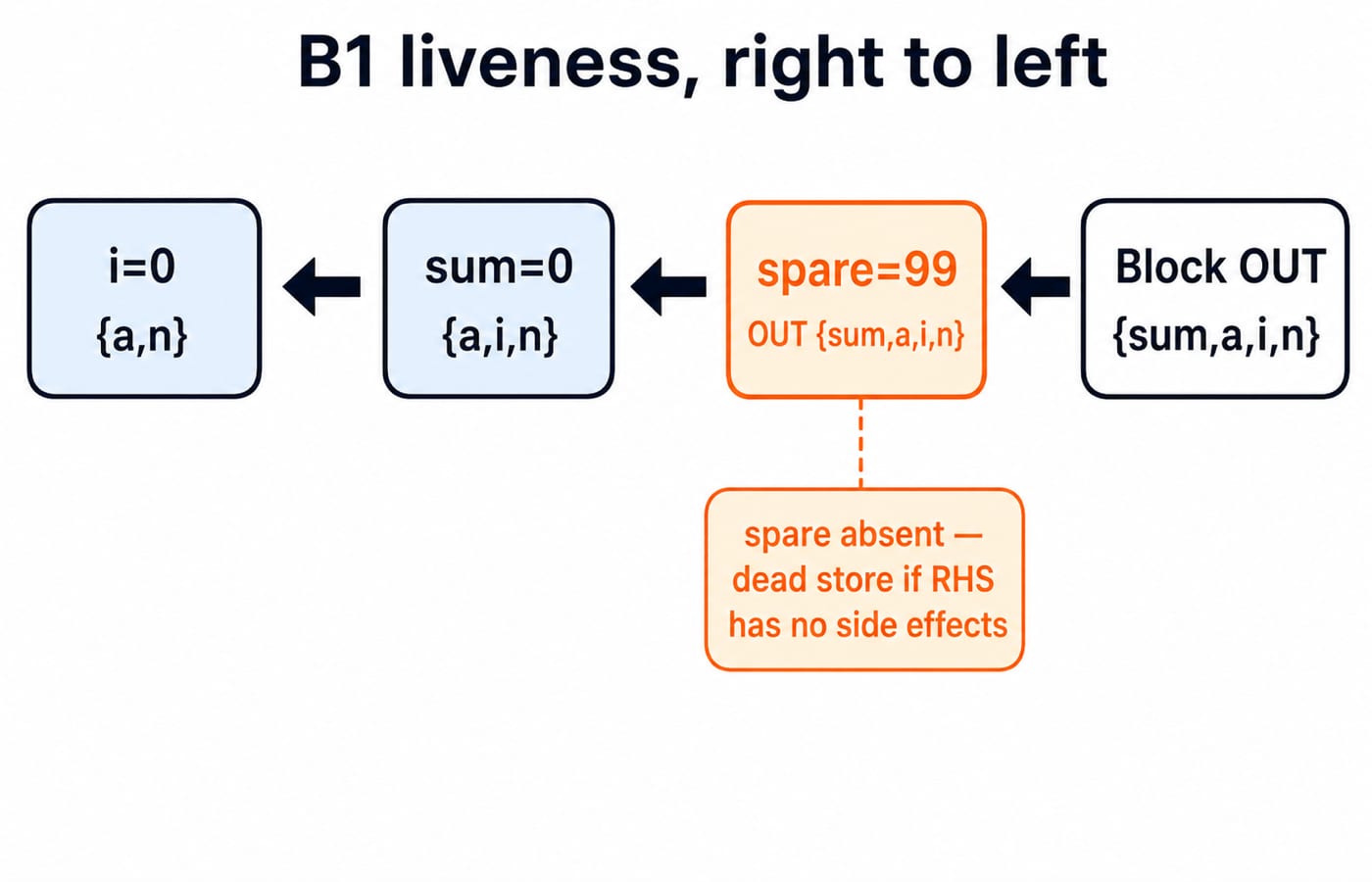
Traverse B1 backwards from OUT[B1] = {sum, a, i, n}. After spare = 99, the live set is {sum, a, i, n}. spare is absent and the right-hand side has no side effect, so this store is dead. Before it, the set is unchanged.
Before sum = 0, the set becomes {a, i, n}. Before i = 0, it becomes {a, n}. The sum and i initialisations are not dead because their definitions reach the first loop test or body use before any guaranteed redefinition. The final IN[B1] also makes sense: a and n must arrive from outside, while B1 creates the initial i and sum values.
Liveness only proves that an assigned value is unused. Deleting spare = f() would require separate proof that evaluating f() has no required side effect or exception behaviour.
Avoid traps that produce plausible but wrong answers
Using intersection at a branch. At the fixed point,
IN[B3] union IN[B4] = {sum, a, i, n}. Intersection gives only{sum, n}, incorrectly losing values needed on the loop-body path.Scanning only once. Successor information must travel through the back-edge. A single backward round leaves
IN[B1] = {}, although the fixed answer is{a, n}.Ignoring statement order in USE. In
B3, bothsumandiare read before their new values are defined. Both therefore appear inUSE[B3]andDEF[B3].Reading live as definitely used. Liveness is a may analysis. One feasible successor path is enough.
Deleting every assignment missing from OUT. First check the expression for side effects and exception behaviour. The safe conclusion here is limited to the plain store
spare = 99.
Turn the analysis into short exam-style checks
Try each question briefly before reading its answer.
What is
OUT[B2]? It is{sum, a, i, n}, the union ofIN[B3]andIN[B4].What is
IN[B1]? SubtractingDEF[B1] = {i, sum, spare}fromOUT[B1]leaves{a, n}.Which plain store is removable?
spare = 99, subject to the side-effect condition.What would intersection at the branch retain?
{sum, n}. That is wrong because it drops variables required on one feasible successor path.Which variables are both used and defined in
B3?sumandi.
The short version and the next practical step
Use five steps: draw the blocks and successors, calculate ordered USE and DEF, initialise empty sets, apply the backward union equations until a round is unchanged, then inspect statement-level liveness before calling a store dead. In this example, remember IN[B1] = {a, n} and the dead plain store spare = 99.
For broader subject learning, continue through the CS Fundamentals category. Zero to Hero - Complete CS Course is an optional structured core-CS path, while GATE Guidance by Sanchit Sir is an optional route for a wider GATE CS plan.
Keep learning
Intermediate Code Generation in Compiler Design: TAC, Backpatching and DAGs
Connect expressions, short-circuit control flow and local optimisation through a single worked translation, from source code to resolved TAC and a reusable DAG.
Updated 5 Oct 20265 min readCompiler Design

Ambiguous Grammars and Inherent Ambiguity: Worked CFG Examples for GATE
Learn what two derivations really prove, resolve expression ambiguity with precedence, and trace the classic inherently ambiguous language through aabbcc.
Updated 1 Oct 20266 min readCompiler Design
Simplification of CFG: Remove Epsilon, Unit and Useless Productions Step by Step
Simplify one context-free grammar from nine nonterminals to six. See each intermediate grammar, complete unit closures, symbol checks and final derivations.
Updated 26 Sep 20266 min readCompiler Design
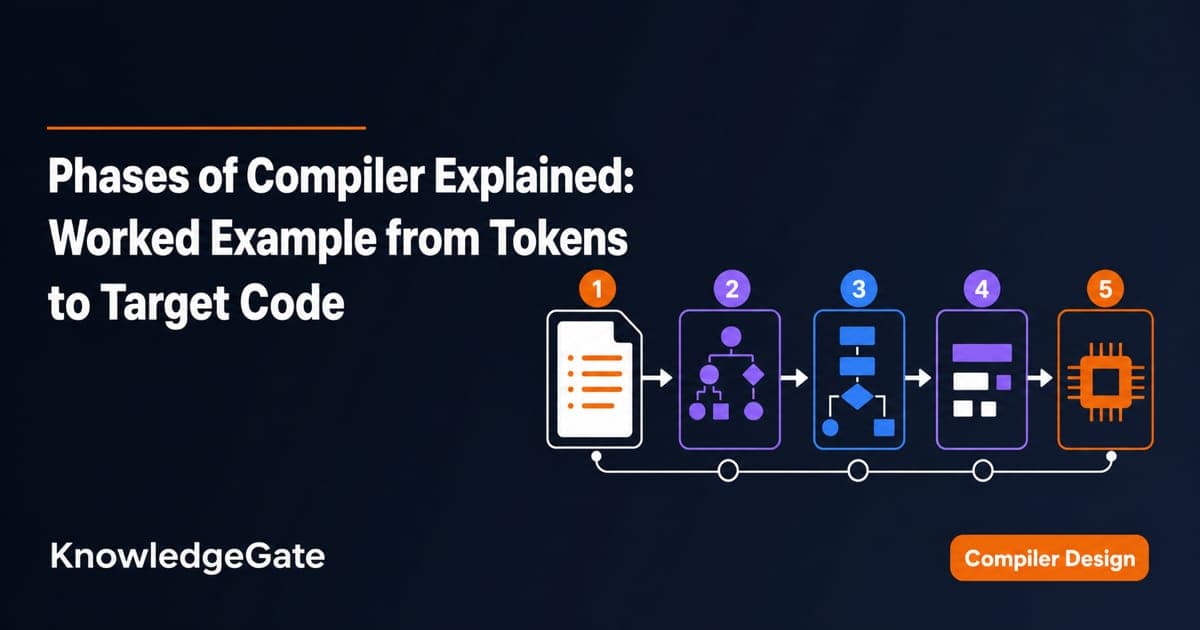
Phases of Compiler Explained: Worked Example from Tokens to Target Code
Follow one four-line program through lexical, syntax and semantic analysis, then see its intermediate code optimized to a final stored value of 24.0.
Updated 24 Sep 20266 min readCompiler Design