Java Interview Questions for Freshers: How to Answer OOPs, Strings, Collections and Exceptions
Prepare the Java questions freshers actually face, then learn to explain each output instead of stopping at a memorised definition.
KnowledgeGate Team
Exam prep & CS education
Updated 6 Aug 20265 min read
Most fresher Java interviews are not testing whether you can design a large system. They are checking whether you understand objects, how Java stores strings, which collection fits a requirement, and what happens when an exception is thrown. The best answer is rarely a definition alone. It is a prediction followed by the reason.
The four buckets an interviewer walks through
The same four areas keep returning because each exposes a different kind of understanding.
OOPs tests whether you can connect a concept to actual method behaviour.
Strings tests the memory model and the difference between identity and content.
Collections tests whether you can choose by ordering, duplication and lookup needs.
Exceptions tests whether you can trace control flow when execution does not follow the happy path.
For every snippet, ask two questions: what will it print, and why? A candidate who narrates both is much harder to unsettle with a follow-up.
OOPs: overriding, overloading and dynamic dispatch
The four pillars fit into one line each. Encapsulation keeps data and the operations on it together behind a controlled interface. Inheritance lets one class reuse and extend another. Polymorphism lets one interface refer to objects with different behaviour. Abstraction exposes what an object does while hiding unnecessary implementation detail.
Now consider the question that separates recall from reasoning:
class Animal {
    String speak() { return "generic sound"; }
}

class Dog extends Animal {
    @Override
    String speak() { return "Woof"; }
}

public class Demo {
    public static void main(String[] args) {
        Animal x = new Dog();
        System.out.println(x.speak());
    }
}
The output is Woof. The reference type is Animal, but the actual object is a Dog. For an overridden instance method, Java selects the implementation at runtime from the actual object type. This is dynamic dispatch and runtime polymorphism.
Overloading is different. If a class has add(int a, int b) and add(double a, double b), the compiler chooses between them from the declared argument types. Overloading is compile-time polymorphism; overriding is runtime polymorphism.
Can a static method be overridden? No. A subclass can declare a static method with the same signature, but that is method hiding. Static methods belong to classes and are selected from the reference or class used at compile time, not from the runtime object.
Field access resolves the same way, from the declared type. If a parent and child both declare a field of the same name, a reference of the parent type reads the parent's field even when the object is a child, while an overridden method still resolves to the child. The worked pair for that contrast sits in OOPs concepts in Java: inheritance, polymorphism, abstraction and encapsulation.
Strings: the pool and the == trap
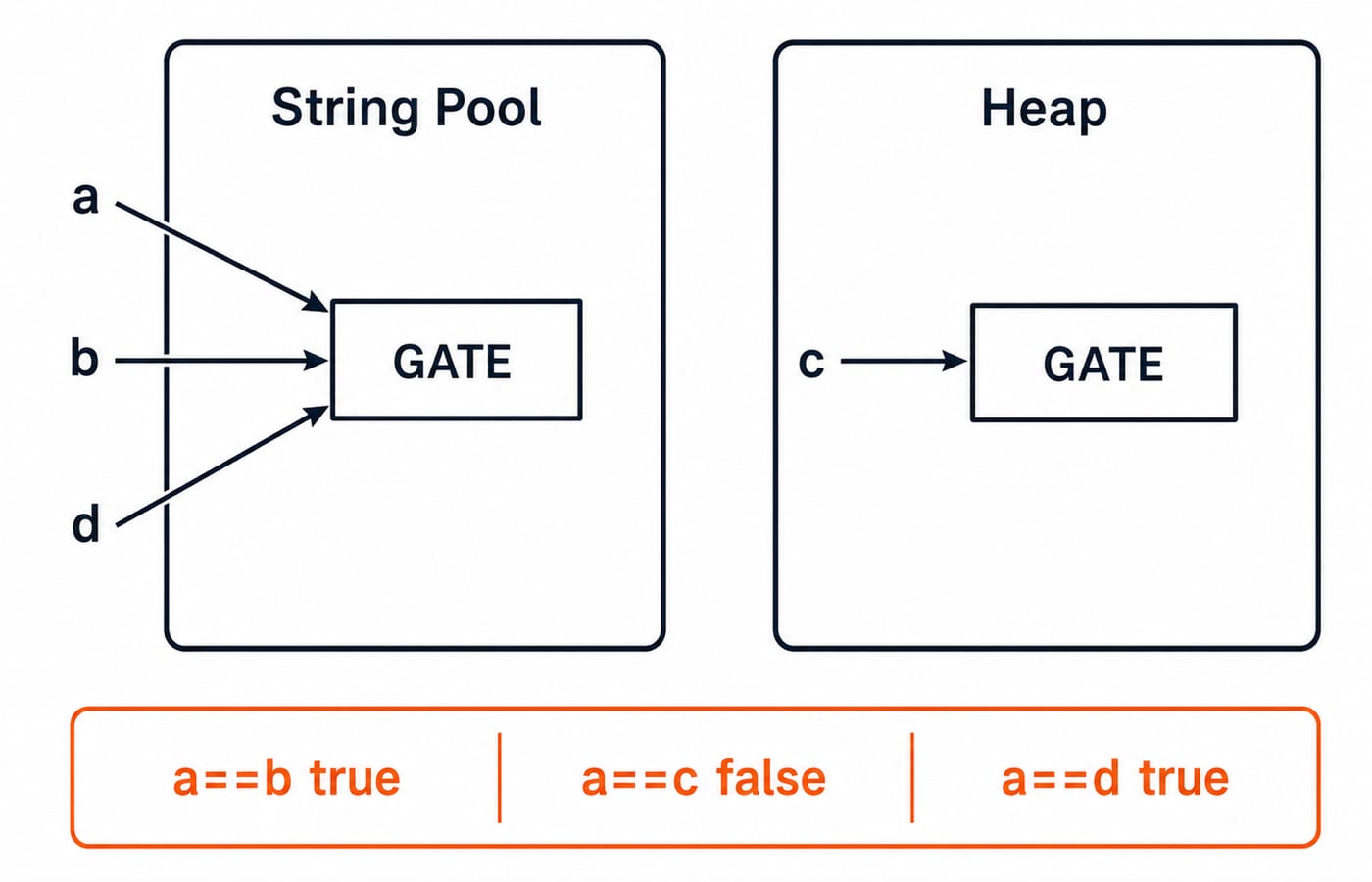
A String is immutable. Once created, its character sequence cannot change. An operation that appears to modify it produces another String. That makes pooled literals safe to share because one caller cannot alter the shared object for another.
Trace this example carefully:
String a = "GATE";
String b = "GATE";
String c = new String("GATE");
String d = c.intern();
Expression | Result | Reason |
|---|---|---|
|
| Both variables refer to the one pooled literal |
|
|
|
|
|
|
|
|
|
The interview rule is simple: use == to test whether two references identify the same object, and .equals() to test whether two strings contain the same characters. Strings read from input, files or APIs are not guaranteed to share a pooled reference, even when their content matches.
Collections: choose by ordering and lookup cost
First choose the abstraction. Use a List for an ordered sequence that may contain duplicates, a Set for unique elements, and a Map for key-value lookup. Then choose the implementation from the required ordering and operations.
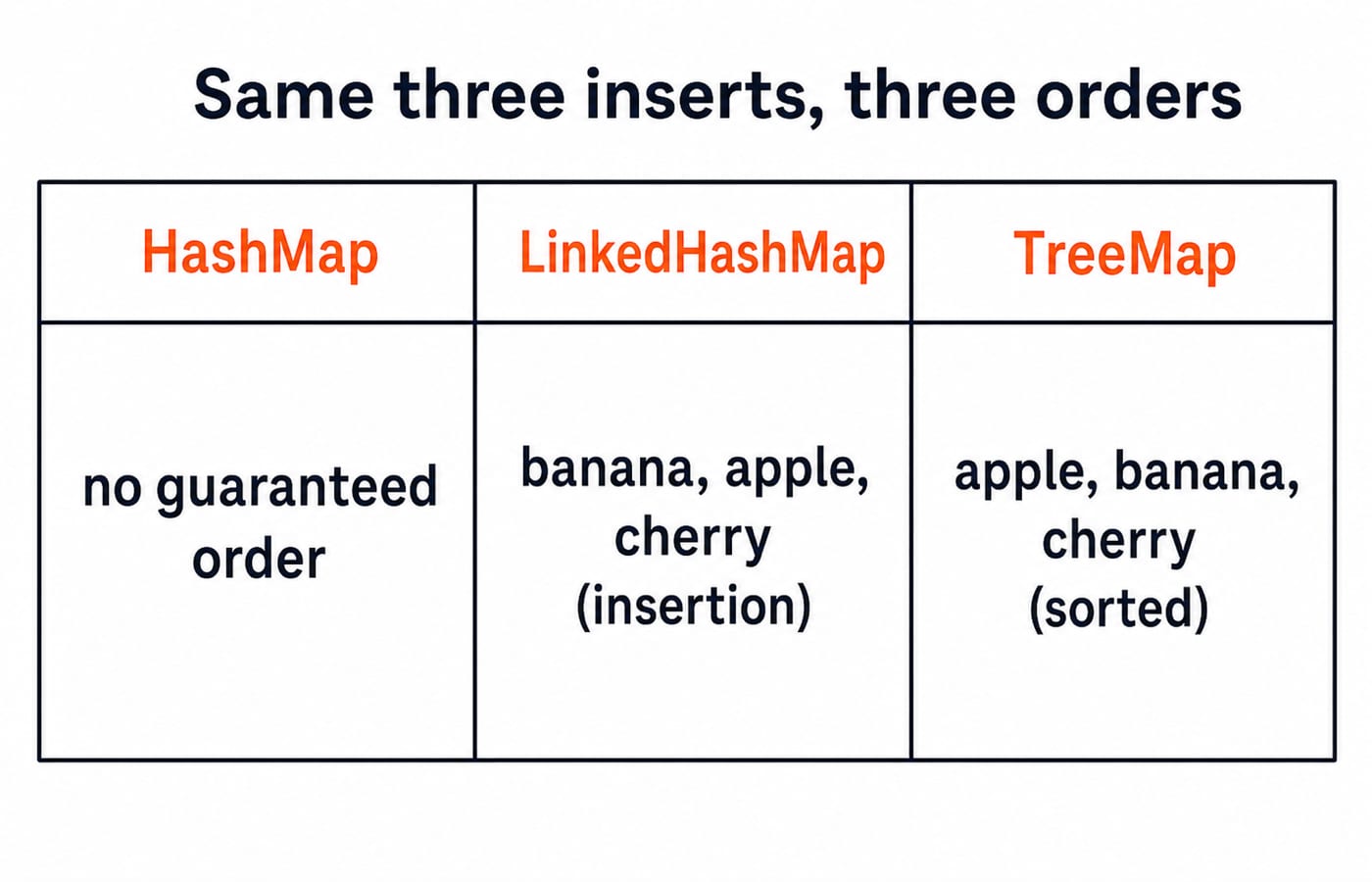
Insert the keys "banana", "apple", "cherry" in that order:
Implementation | Iteration result |
|---|---|
| No guaranteed order. Never build logic around the order observed in one run. |
|
|
|
|
The useful complexity anchors are equally direct. ArrayList gives O(1) indexed access but O(n) insertion or removal in the middle. LinkedList supports O(1) addition and removal at its ends through deque operations, while indexed access is O(n). HashMap gives average O(1) get and put. TreeMap gives O(log n) lookup and update while keeping keys sorted.
Why must a custom HashMap key implement both equals() and hashCode() consistently? The hash code guides the map to a bucket, and equals() identifies the matching key among candidates there. If equal objects return different hash codes, a lookup can search the wrong bucket and miss.
Exception handling: checked, unchecked and finally
Throwable divides broadly into Error and Exception. Errors represent serious conditions application code normally should not try to recover from. Checked exceptions, such as IOException, must be caught or declared. Unchecked exceptions are subclasses of RuntimeException, including NullPointerException and ArrayIndexOutOfBoundsException.
Now trace this trap:
static int answer() {
    try {
        return 1;
    } finally {
        return 2;
    }
}
The method returns 2. Java evaluates the return in try, then executes finally before completing the method. The return inside finally replaces the pending return. The same pattern can suppress a pending exception, which is why returning or throwing from finally is dangerous. In normal execution finally runs whether or not an exception occurs, though abrupt JVM termination such as System.exit or a crash can prevent it.
throw raises a particular exception object. throws declares exception types that a method may propagate to its caller. One raises an exception at a single point in the code, the other belongs to the method signature.
The traps freshers fall into
Saying strings are safe to share without explaining that an apparent change creates a new object.
Comparing user input with
==instead of.equals().Choosing
HashMapwhen the result must preserve insertion order or sorted order.Catching
ExceptionorThrowablebroadly and hiding the failure instead of handling a specific case.Swapping overloading and overriding when the interviewer changes the reference type.
How interviewers test this: the short version
Expect output-prediction snippets, a collection choice followed by "why", and scenarios where you must explain what a faulty implementation does. Practise saying the mechanism aloud: runtime type for overriding, reference identity for ==, required order for the map choice, and pending control flow for finally.
KnowledgeGate's question bank carries over 1,300 programming-language questions for this style of output drilling. Build the underlying language systematically with the Java course, then use the placement preparation category to connect it to the rest of your interview plan. Keep the focused guides to Java string handling, the string pool and immutability and the Java Collections Framework open as revision cards.
The short version is four contrasts: compile time versus runtime, identity versus content, unordered versus insertion-ordered versus sorted, and checked versus unchecked. If you can predict the code and explain each contrast, you are answering like a Java developer rather than reciting like a fresher.
Keep learning
Abstraction and Interfaces in Java: Abstract Classes, Contracts and Runnable Examples
Learn when Java needs an abstract class, when it needs an interface, and how both work together in one runnable charge-calculation program with exact outputs.
Updated 6 Oct 20266 min readJava
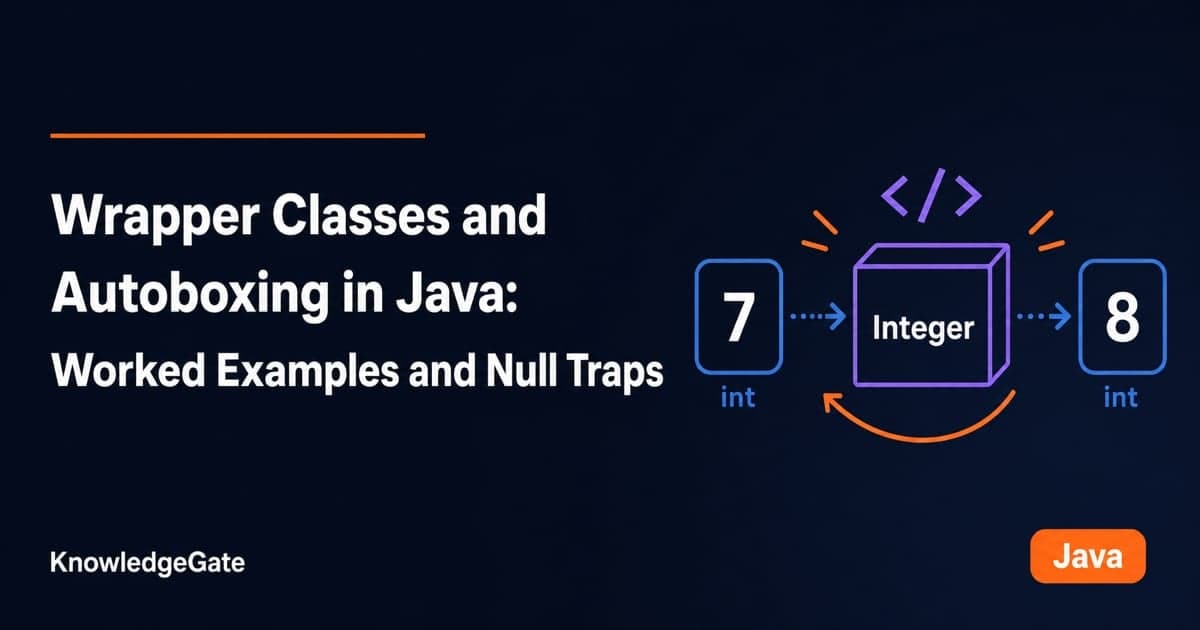
Wrapper Classes and Autoboxing in Java: Worked Examples and Null Traps
Learn why Java wrapper classes exist, how boxing and unboxing work, and where nulls, reference identity, and overload selection create surprises.
Updated 1 Oct 20265 min readJava
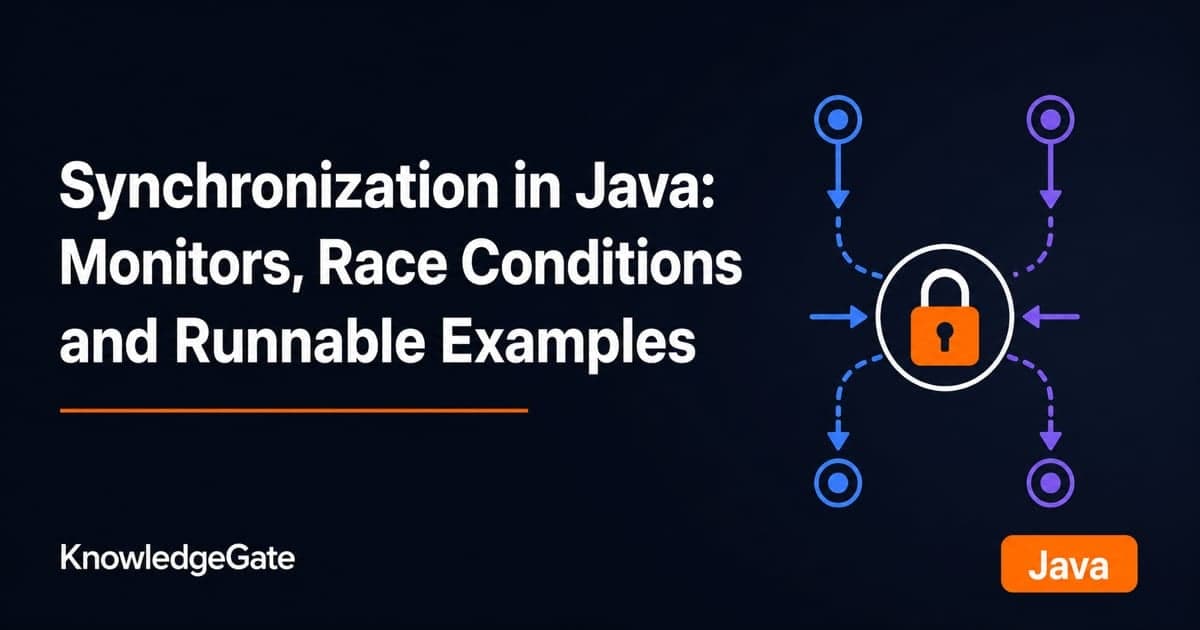
Synchronization in Java: Monitors, Race Conditions and Runnable Examples
Learn why Java threads lose updates, what each synchronized form locks, and how to build safe counters, inventory checks and condition-waiting code.
Updated 26 Sep 20266 min readJava
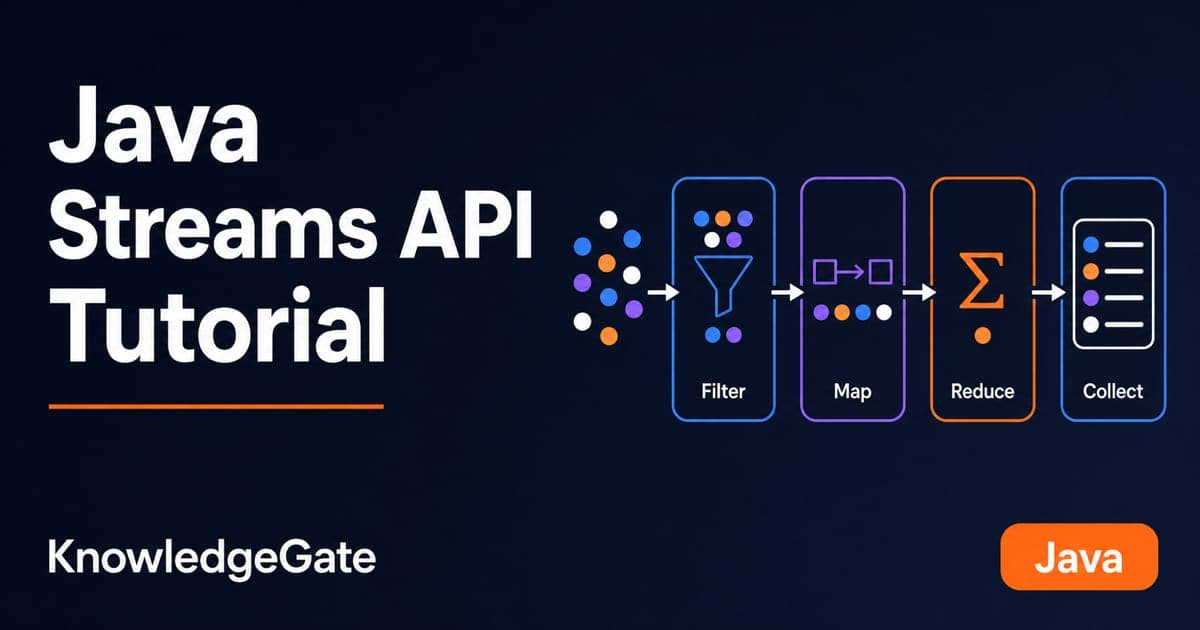
Java Streams API Tutorial: Filter, Map, Reduce and Collect with Runnable Examples
Learn Java streams from the source-to-terminal mental model, then trace operations, reductions and collectors through runnable examples and practice tasks.
Updated 24 Sep 20265 min readJava