

Iterative Loops Interview Questions and Answers: Output, Complexity and Code
Learn a repeatable way to trace loop values, count exact work and derive tight bounds. Includes nested-loop sums, control-flow output and ten interview answers.
KnowledgeGate Team
Exam prep & CS education
Updated 13 Nov 20266 min read

A loop looks simple until the update changes, an inner bound starts depending on the outer variable, or continue and breakThe worked traces span additive and multiplicative loops, dependent and fixed nested bounds, control flow and interview model answers.
Iterative loops in a 60-second interview answer
Identify the control variable and list its exact values. Count valid entries. Check whether inner work is fixed or depends on the outer value, write the sum, then simplify to a tight bound. Exact count and growth class are separate answers.
The update gives the first clue: i += c is linear, while i *= c and i /= c are logarithmic when c > 1. A dependent nested loop needs a sum, not multiplication of its largest bounds.
Service-company screening depth and product-company deep-dive depth are useful labels for answer depth, not rules. Screening answers need traces, boundaries and basic complexity; deeper answers add proofs, mutations, overflow risks and tests. Iterative-loop interviews centre on traces, state transitions and exact sums. Broader algorithm-analysis work handles input-size definitions, tight bounds and recurrence conversions. Algorithm Analysis Interview Questions and Answers covers that wider frame, while DSA using Java structures both.
Trace additive, growing and shrinking loops before naming complexity
Write body-entry values first. They expose inclusive boundaries and the exact execution count.
loop | body-entry values | exact executions | tight growth |
|---|---|---|---|
|
|
|
|
| for |
|
|
| for |
|
|
Replacing <= with < removes the last value when the loop reaches that boundary exactly. Changing the start changes the exact count, even when the asymptotic class stays unchanged.
State the numeric model you assume. Multiplication and division loops need positive starting values and a factor greater than one. Here division is integer division, so it truncates. In every language, the update must still make progress and guarantee termination.
A dependent nested loop does 62 operations, not 160
Define one operation as one execution of count++:
count = 0
for i = 2; i <= n; i = i * 2
    for j = 0; j < i; j = j + 1
        count++
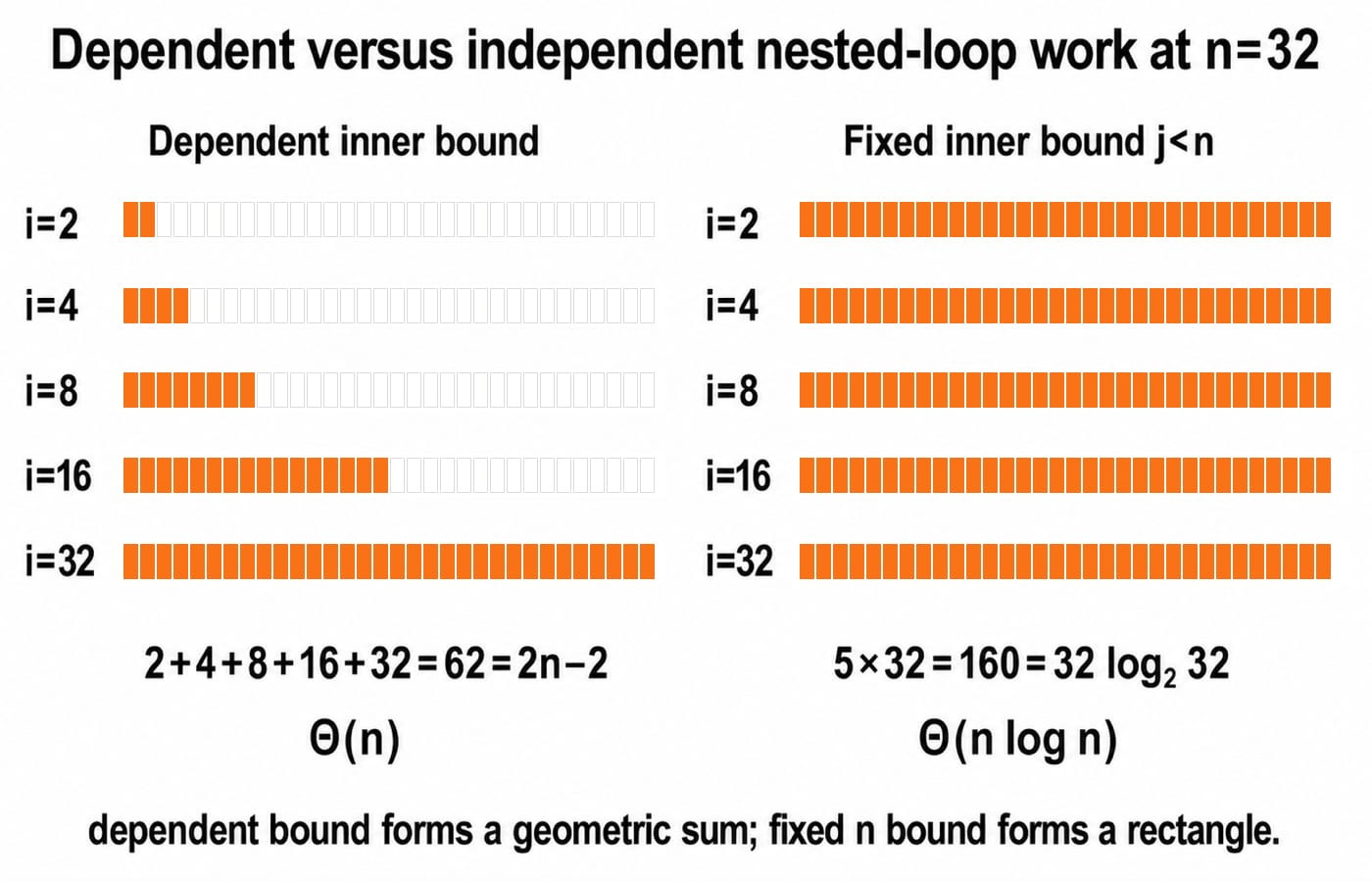
At n=32, the outer values are 2, 4, 8, 16, 32. The inner loop therefore contributes 2, 4, 8, 16, 32 operations, giving 2+4+8+16+32 = 62.
For n=2^m, the sum is 2^1+2^2+...+2^m = 2^(m+1)-2 = 2n-2, so the tight bound is Theta(n), not Theta(n log n). For arbitrary n>=2, the exact count is 2^(floor(log2 n)+1)-2, which is still Theta(n).
Change only the inner condition to j<n. Each of the five outer iterations at n=32 now performs 32 operations, so the total is 5x32=160. For powers of two, that is n log2 n. The condition j<i forms a geometric sum; j<n forms a rectangle.
Two snippets can both total 21 and still have different growth
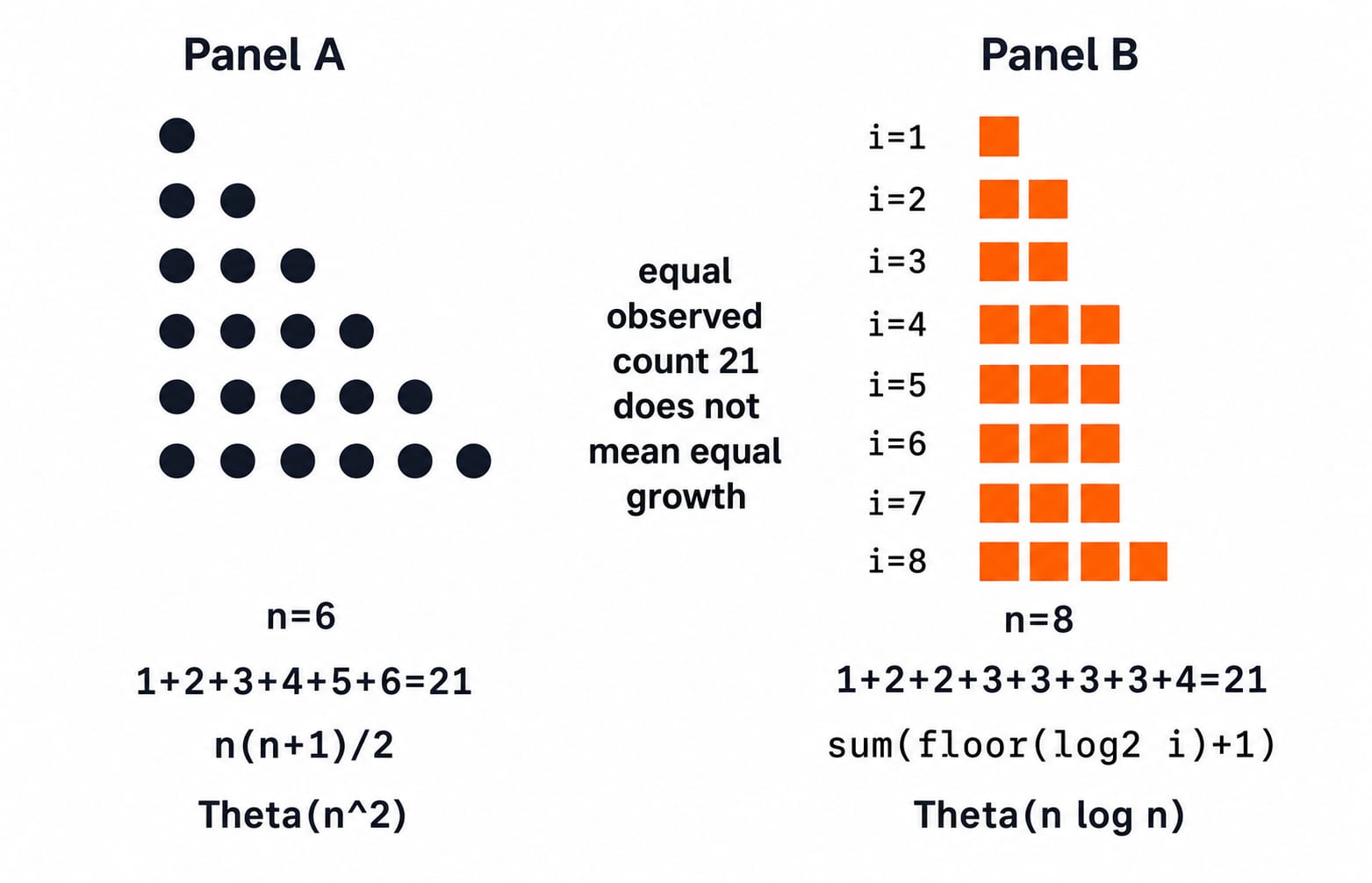
For Snippet A, the outer loop is i=1..n and the inner loop is j=1..i. At n=6, the trace is triangular:
outer value | inner executions | running total |
|---|---|---|
1 | 1 | 1 |
2 | 2 | 3 |
3 | 3 | 6 |
4 | 4 | 10 |
5 | 5 | 15 |
6 | 6 | 21 |
Thus 1+2+3+4+5+6 = 21, and the general formula n(n+1)/2 gives Theta(n^2).
For Snippet B, the inner update halves j: for (j=i; j>=1; j=floor(j/2)). At n=8:
outer value | inner executions | running total |
|---|---|---|
1 | 1 | 1 |
2 | 2 | 3 |
3 | 2 | 5 |
4 | 3 | 8 |
5 | 3 | 11 |
6 | 3 | 14 |
7 | 3 | 17 |
8 | 4 | 21 |
Its per-value count is floor(log2 i)+1. Summing that expression for i=1..n gives Theta(n log n). One observed total cannot identify a growth class; the formula must show how work changes with n. See Time Complexity: Big-O, Theta, Omega & Master Theorem after completing both derivations.
Trace continue and break as state changes, not guesses
Trace each body action in order:
total = 0
for i = 0; i < 5; i++
    if i == 2
        continue
    total = total + (2*i + 1)
    if total > 10
        break
print(total)
i | continue? | value added | total | break? |
|---|---|---|---|---|
0 | no | 1 | 1 | no |
1 | no | 3 | 4 | no |
2 | yes | none | 4 | not checked |
3 | no | 7 | 11 | yes |
4 | never entered | none | 11 | not checked |
The printed value is 11. continue skips the remaining body, but the for update still runs. break exits immediately. Since the bound is the literal 5, this snippet is Theta(1). For a search bounded by input n, an early break may give best-case Theta(1), while a no-match run remains worst-case Theta(n).
Five screening-depth loop questions with model answers
question | model answer | number or reason to say aloud |
|---|---|---|
1. How do you analyse an unfamiliar loop? | Identify the variable, list its values, count valid entries, inspect inner dependency, write the sum and derive a tight bound. | Exact count and asymptotic growth answer different questions. |
2. How many times does | Seven times. | The values are |
3. Why is repeated multiplication logarithmic? | After | From |
4. What is the count for the dependent nest at | It is |
|
5. What does the continue-and-break snippet print? | It prints | Skip the addition at |
Five deep-dive follow-ups, traps and tests
question | model answer | number or reason to say aloud |
|---|---|---|
6. What changes if the main outer update becomes |
| Evens |
7. Does the same measured count imply the same complexity? | No equal bound can be inferred. Both total | One count proves neither bound. |
8. Can | Yes. Use a wider type or guard the final multiplication. | Overflow can defeat termination. |
9. Which boundary tests expose mistakes in the main loop? |
| Test around a power of two. |
10. Does timing one input prove the complexity? | No. The operation-count formula proves it. | Timing includes machine, compiler and input effects. |
KnowledgeGate has over 60 practice questions on Iterative Loops & Code, not frequency evidence. Use Loops & Iteration MCQs in C: 12 Solved PYQs and Coding & DSA Courses for Placements.
Iterative loops interview answers in the short version
Keep one recall chain: trace values -> count entries -> identify dependency -> write the sum -> simplify -> test boundaries. The dependent nest totals 62 at n=32; its fixed-n inner-bound variant totals 160; the control-flow snippet prints 11.
Reproduce the traces without running the code. Then implement the three update families and test the five boundary cases. Coding for Placements offers a broader multi-language practice route.
Keep learning

Time Complexity of Loops MCQs: 12 Solved Questions with Explanations
Solve 12 previous-year loop questions by counting iterations, tracing values, summing dependent loops and separating running time from return values.
Updated 30 Oct 20268 min readAlgorithms MCQs

Iterative Loops in C for GATE: Code Traces, Worked Examples and Exam Traps
Learn a mechanical method for tracing C loops. Work through exact values, invariants, nested-loop counts, complexity, termination bugs, and output traps.
Updated 14 Nov 20265 min readDSA & Algorithms
Merge Sort Interview Questions and Answers: Traces, Complexity, and Code
Prepare crisp merge sort interview answers through a fully traced array, boundary-safe Java implementation, complexity proof, stability example, and inversion-count follow-up.
Updated 3 Nov 20266 min readInterview Corner
C++ Iterators and Invalidation: Container Rules and Safe Erase Loops
Learn to read iterator ranges, match algorithms to categories, and mutate standard containers without using stale handles. Includes two fully traced erase examples.
Updated 18 Sep 20266 min read59 viewsC++