LR(0) Parser Explained: Bottom-Up Parsing, Item Sets and a Worked Example
Build an LR(0) parser from one augmented grammar, then follow every state, table entry and stack operation until cdd$ is accepted.
KnowledgeGate Team
Exam prep & CS education
Updated 15 Sep 20266 min read
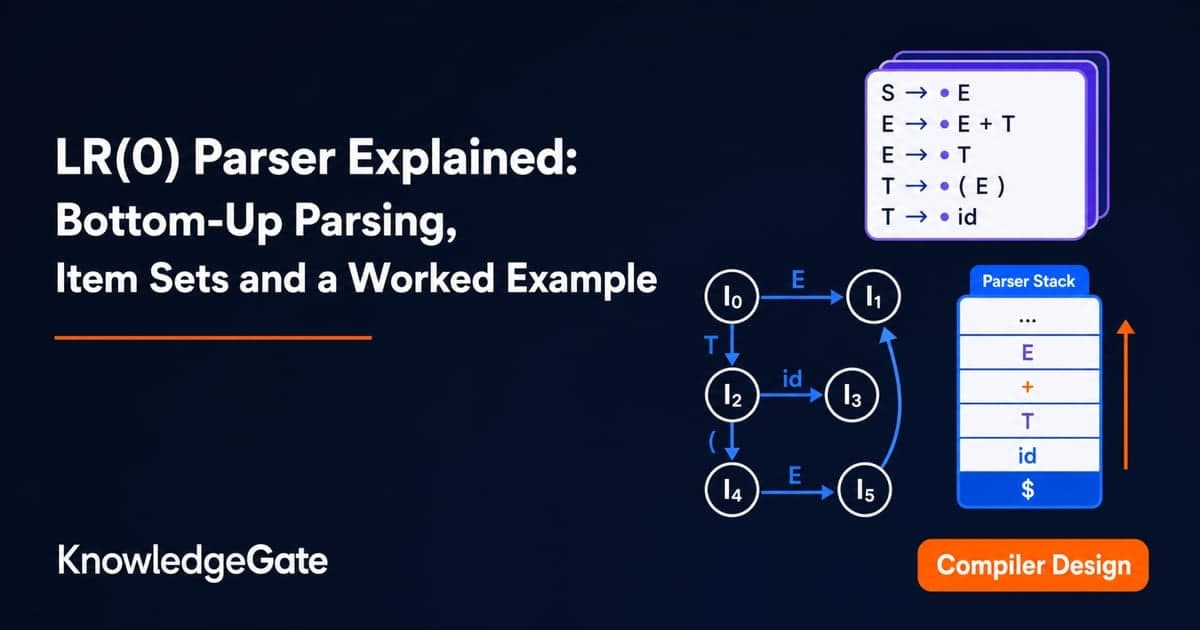
Bottom-up parsing sounds intuitive until dots, item sets, ACTION/GOTO entries and stack reductions appear together. Then one changed state number can invalidate the entire solution. The construction runs from the augmented grammar through closure, GOTO, a seven-state LR(0) automaton, the complete parsing table and acceptance of cdd$. Each shift, reduction and GOTO in that trace follows from one table cell, and each table cell follows from one item set, so a wrong state number is always traceable to the exact item set that produced it.
Bottom-up parsing means finding handles in reverse
Bottom-up parsing starts with the input and reduces handles until only the start symbol remains. A handle matches the production used in one step of a rightmost derivation. It is not an arbitrary match: the viable prefix and parser state decide whether it is legal.
The parsing table can prescribe four outcomes:
shift j: consume the next terminal and push it with statej.reduce A -> beta: pop2 x |beta|interleaved entries, then pushAandGOTO[top,A].accept: succeed only for the completed augmented item with$.error: no legal action exists.
For our input, the rightmost derivation is S => C C => C d => c C d => c d d. The parser reverses it using d -> C, cC -> C, d -> C, then CC -> S.
LR(0) items, closure and GOTO without lookahead
An LR(0) item is a production with a dot showing progress. C -> c C gives C -> . c C, C -> c . C and C -> c C .. The dot is parser position, not input; at the far right, the item is complete.
For closure(I), if an item has A -> alpha . B beta, add B -> . gamma for every production of B; repeat to a fixed point. GOTO(I,X) moves every eligible dot across X, then takes closure. Terminals lead to shifts; non-terminals fill GOTO.
The zero means no lookahead. Thus A -> beta . reduces in every terminal column, including $; S' -> S . instead puts accept only under $. SLR restricts reductions using FOLLOW sets, which this LR(0) construction does not use.
Build the seven LR(0) item sets for one grammar
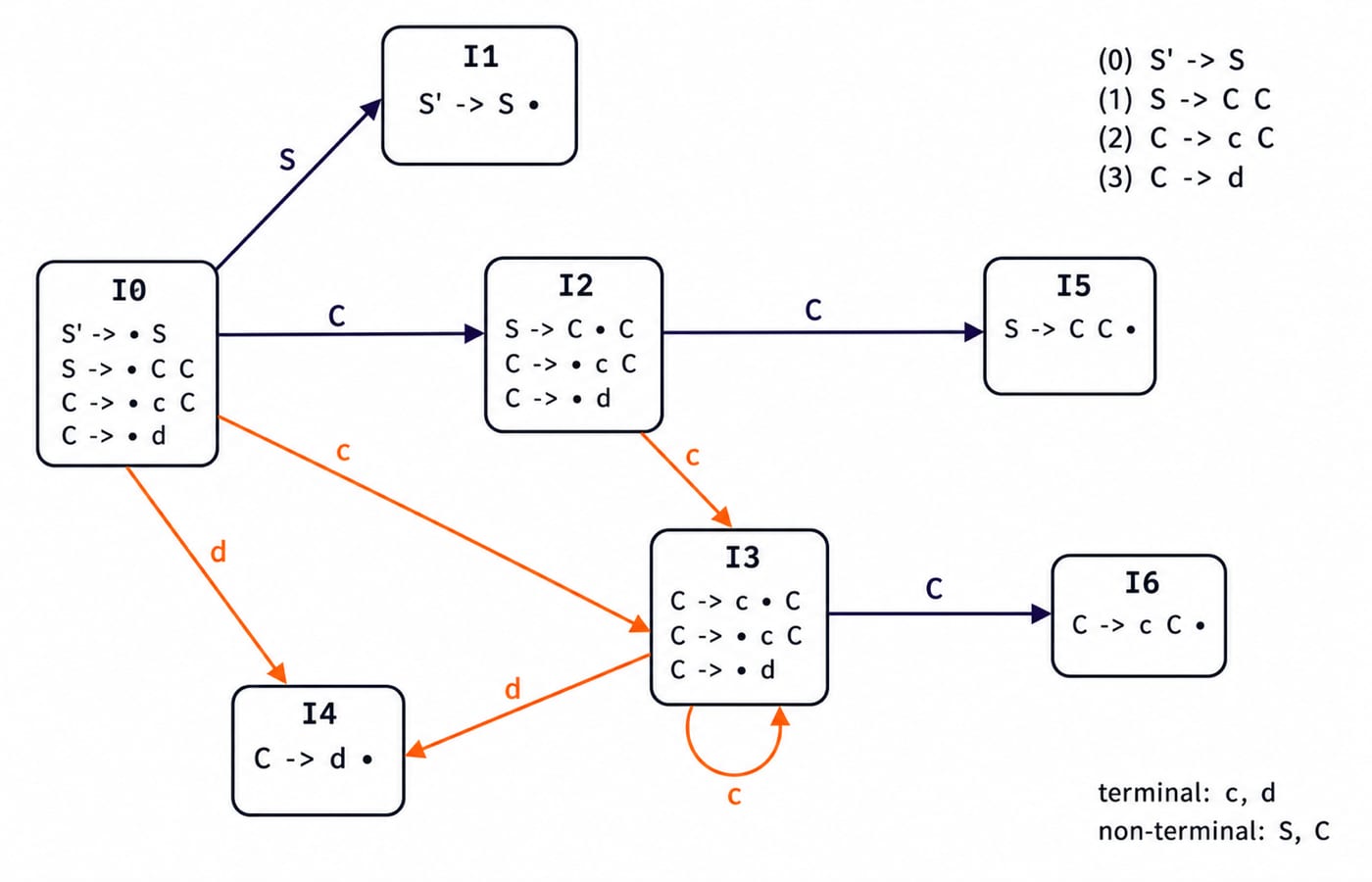
Use (0) S' -> S, (1) S -> C C, (2) C -> c C, (3) C -> d. The terminals are {c,d,$} and the non-terminals are {S,C}. Starting with closure({S' -> . S}), not a memorised state, gives:
I0: S' -> . S
    S  -> . C C
    C  -> . c C
    C  -> . d

I1: S' -> S .

I2: S  -> C . C
    C  -> . c C
    C  -> . d

I3: C  -> c . C
    C  -> . c C
    C  -> . d

I4: C  -> d .

I5: S  -> C C .

I6: C  -> c C .
Every non-empty transition is:
I0 --S--> I1    I0 --C--> I2    I0 --c--> I3    I0 --d--> I4
I2 --C--> I5    I2 --c--> I3    I2 --d--> I4
I3 --C--> I6    I3 --c--> I3    I3 --d--> I4
GOTO(I3,c)=I3 because moving across c produces C -> c . C; closure then restores C -> . c C and C -> . d.
Convert the item sets into the LR(0) ACTION/GOTO table
Let r1 mean S -> C C, r2 mean C -> c C, and r3 mean C -> d. A terminal edge creates a shift, a non-terminal edge fills GOTO, and a completed ordinary item fills its reduction across c, d and $. Only S' -> S . creates accept, under $.
State | ACTION | ACTION | ACTION | GOTO | GOTO |
|---|---|---|---|---|---|
0 | s3 | s4 | error | 1 | 2 |
1 | error | error | accept | error | error |
2 | s3 | s4 | error | error | 5 |
3 | s3 | s4 | error | error | 6 |
4 | r3 | r3 | r3 | error | error |
5 | r1 | r1 | r1 | error | error |
6 | r2 | r2 | r2 | error | error |
No ACTION cell contains a shift-reduce or reduce-reduce pair. This absence of conflicts, not merely having a table, makes the grammar LR(0).
Parse cdd$ from the first shift to accept
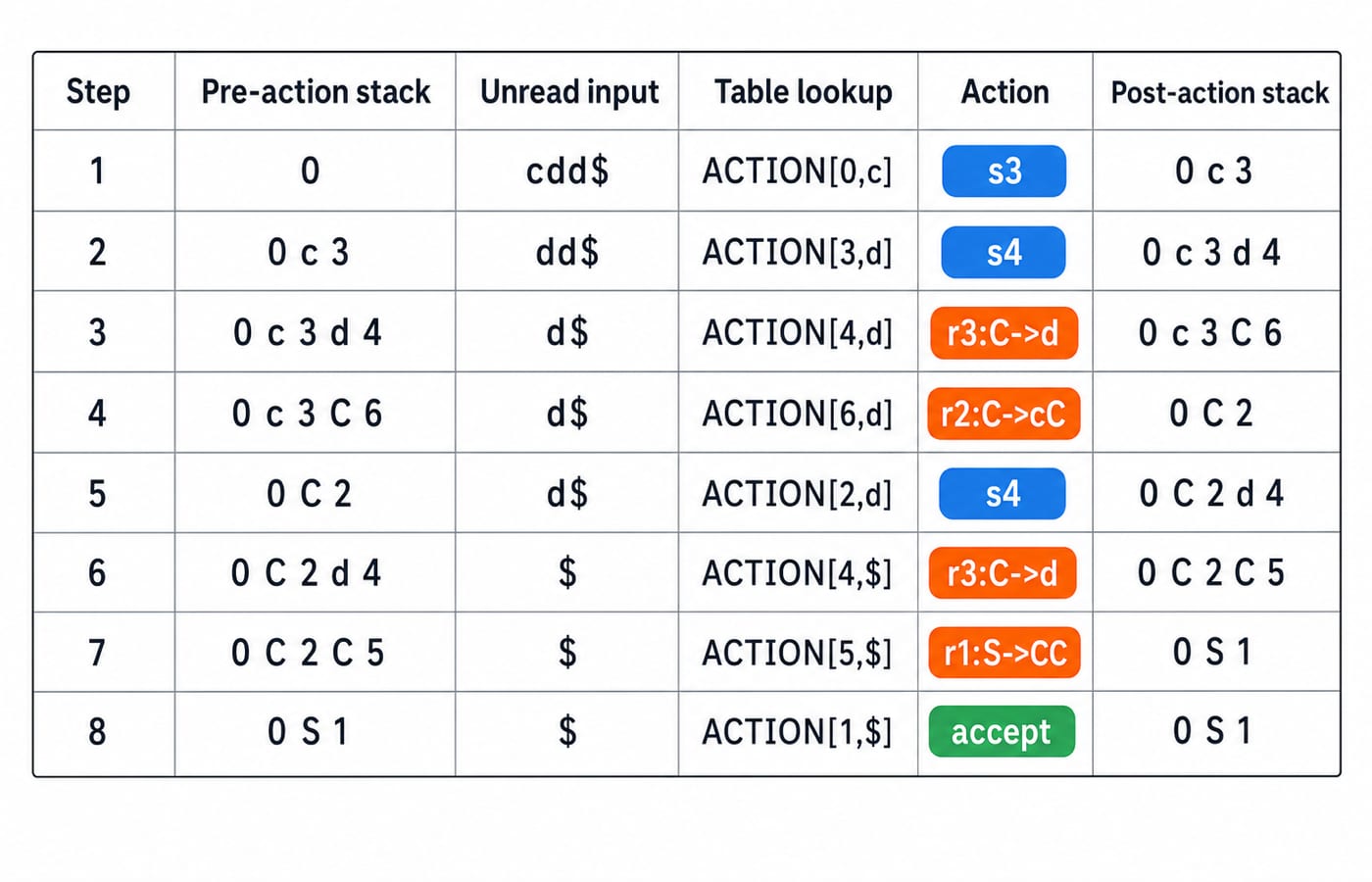
Read each row before performing its action:
Step | Pre-action stack | Unread input | Table lookup | Action | Post-action stack |
|---|---|---|---|---|---|
1 |
|
|
|
|
|
2 |
|
|
|
|
|
3 |
|
|
|
|
|
4 |
|
|
|
|
|
5 |
|
|
|
|
|
6 |
|
|
|
|
|
7 |
|
|
|
|
|
8 |
|
|
|
|
|
At step 3, r3 pops d 4, exposes 3, uses GOTO(3,C)=6, then pushes C 6. At step 4, r2 pops c 3 C 6, exposes 0, uses GOTO(0,C)=2, then pushes C 2. Reductions do not advance input.
The reduction order C -> d, C -> cC, C -> d, S -> CC exactly reverses S => CC => Cd => cCd => cdd.
Detect LR(0) conflicts and avoid common construction traps
For (0) S' -> S, (1) S -> a A, (2) A -> b, (3) A -> b c, the state after ab contains A -> b . and A -> b . c. The first reduces everywhere; the second shifts on c. Their shift-reduce conflict means the grammar is not LR(0).
Mistake | Why it fails | Correction |
|---|---|---|
Omit | No unique accept item | Augment first |
Stop closure early | Items are missing | Repeat to a fixed point |
Compare one item | States may differ elsewhere | Compare full sets |
Reduce only under | LR(0) uses every terminal | Fill |
Consume input on reduce | Reduce reads nothing | Move only on shift |
Pop only symbols | States remain on stack | Pop |
Trust a partial table | Hidden cells may conflict | Inspect every ACTION cell |
Useful checks are that I3 has a self-loop on c; I4, I5 and I6 reduce under all three terminals; and only I1 accepts, only on $.
How exams test LR(0) construction and tracing
Common tasks ask you to complete closure or GOTO, count states, fill a cell, find a conflict, classify a grammar, or trace input. Here the answers are 7 states, GOTO(I3,C)=I6, ACTION[4,$]=r3, and final stack 0 S 1.
A 45-second order is: augment, close I0, generate and deduplicate GOTO states, number productions, fill shifts and GOTOs, add all-terminal reductions and accept, then scan ACTION cells for multiple entries. State count alone proves nothing.
Next, compare SLR, CLR and LALR parsers, which keep this item-set machinery but restrict where each reduction may fire, using FOLLOW sets or explicit lookaheads. The stack discipline from the cdd$ trace carries over to all three unchanged.
LR(0) in the short version, then the next study step
Remember: dotted items recognise viable prefixes; closure expands after a non-terminal; GOTO moves the dot; completed ordinary items reduce on every terminal; multiple ACTION entries mean conflict. Recall 7 states -> cdd$ accepted.
For a complete core-CS sequence, use ZERO TO HERO, Complete CS Course. For broader GATE preparation, see GATE Guidance by Sanchit Sir. Browse adjacent subjects in CS Fundamentals. Now build the states, trace cdd$, and spot a conflict without the finished table.
Keep learning
Intermediate Code Generation in Compiler Design: TAC, Backpatching and DAGs
Connect expressions, short-circuit control flow and local optimisation through a single worked translation, from source code to resolved TAC and a reusable DAG.
Updated 5 Oct 20265 min readCompiler Design
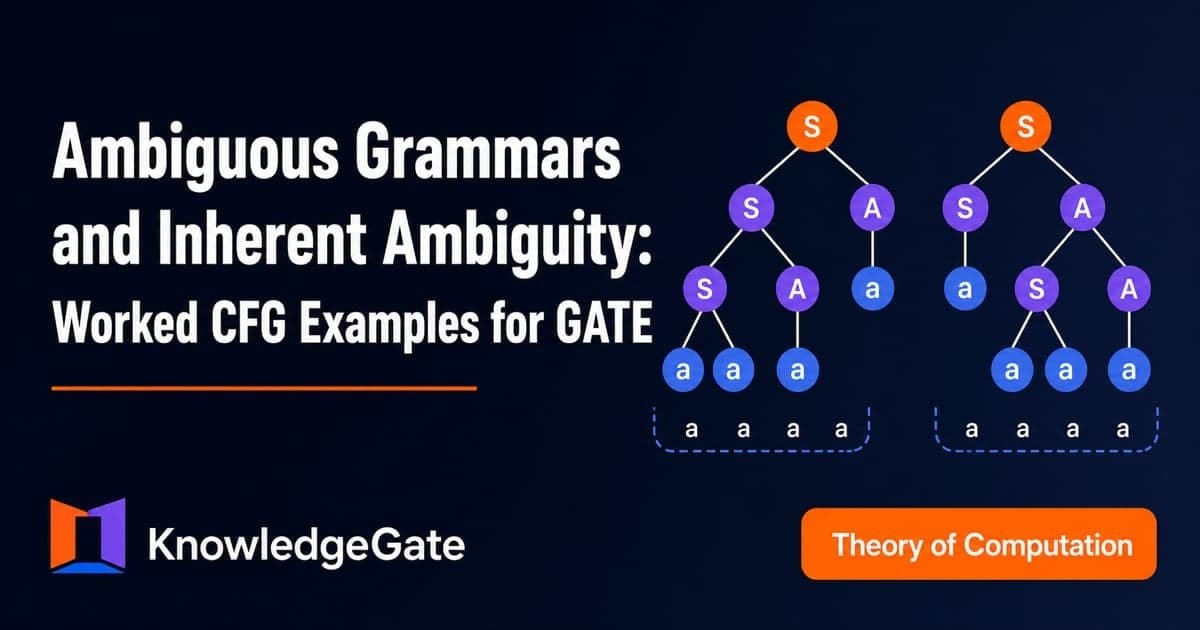
Ambiguous Grammars and Inherent Ambiguity: Worked CFG Examples for GATE
Learn what two derivations really prove, resolve expression ambiguity with precedence, and trace the classic inherently ambiguous language through aabbcc.
Updated 1 Oct 20266 min readCompiler Design
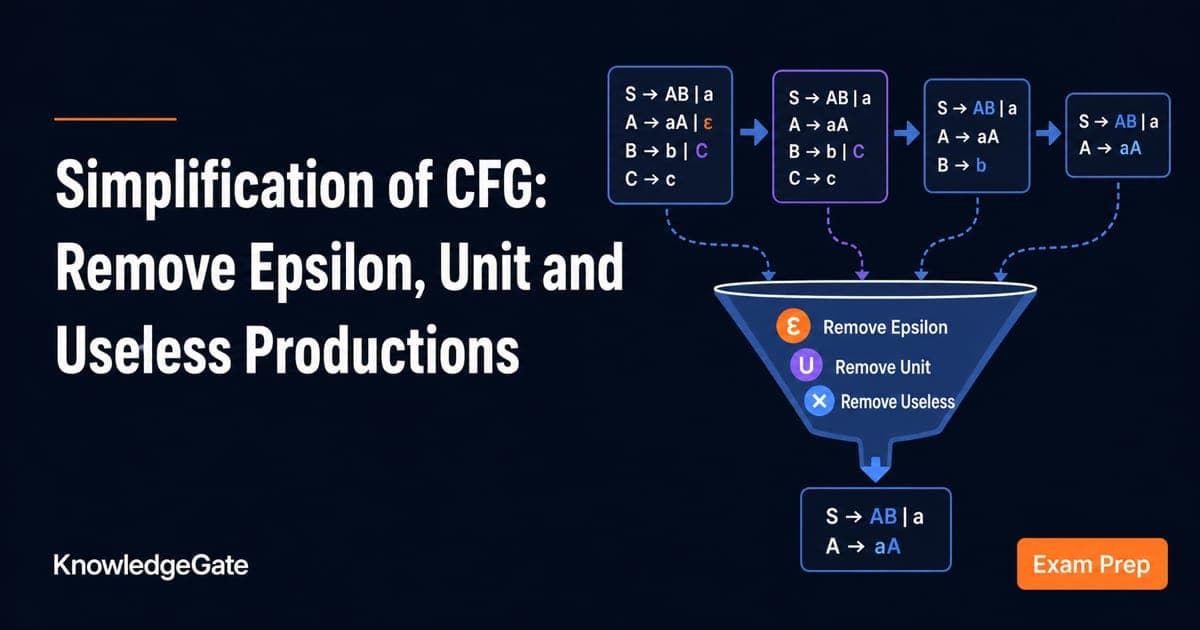
Simplification of CFG: Remove Epsilon, Unit and Useless Productions Step by Step
Simplify one context-free grammar from nine nonterminals to six. See each intermediate grammar, complete unit closures, symbol checks and final derivations.
Updated 26 Sep 20266 min readCompiler Design
Phases of Compiler Explained: Worked Example from Tokens to Target Code
Follow one four-line program through lexical, syntax and semantic analysis, then see its intermediate code optimized to a final stored value of 24.0.
Updated 24 Sep 20266 min readCompiler Design