C Programming Data Types Explained: Concepts, Conversions and Worked Examples
Learn how C declarations, literal types, conversions, sizeof and format specifiers work. Follow one complete calculation and correct common objective-question traps.
KnowledgeGate Team
Exam prep & CS education
Updated 5 Sep 20266 min read
int count = 17; looks simple, but its type changes what values can be stored, how expressions are evaluated and whether a result is portable. The beginner's real difficulty is tracking those rules when types meet. A reliable trace names each operand's type, applies the operation's conversions, calculates the value and then checks the destination type.
Where data types fit in a C program
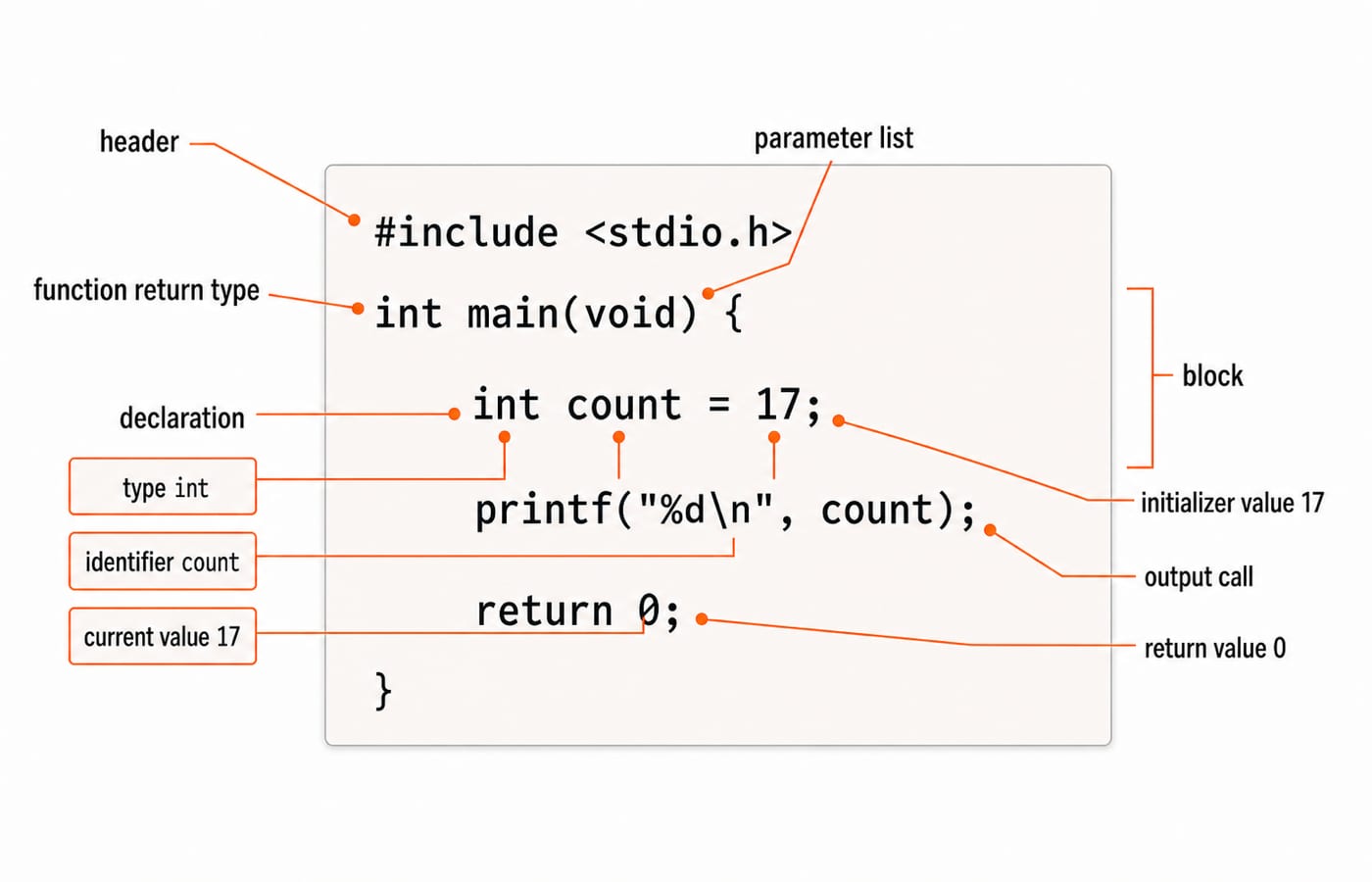
Start with a complete minimal program:
#include <stdio.h>

int main(void) {
    int count = 17;
    printf("%d\n", count);
    return 0;
}
The header inclusion makes the declaration of printf available. main is a function returning int; void says its parameter list accepts no arguments. Braces form its block. Inside that block are a declaration with an initializer, a function call and a return statement. The semicolons terminate the declaration, call statement and return statement.
In int count = 17;, int is the type specifier, count is the identifier, = supplies the initializer, 17 is an integer literal and ; ends the declaration. A later count = 21; is an assignment, not a new declaration. The stored value changes, but count remains an int.
A data type is a contract for the kind of value, supported operations, conversion behaviour and implementation-dependent storage limits. It does not promise one fixed byte size on every machine.
C type families and literal types
The basic families are easier to see through declarations:
Declaration | Role in the inspection batch |
|---|---|
| Whether the panel batch passed inspection |
| The one-character code for the inspected row |
| The signed count used in the crate calculation |
| A non-negative image size stored in an unsigned object |
| The labour time for one loose panel, starting as a |
| The labour time for one sealed crate, stored as |
| A function returning no value |
Integer types also use signed, unsigned, short, long and long long. Plain char, signed char and unsigned char are three distinct types. Whether plain char behaves as signed or unsigned is implementation-defined. Pointers, arrays, structures, unions and enumerations extend this map later.
Declared types and literal types are separate questions. 53 has type int, 4096u has type unsigned int, 0.75 has type double, and 0.125f has type float. In C, 'Q' is an integer character constant of type int, while "Q" is a two-element array containing 'Q' and the terminating null character. When you begin reading binary, octal and hexadecimal literals, Number Systems and Base Conversions Explained is the useful next step.
Read Data Types in C Explained: Ranges, Conversions and Worked Exam Examples for the type-family and range overview. That earlier guide owns representation; this post focuses on expression tracing, destination conversions and input/output format contracts.
Worked C data-type example: trace an inspection batch
A solar-panel crew packs 53 inspected panels into crates. Predict the four results before tracing this fragment:
int panels_checked = 53;
int panels_per_crate = 8;
float loose_panel_hours = 0.125f;
double crate_hours = 0.75;
int sealed_crates = panels_checked / panels_per_crate;
int loose_panels = panels_checked % panels_per_crate;
double crate_equivalent = (double)panels_checked / panels_per_crate;
double labour_hours = sealed_crates * crate_hours
                    + loose_panels * loose_panel_hours;
Both operands of 53 / 8 are int, so integer division gives sealed_crates = 6. The remainder operation gives loose_panels = 53 % 8 = 5, confirmed by 53 = 8 * 6 + 5.
Casting (double)panels_checked converts the other operand to double, so crate_equivalent is 53.0 / 8.0 = 6.625, or six crates plus five-eighths of another.
For labour_hours, multiplication happens before addition. The sealed-crate term is 6 * 0.75 = 4.5 hours. The loose-panel term is 5 * 0.125f = 0.625 hours. Adding the two terms gives 4.5 + 0.625 = 5.125 hours.
Implicit conversions, explicit casts and the destination trap
C forms each operation according to precedence, promotes narrower integer operands when required, converts the operands to a common arithmetic type and calculates. Assignment may then perform another conversion to the destination type. The type on the left does not go backwards and rewrite the calculation on the right.
Compare three exact cases:
double a = 7 / 2;performs integer division first, then stores3.0.double b = 7 / 2.0;converts7todouble, then stores3.5.int c = (int)-7.9;discards the fractional part towards zero, then stores-7.
A cast does not round to the nearest integer. Literal suffixes matter too: float f = 2.5f; starts with a float literal, while double d = 2.5; starts with a double literal. For the deeper sign, exponent and fraction model, continue to Floating Point Representation: IEEE 754 Format. The C standard does not require every implementation to use one particular IEEE floating-point format.
C type size, range and representation
Portable reasoning starts with the implementation, not a memorised chart. sizeof(char) == 1 C byte, while CHAR_BIT from <limits.h> tells you how many bits that byte has. Use <limits.h> for integer limits and <float.h> for floating limits and precision. Exact-width types such as int32_t from <stdint.h> exist only when the implementation provides them.
For int values[4] = {10, 20, 30, 40};, the expression sizeof(values) / sizeof(values[0]) gives 4 while values is still an array. Its total storage is 4 * sizeof(int), not a universal byte count. Similarly, sizeof("C") == 2 because the array stores 'C' and '\0'.
Unsigned arithmetic is modular over that unsigned type's range. Signed overflow is undefined behaviour. Even if you explicitly assume a 32-bit int, evaluating 2147483647 + 1 as signed int has no valid wraparound answer in C.
Common C data-type mistakes and corrections
Mistake | What goes wrong | Correction |
|---|---|---|
Expecting | Integer division produces | Use |
Omitting | The literal begins as | Write |
Storing without checking the destination range | The conversion may change the value or trigger unwanted behaviour | Check the limits for the destination type |
Assuming | The code depends on one implementation | Use |
Treating | The character code and numeric value are different | Use |
I/O adds another type contract. With printf, use %d for int, %u for unsigned int, %f for a promoted floating argument and %zu for size_t. With scanf, %f requires float *, while %lf requires double *. A mismatch can cause undefined behaviour, not merely untidy output.
Do not assume floating arithmetic should always be tested with exact equality. double x = 0.1 + 0.2; motivates a representation-aware comparison, but a suitable tolerance depends on the calculation's scale and purpose.
How exams test introductory C data types
Recurring questions ask you to identify a literal's type, predict integer or floating division, trace a cast, count array elements with sizeof, match a format specifier, or classify behaviour as defined, implementation-defined or undefined. Try these checks:
double p = 9 / 4;stores2.0because division occurs between integers.double q = 9 / 4.0;stores2.25because one operand isdouble.sizeof("KG")is3forK,Gand'\0'.(int)3.99is3because conversion truncates towards zero.sizeof(3.0)measuresdouble, whilesizeof(3.0f)measuresfloat; their byte counts remain implementation-dependent.
For practice, begin with introductory C declarations, literal types, conversions and format specifiers. The Coding & Skills category provides the wider programming route without assuming any one exam pattern.
C data types: the short version and next step
Use a five-step checklist: name the declared type, identify every literal's type, evaluate operations in order, note every implicit or explicit conversion, and inspect the destination type. Applied to the inspection batch, the checklist gives sealed_crates = 6, loose_panels = 5, crate_equivalent = 6.625 and labour_hours = 5.125 hours.
If you want a structured route from syntax and data types into operators, control flow, functions and later topics, continue with the C Language course. Once you track operand types before calculating, most introductory data-type questions stop being memory tests and become short, checkable traces.
Keep learning
C Operators and Expressions Explained: Precedence, Types and Worked Traces
Learn a repeatable way to parse and evaluate C expressions. Follow typed calculations, bitwise and short-circuit traces, and common exam traps.
Updated 22 Oct 20266 min readC Programming & Data Structures
Introduction to Flowcharts: Symbols, a Worked Example and Exam Traps
Learn how flowchart symbols express sequence, decisions and loops. Then trace a complete even-sum example, translate it into C and repair common logic defects.
Updated 18 Oct 20266 min readC Programming & Data Structures
Undefined Behavior in C: Common Causes, Examples, and Fixes
Learn to find the first undefined operation in common C programs, repair the missing invariant, and verify the corrected result with worked examples.
Updated 14 Oct 20266 min readC Programming & Data Structures
Structures in C: Syntax, Member Access and Worked Examples
Learn how C structures group related values, then trace object and pointer access through complete, implementation-safe examples.
Updated 10 Oct 20266 min readC Programming & Data Structures