GST Explained for Competitive Exams: Rates, CGST vs SGST vs IGST
Separate GST rates from tax components, then work through a 1,000 rupees supply and a simple input tax credit chain. Keep dated reforms apart from the concepts you use in calculations.
KnowledgeGate Team
Exam prep & CS education
Updated 14 Oct 20265 min read
Remembering GST's full form is easy; deciding whether 18% means one tax or two is where confusion begins. For Banking & Insurance preparation, learn to identify the supply type, calculate the components and keep dated rate news separate from stable concepts. These worked examples give you a method you can reproduce under exam pressure.
What GST means and why it is an indirect tax
GST means Goods and Services Tax. It applies to taxable supplies of goods or services, such as a business selling goods to a customer. It is an indirect tax: the supplier remits tax under the applicable rules, while the final consumer bears the burden in an ordinary purchase.
CBIC's GST explainer describes it as destination-based consumption taxation. Think of the destination of consumption rather than merely where the goods were produced. Credit for tax paid at earlier stages helps prevent tax from repeatedly accumulating along the supply chain.
Income tax concerns income; GST concerns taxable supplies. GST did not replace every Indian tax. The Ministry of Finance records its launch on 1 July 2017.
Keep two questions separate: What total rate applies? Which tax components apply? The rate tells you how much tax to calculate; supply classification tells you how to label it.
GST slabs: keep historical rates separate from dated reforms
An old rate mnemonic needs a date attached to it. The 56th GST Council recommendations of 3 September 2025 described rationalising the earlier four-tier structure.
Framework | Rates to remember in that context |
|---|---|
Older commonly taught main rates | 5%, 12%, 18%, 28% |
September 2025 Council recommendations | 5% merit, 18% standard, 40% special demerit for select supplies |
Nil or exempt supplies and special treatments mean this table is not an exhaustive tariff. The Ministry of Finance's FAQs dated 3 September 2025 announced 22 September 2025 implementation for most changes, with exceptions, and directed readers to rate notifications.
For static and current banking awareness, maintain a stable-concepts page and a separate dated-update page. Answer historical questions for the period stated. In a calculation, use the rate explicitly supplied.
Rate-update note: A Council recommendation and legally notified implementation are different stages. Rates change through notifications; use the GST Council official rate-notification index to find the applicable dated notification and amendments. Do not treat a reform headline as a complete current goods-rate list.
CGST, SGST and IGST: solve the same 1,000 rupees supply two ways
CGST is Central GST, SGST is State GST and IGST is Integrated GST. Under the ordinary domestic rule, supplier location and place of supply in the same state attract CGST plus SGST. Different states attract IGST. CGST plus Union Territory GST (UTGST) applies where applicable.
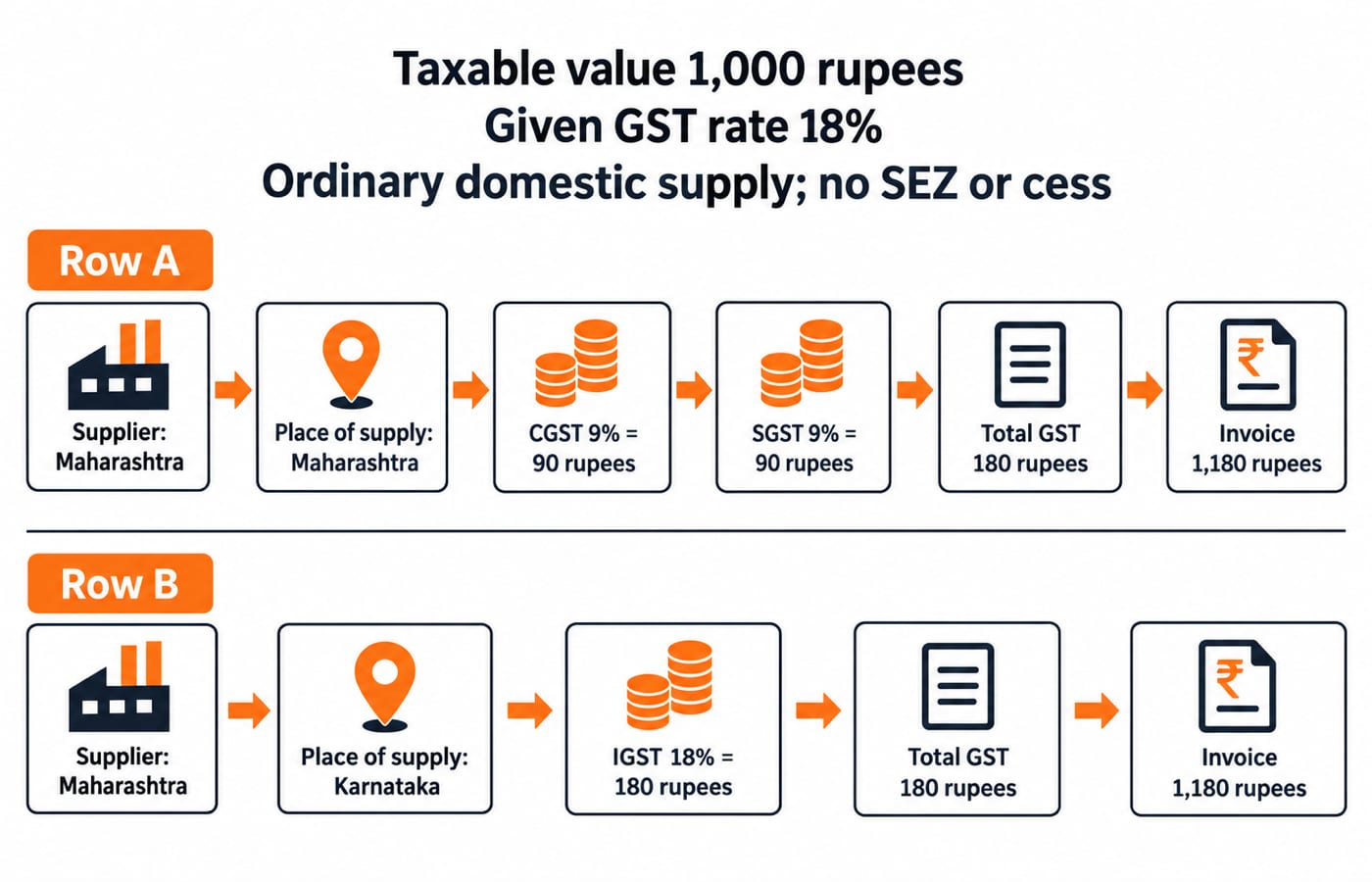
Use place of supply, not a buyer-address shortcut. For this example, assume an ordinary taxable domestic supply, no SEZ, no cess and no exemption. The taxable value is 1,000 rupees and the given total rate is 18%.
Case A: Maharashtra to Maharashtra. Supplier location and place of supply are both Maharashtra:
CGST = 1,000 rupees × 9/100 = 90 rupees.
SGST = 1,000 rupees × 9/100 = 90 rupees.
Total GST = 90 rupees + 90 rupees = 180 rupees.
Invoice total = 1,000 rupees + 180 rupees = 1,180 rupees.
Case B: Maharashtra to Karnataka. Supplier location is Maharashtra; place of supply is Karnataka:
IGST = 1,000 rupees × 18/100 = 180 rupees.
Invoice total = 1,000 rupees + 180 rupees = 1,180 rupees.
The total remains 18%; only the components change. Do not add IGST to CGST and SGST.
Input tax credit: why the next business does not pay the full tax twice
Now keep every supply within Maharashtra, at the given 18%, with all input credits eligible and no other adjustments. Supplier A sells to trader B for 1,000 rupees plus 180 rupees GST. B sells to the final consumer for a taxable value of 1,500 rupees.
B's output GST is 1,500 rupees × 18/100 = 270 rupees. The consumer's invoice totals 1,500 rupees + 270 rupees = 1,770 rupees. B uses 180 rupees input tax credit against 270 rupees output liability, leaving 90 rupees payable in cash.
B's component | Output tax | Eligible input credit | Cash payment |
|---|---|---|---|
CGST | 1,500 rupees × 9% = 135 rupees | 90 rupees | 45 rupees |
SGST | 1,500 rupees × 9% = 135 rupees | 90 rupees | 45 rupees |
Total | 270 rupees | 180 rupees | 90 rupees |
No CGST credit is used against SGST here. The cash payment also equals 18% of B's 500 rupees value addition: 500 rupees × 18/100 = 90 rupees. However, the outward taxable value remains 1,500 rupees, not 500 rupees.
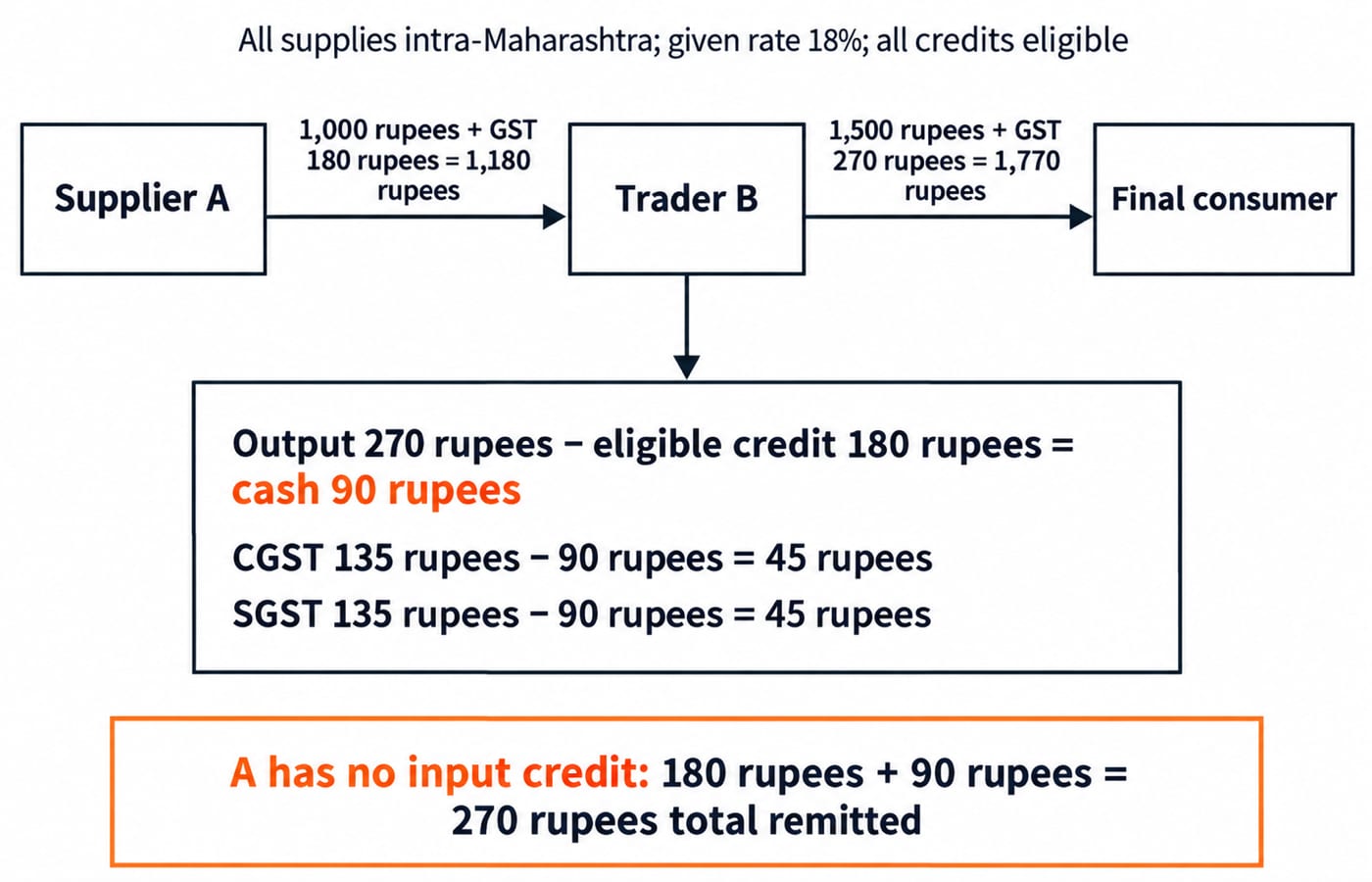
Assuming A has no input credit, A remits 180 rupees and B remits 90 rupees, totalling 270 rupees. The Ministry's FAQs explain that credit has eligibility conditions. It is not an automatic refund for every buyer. The final consumer has no business ITC in this example.
Four GST traps that produce wrong answers
Doubling the rate. Charging 18% CGST plus 18% SGST on 1,000 rupees gives 180 rupees + 180 rupees = 360 rupees. The correct total in our example is 180 rupees, split equally. IGST is not an extra surcharge either.
Treating credit as a discount. B's 90 rupees cash remittance does not replace the 270 rupees tax on the consumer's invoice. Credit adjusts B's liability after output tax is calculated.
Merging different categories. Nil-rated or exempt supplies and zero-rated supplies are not interchangeable terms. Do not substitute one label for another merely because a question mentions no tax payment.
Ignoring the date. The old four-slab mnemonic is insufficient for questions about the 2025 reforms. Record the announcement date and effective date separately. “One nation, one tax” does not mean one numerical rate for every supply.
How exam practice can test these concepts
The SSC CGL notice includes current events and the economic scene within General Awareness. That makes GST a sensible preparation topic, not a guaranteed question. Banking aspirants can practise the same concepts for awareness revision.
Try these original checks, assuming ordinary domestic taxable supplies, no SEZ or cess and fully eligible credit:
Same-state 2,000 rupees supply at 5%: total tax = 2,000 rupees × 5/100 = 100 rupees. CGST and SGST are 50 rupees each because each component is 2.5%.
Inter-state 2,000 rupees supply at 5%: IGST = 2,000 rupees × 5/100 = 100 rupees. There is no separate CGST-plus-SGST charge.
Output GST 360 rupees; eligible input credit 240 rupees: net cash = 360 rupees − 240 rupees = 120 rupees, assuming no other adjustments.
Combine these checks with SSC CGL static GK revision, keeping concepts and dated developments distinct.
Short revision version and the next step
Identify the supply type, read the given or date-appropriate rate, calculate tax on the taxable value, then apply eligible credit separately. Keep two memory checks: 90 rupees + 90 rupees = 180 rupees for the component split, and 270 rupees − 180 rupees = 90 rupees for net cash after credit.
Reproduce both worked examples without looking. For broader banking-exam preparation after this revision, use the IBPS PO Mains preparation course as your next step.
Keep learning
RBI Grade B Exam Pattern and Marking Scheme: Phases, Scores and Penalties
Clearing Phase I and earning final-merit marks are different jobs. Understand the General-cadre stages, section timers and score calculations before planning your next mock.
18 Oct 20265 min readBanking Exams
RBI Grade B Eligibility and Selection Process: Age, Qualifications and Stages
Check your RBI Grade B General Cadre eligibility in the right order: stream, age, qualification and previous appearances. Worked examples explain the boundaries before you plan for each selection stage.
9 Oct 20265 min readBanking Exams
NABARD Grade A Finance Preparation: Resources and an 8-Week Plan
Build a Finance specialist study plan around accounting, calculations and management applications. Use a 12-hour weekly schedule, a worked project appraisal and an error-based review routine.
5 Oct 20265 min readBanking Exams
LIC AAO Preparation for Repeat Attempts: A Six-Week Reset Plan
Familiar chapters need a sharper review method. Use your previous attempt and recent errors to plan six weeks of focused repair, protected mains work and manageable retests.
30 Sep 20265 min readBanking Exams