IBPS SO IT Officer Mains Professional Knowledge Mock Strategy: A 4-Week Review System
Build mocks that test coverage, execution and diagnosis. This guide turns one timed paper into a measured four-week cycle of analysis, repair and retesting.
KnowledgeGate Team
Exam prep & CS education
Updated 1 Sep 20266 min read56 views
A mock score hides which concepts, decisions and time losses produced it. Waiting for syllabus completion before attempting a full paper compounds the problem. A transparent blueprint, a worked scorecard and cause-based repair make each test evidence for the next one.
What an IBPS SO IT Officer Professional Knowledge mock must measure
A mock measures coverage, execution and diagnosis. Coverage checks the technical map, execution tests timed retrieval, and diagnosis explains wrong or skipped answers. A total score captures only execution.
The dated CRP SPL-XV Main Examination Information Handout specifies a Professional Knowledge test for IT Officer with 60 questions, 60 marks, 45 minutes and a 0.25 penalty per wrong answer. Before adopting those values, compare them with the current IBPS notification or handout.
The IBPS SO IT Mains Preparation Course provides a structured route, while IBPS PO & SO IT Exam Preparation is the course hub. Confirm the live format on IBPS before fixing mock duration or scoring.
Build a 60-question mock blueprint without inventing topic weightage
Use a house blueprint, not a prediction of official weights:
House-mock bucket | Questions |
|---|---|
DBMS | 8 |
Operating Systems | 8 |
Computer Networks | 8 |
Data Structures and Programming | 10 |
Computer Organisation and Digital Logic | 8 |
Software Engineering and Testing | 6 |
Cyber Security, Cloud and Web | 6 |
Mixed CS/IT fundamentals | 6 |
The buckets total 8 + 8 + 8 + 10 + 8 + 6 + 6 + 6 = 60. Mix 30 direct concepts, 18 application or output-tracing items and 12 close-option items: 30 + 18 + 12 = 60. Official topic weights may change or remain undisclosed, so rotate the contents without presenting the house mix as a forecast.
Keep totals stable while rotating contents. Mock A's DBMS split could be keys 2, SQL 2, normalisation 2, transactions 1 and indexing 1. Mock B could use keys 1, SQL 2, normalisation 1, transactions 2, indexing 1 and concurrency control 1. Rotation limits familiarity gains.
Use a 45-minute three-pass attempt plan, then test it
For recent-format practice, give Pass 1 23 minutes for high-confidence items and Pass 2 15 minutes for calculations, traces and two-option decisions. Reserve 5 minutes for flags and 2 for review: 23 + 15 + 5 + 2 = 45 minutes. The current handout controls the real duration.
Mark flags K for knowledge gap, T for time-heavy but solvable or R for risky options. With a penalty, attempt only when elimination supports the decision.
At minute 23, suppose you have answered 35, flagged 9 and not opened 16. Passes 2 and 3 add 12 and 5 answers. Final attempts are 35 + 12 + 5 = 52, leaving 8. Compare the split with your own first-pass pace; a slower Pass 1 needs a stricter skip rule.
Analyse one complete Professional Knowledge mock scorecard
C, W and U mean correct, wrong and unattempted. Accuracy uses attempts.
House-mock bucket | Questions | C | W | U | Attempt accuracy | Net under SPL-XV example penalty |
|---|---|---|---|---|---|---|
DBMS | 8 | 6 | 1 | 1 |
|
|
Operating Systems | 8 | 5 | 2 | 1 |
|
|
Computer Networks | 8 | 4 | 3 | 1 |
|
|
Data Structures and Programming | 10 | 7 | 2 | 1 |
|
|
Computer Organisation and Digital Logic | 8 | 5 | 2 | 1 |
|
|
Software Engineering and Testing | 6 | 4 | 1 | 1 |
|
|
Cyber Security, Cloud and Web | 6 | 4 | 1 | 1 |
|
|
Mixed CS/IT fundamentals | 6 | 4 | 1 | 1 |
|
|
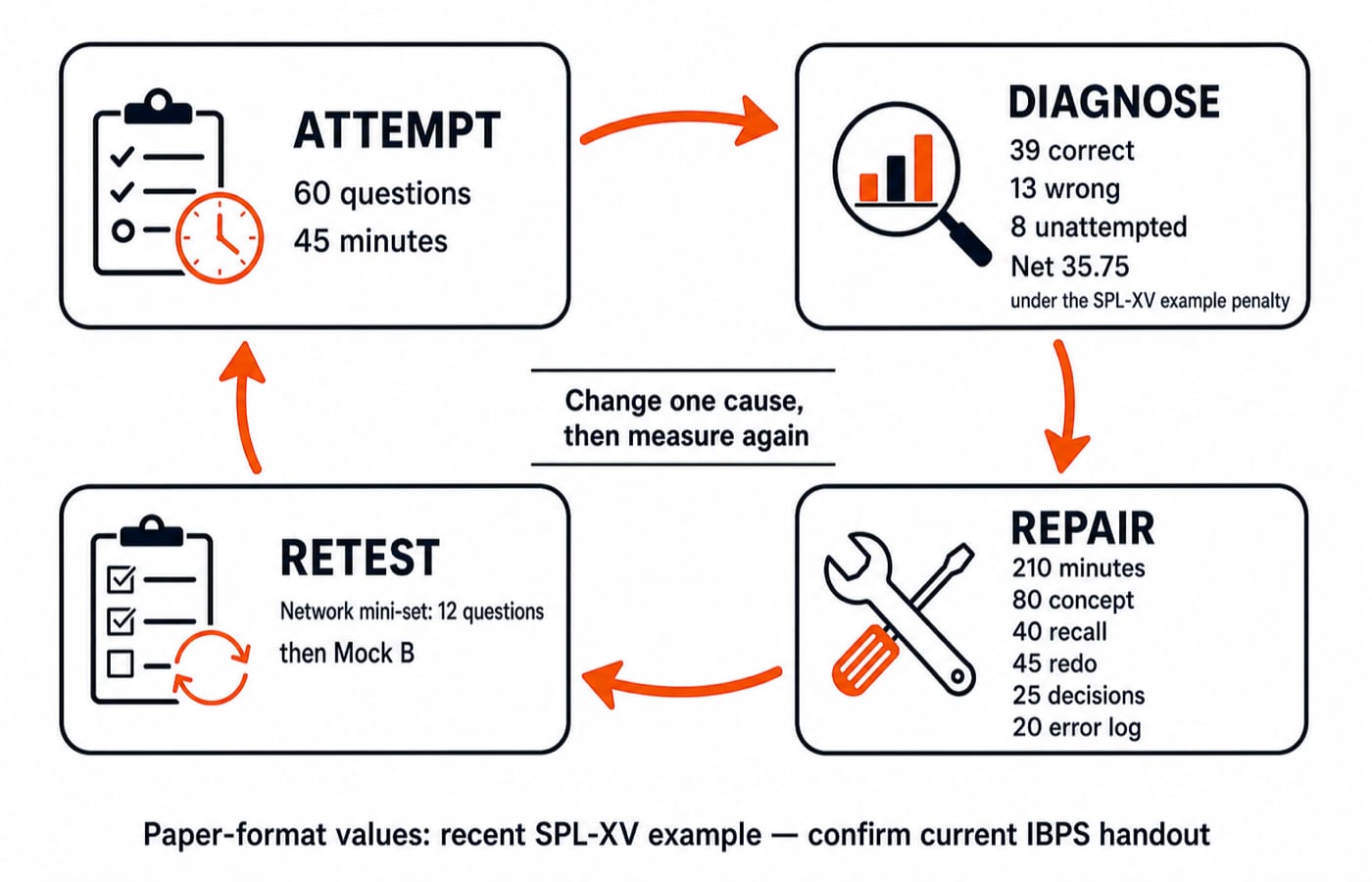
Totals are 39 correct + 13 wrong + 8 unattempted = 60, with 52 attempts. Accuracy is 39 / 52 x 100 = 75%; coverage is 52 / 60 x 100 = 86.67%; example net is 39 - (13 x 0.25) = 35.75. Track these three figures against later mocks built to the same blueprint; 35.75 is a baseline, not an IBPS benchmark.
Repair Computer Networks first because 57.14% is lowest; DBMS is strongest. Each bucket has one unattempted question, so inspect causes before blaming the clock.
Convert every wrong and skipped question into a repair action
Classify the 13 wrong answers as 5 concept gaps, 3 recall confusions, 3 trace slips and 2 poor decisions: 5 + 3 + 3 + 2 = 13. Split the 8 unattempted into 4 slow-but-solvable, 3 forgotten and 1 unfamiliar: 4 + 3 + 1 = 8.
Build a 210-minute repair block:
80 minutes to relearn the five concept gaps
40 minutes for closed-book recall on six recall-related wrong or skipped items
45 minutes to redo seven calculation, trace or slow-but-solvable items
25 minutes to replay two poor decisions and the unfamiliar item
20 minutes to update the error log
The total is 80 + 40 + 45 + 25 + 20 = 210 minutes.
The Network errors involve subnet ranges, distance-vector updates and TCP flow control. Use the Computer Networks Blog, then take a fresh 12-question mini-set. Give stronger DBMS only a short retrieval set.
Run the four-week mock cycle for 56 honest study hours
Allocate 14 hours per week across mocks, analysis, targeted repair, question sets, recall and the error log:
Week | Full mocks | Mock time | Analysis | Concept or targeted repair | Subject or mixed sets | Recall and error log | Weekly total |
|---|---|---|---|---|---|---|---|
1, diagnose | 1 |
|
|
|
|
|
|
2, build | 2 |
|
|
|
|
|
|
3, apply pressure | 2 |
|
|
|
|
|
|
4, consolidate | 3 |
|
|
|
|
|
|
The cycle has 1 + 2 + 2 + 3 = 8 full mocks and 14 x 4 = 56 hours. Analysis grows first so errors change the next attempt.
After repair, Mock B has 42 correct, 10 wrong and 8 unattempted. Accuracy is 42 / 52 x 100 = 80.77%; coverage remains 52 / 60 x 100 = 86.67%; example net is 42 - (10 x 0.25) = 39.50. Network moves from 4C, 3W, 1U to 6C, 1W, 1U. With the blueprint and coverage held constant, treat the gain as evidence that the repair worked, then demand the same trend on another fresh mock before calling it exam readiness.
Avoid false improvement and recover honestly from missed mock days
Repeated questions reward familiarity, so use fresh items. Easier papers inflate scores, so keep the blueprint and difficulty notes stable. Follow solutions with a closed-book mini-set within 48 hours.
If one 2-hour block is missed, recover 75 minutes: 45 for analysis and 30 for priority repair. Drop 45 minutes of volume. The week closes at 14 - 2 + 1.25 = 13.25 hours.
If two blocks are missed, preserve one 45-minute mock, its 105-minute review, 60 minutes of recall and 120 minutes of repair. Recover 2 hours elsewhere: 14 - 4 + 2 = 12 hours. Do not force two Sunday mocks.
IBPS SO IT Officer Mains mock strategy: the short version and next step
Confirm the current format, freeze a blueprint, use three timed passes, classify every wrong and skipped item, then retest each repaired cause. Compare scores only when difficulty and coverage stay stable. Use the Banking Exams Blog for wider context. For a connected Prelims, Mains and Interview path, consider the IBPS IT Officer Scale I Complete Course Bundle.
Keep learning
IBPS SO IT Officer Syllabus: What to Study for Each Section
Separate the official IBPS exam structure from the detailed study map. See what to cover for English, Reasoning, Quantitative Aptitude, Professional Knowledge and Descriptive English.
Updated 21 Oct 20264 min readIBPS Exams
IBPS SO IT Officer Preparation Strategy: A 16-Week Phase-by-Phase Plan
Turn 18 weekly hours into a realistic IBPS SO IT Officer plan, from the first diagnostic to mock repair, tapering and a conditional next-stage bridge.
Updated 17 Oct 20266 min readIBPS Exams
IBPS SO IT Officer Exam Pattern and Marking Scheme: Prelims, Mains and Interview
Understand the CRP SPL-XVI stage sequence, section timings and marks, then use worked score calculations and a 12-hour study plan to prepare for each stage.
Updated 13 Oct 20264 min read124 viewsIBPS Exams
IBPS Clerk Eligibility and Selection Process: From Application to Allotment
Separate the eligibility gate from the selection gate using a dated checklist, three candidate profiles and a 124-to-62 Main-score example.
Updated 8 Oct 20264 min readIBPS Exams