Computer Networks for GATE: An 8-Week Topic-by-Topic Preparation Plan
Use a 96-hour Computer Networks plan that moves from delay and flow control to subnetting, TCP and timed sets, with worked numericals and recovery rules.
KnowledgeGate Team
Exam prep & CS education
Updated 24 Oct 20265 min read
Many students study Computer Networks layer by layer but postpone numericals. By revision, subnetting, delay, flow control, routing and TCP demand different kinds of practice. First confirm the syllabus clusters and question-family priorities in Computer Networks for GATE: Syllabus Areas, Weightage Pattern and How to Prepare. Then schedule 96 hours around weekly outputs, diagnostics, timed sets and missed-session recovery.
1. Set the 96-hour target before opening the first chapter
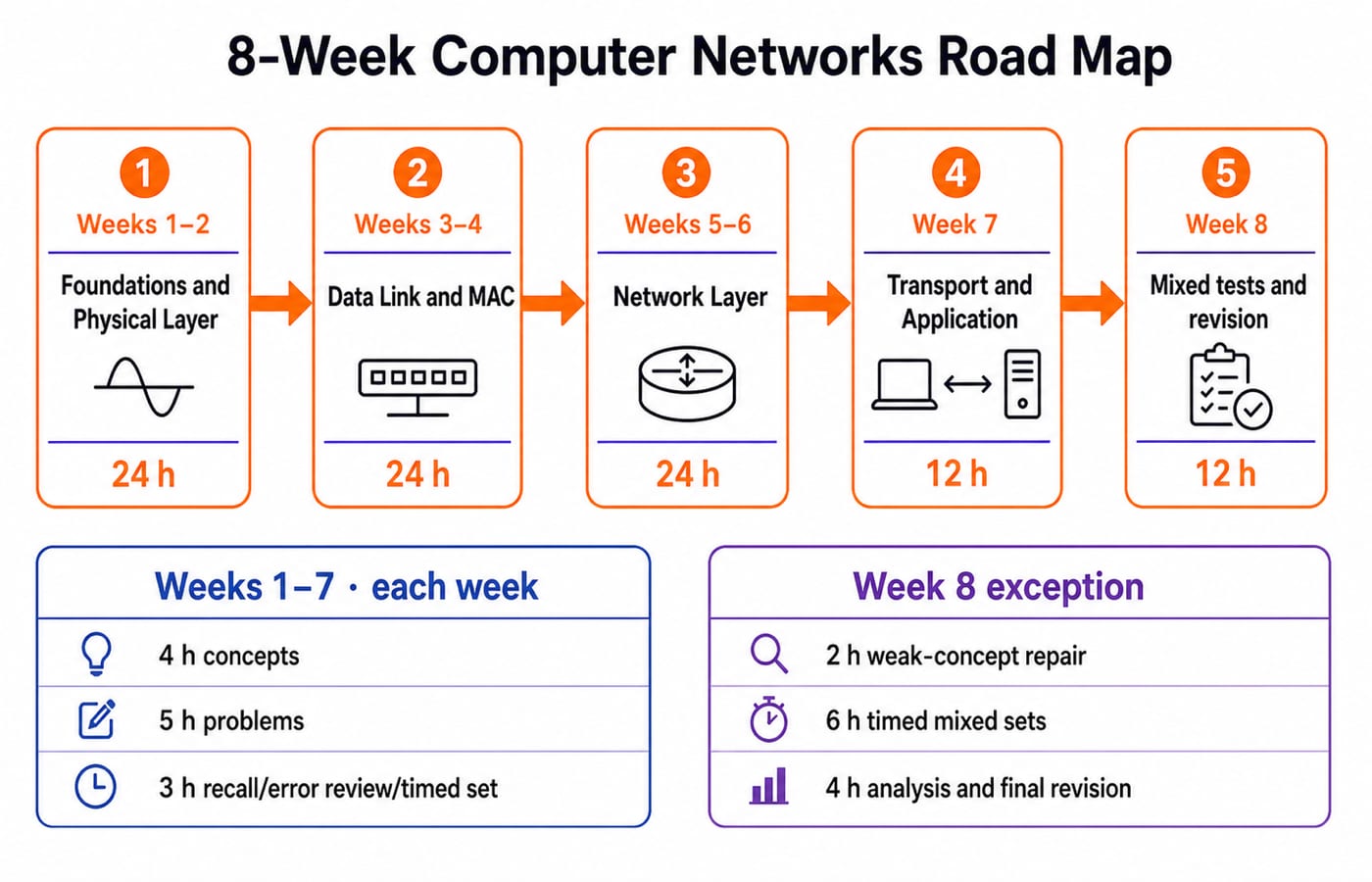
Eight weeks x 12 hours = 96 hours. Each week gets 4 hours for concepts, 5 for worked problems and topic practice, and 3 for recall, error review and a timed set. Measure progress with a formula sheet, error log and timed-set record per block, not videos.
Begin with a 20-minute diagnostic: 2 delay or bandwidth questions, 2 data-link or flow-control questions, 3 IP or routing questions, 2 TCP or UDP questions, and 1 application-layer question. Label responses C (concept), S (setup), A (arithmetic) or T (time). Shift up to 2 hours between blocks, but skip none.
Reserve these 96 hours inside your wider GATE schedule, but keep CN checkpoints separate: one diagnostic, one error code and one output target per block.
2. Weeks 1-2: Build the delay, bandwidth and layering base
Study model and encapsulation, transmission versus propagation delay, end-to-end delay, bandwidth-delay product, switching and media for throughput reasoning. Read Introduction to Computer Networks: Layers, Topologies, Switching and Delay Formulas with Worked Examples for the full layer map and derivations. Then make one short Week 1 delay checkpoint automatic.
A 1,000-byte packet contains 1,000 x 8 = 8,000 bits. On a 20 Mb/s link:
Transmission delay = 8,000 / 20,000,000 s = 0.0004 s = 0.4 ms.
Link length = 1,200 km = 1,200,000 m.
Propagation delay = 1,200,000 / (2 x 10^8) s = 0.006 s = 6 ms.
One-way delay = 0.4 + 6 = 6.4 ms, ignoring processing and queueing.
Write why packet size changes transmission delay but not propagation delay. End each week with 15 targeted questions and 20 minutes of recall. Below 10 correct, use the next concept hour to rework three examples.
3. Weeks 3-4: Join framing, error control, flow control and MAC
Follow framing, error detection and CRC, Stop-and-Wait, sliding windows, MAC protocols, then Ethernet. Protocol names are fragile without utilisation and collision assumptions.
Spend the first half of the block on untimed CRC, window and MAC sets. In the second half, use 25-minute mixed sets and write Tt, Tp, a, the acknowledgement assumption and the window size before choosing a formula. Classify every miss as a framing-rule gap, an assumption error, a model-selection error or an arithmetic slip. Rework one fresh problem from the same class before moving on.
4. Weeks 5-6: Give the Network Layer the largest numerical block
Study IPv4 addressing, masks and CIDR, fragmentation, ARP, ICMP and DHCP basics, forwarding and routing, then distance-vector versus link-state reasoning.
Give 10 of the 24 hours to addressing, forwarding and routing numericals. By the end of Week 6, complete three timed outputs: place a host in its subnet with network and broadcast boundaries, allocate one unequal VLSM block from largest to smallest, and choose a next hop by longest-prefix match. Write the rejected boundaries or routes as part of the solution. A correct option without the boundary work does not count as a completed drill.
5. Week 7: Learn Transport and Application as end-to-end behaviour
Cover UDP versus TCP, setup and teardown, sequence and acknowledgement numbers, flow versus congestion control, retransmission, then DNS, HTTP, email and FTP. Tie applications to their transport service, not a loose port list.
Read TCP Congestion Control for GATE for the full round-by-round cwnd table. In Week 7, compress that method into a one-minute setup: write the starting cwnd, ssthresh, loss event, named TCP variant and whether each value is measured at the start or end of an RTT. Solve one timeout case and one triple-duplicate-ACK case under explicit rules before adding application-layer questions.
Finish with 20 mixed questions: 8 on TCP, UDP or congestion control, 4 connection or sequence-number traces, and 8 application-layer items. Revisit a concept after two errors from one misconception.
6. Week 8: Convert chapter knowledge into timed decisions
Use 2 hours to patch the two weakest concepts, 6 for three timed mixed sets and one longer test, and 4 for analysis and final revision. Add no new chapter.
In a 30-question, 60-minute test, attempt 24, get 18 correct and 6 wrong, and skip 6. Attempt accuracy = 18/24 x 100 = 75%. Classify the wrong answers as 2 concept gaps, 2 setup errors, 1 arithmetic slip and 1 time-pressure mistake. Do two concept reworks, two fresh setup problems, one calculator-free drill and one five-question speed set. Do not calculate net marks because marking can differ. Give each test a correction and re-attempt date.
7. Make the plan survive college, work and missed days
Use four weekday sessions of 90 minutes, 4 hours on Saturday and 2 on Sunday. The total is 4 x 1.5 + 4 + 2 = 12 hours. A weekday session uses 35 minutes for concept repair, 45 for problems and 10 for error-log recall. Keep timed sets for weekends.
If Tuesday's 90 minutes are lost, recover 45 on Thursday and 45 on Sunday. At a 3-hour backlog, carry only the unfinished set forward and protect Week 8. Never compress two conceptual chapters into one sitting.
KnowledgeGate offers more than 2,200 Computer Networks questions for practice. Filter by topic and solve diagnosed sets of 15 to 25, then re-attempt wrong questions after 48 hours.
8. The short version and the next action
Learn in dependency order, solve numericals immediately and let the error log choose revision. Schedule four 90-minute sessions now and start with the 10-question diagnostic, not a perfect timetable. Use the GATE CS exam preparation category to fit CN beside the other subjects. After the weekly checkpoints pass, use the GATE Test Series for topic tests and full mocks.
Keep learning
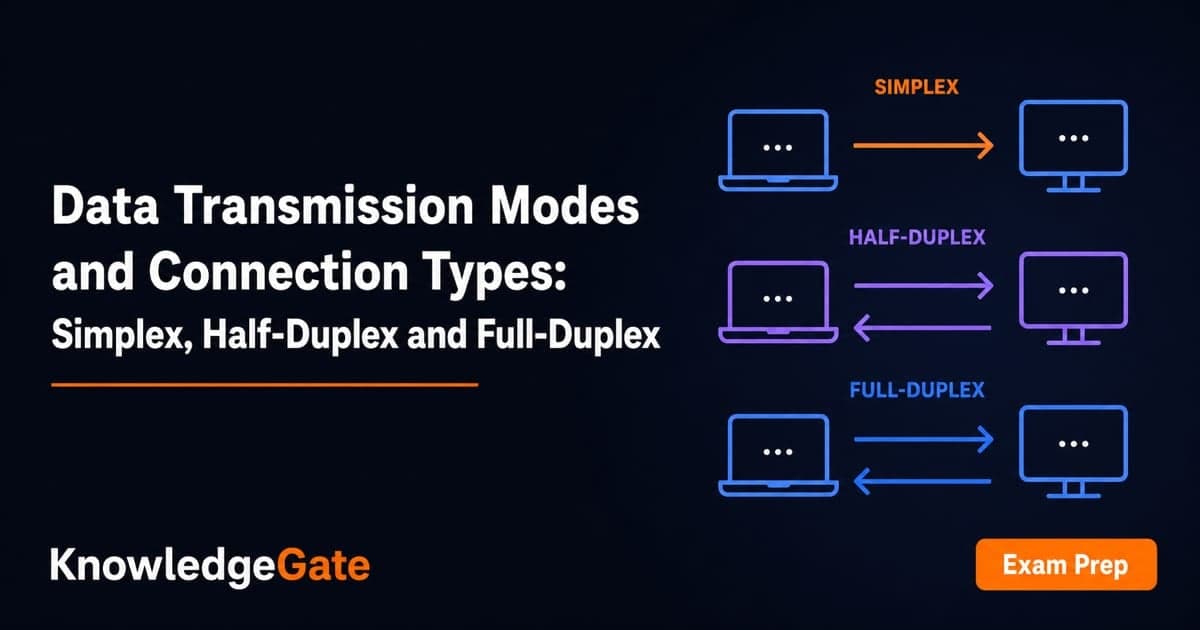
Data Transmission Modes and Connection Types: Simplex, Half-Duplex and Full-Duplex
Learn to classify simplex, half-duplex, full-duplex, point-to-point and multipoint links, then calculate completion time without relying on memorised examples.
Updated 22 Oct 20265 min readComputer Networks
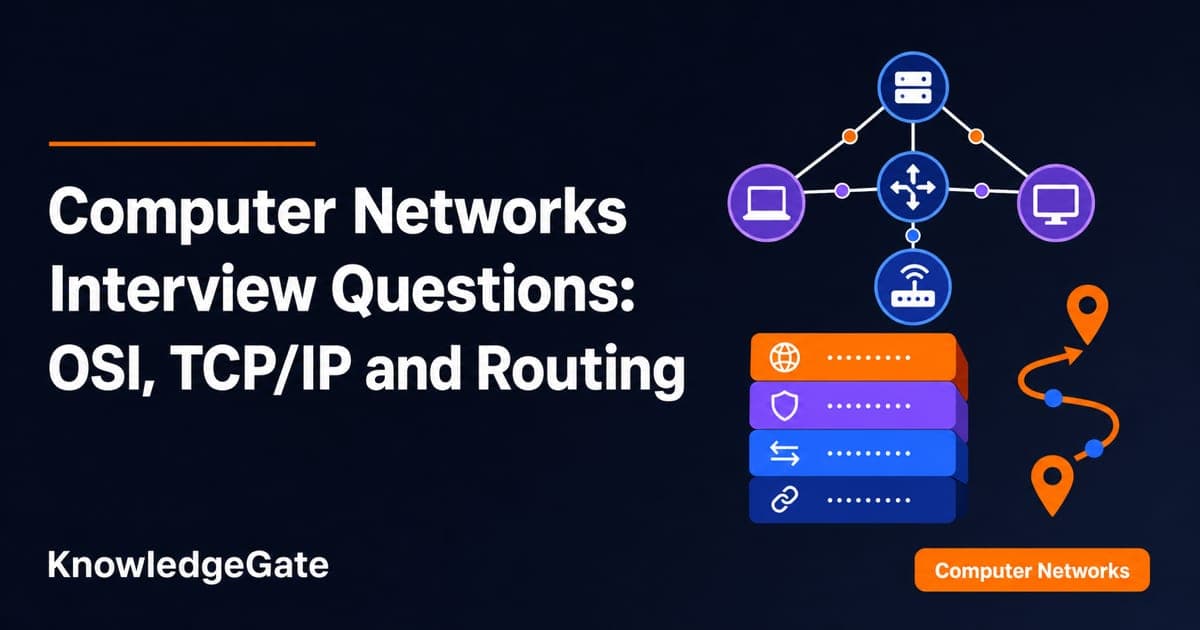
Computer Networks Interview Questions: Trace OSI, TCP/IP and Routing Step by Step
Follow one synthetic web request across DNS, ARP, TCP, NAT and longest-prefix routing, then turn each step into a strong interview answer.
Updated 18 Oct 20266 min readComputer Networks

Basics of Cyber Security: CIA Triad, Risks and a Worked Defence
Learn a consistent security vocabulary, connect common attack paths to suitable controls, and calculate how two defensive layers reduce account takeovers.
Updated 14 Oct 20266 min readComputer Networks
Cyber Threats and Attacks Explained: Types, Worked DDoS Example and Exam Traps
Learn to separate threats, vulnerabilities, vectors and attacks, then apply the distinctions to a calculated DDoS scenario and exam-style questions.
Updated 10 Oct 20266 min readComputer Networks