

Functional Interfaces in Java: SAM Rules, Lambdas and Runnable Examples
Build functional interfaces from zero, replace an anonymous class with a lambda, select standard interfaces by shape, and avoid common compiler traps.
KnowledgeGate Team
Exam prep & CS education
Updated 10 Nov 20265 min read
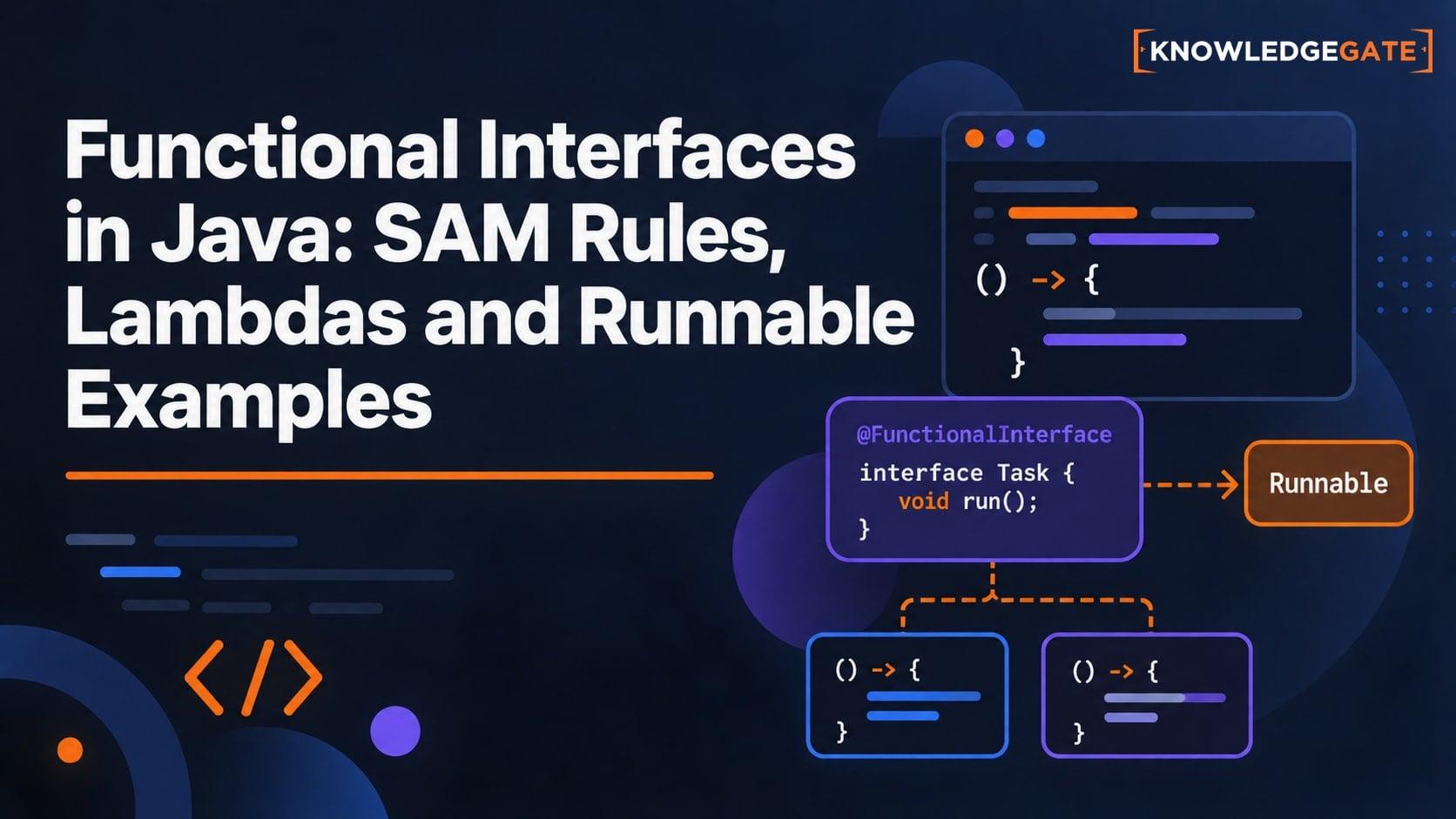
A functional interface has one logical abstract method, even when it also declares default or static methods. The @FunctionalInterface annotation asks the compiler to enforce that rule; it does not create lambda support. Lambdas gain their parameter and return contracts from a target functional-interface type, and composition order determines which function runs first.
What makes an interface functional?
Under section 9.8 of Oracle's Java Language Specification, a functional interface has one logical abstract instance method, called its single abstract method or SAM. @FunctionalInterface is an optional compiler check. An unannotated interface that satisfies the rule still works with lambdas.
@FunctionalInterface
interface PriceRule {
    int finalPrice(int markedPrice);

    default String label() { return "offer"; }
    static boolean valid(int price) { return price >= 0; }
}
Only finalPrice(int) is abstract. The default method has an implementation, while the static method belongs to the interface itself.
This version fails at compile time because the annotation exposes two unrelated abstract methods:
@FunctionalInterface
interface BrokenRule {
    int apply(int x);
    boolean test(int x);
}
Two specification details prevent bad counting. An abstract declaration matching a public method of Object, such as boolean equals(Object other), does not count towards the SAM. Also, identical inherited declarations such as int map(int x) from two parent interfaces can describe one logical function method. These are JLS rules, not a shortcut that makes any repeated methods acceptable.
Replace an anonymous class with a lambda
Here is a 10 percent discount in anonymous-class form:
PriceRule oldStyle = new PriceRule() {
    @Override
    public int finalPrice(int price) {
        return price - price / 10;
    }
};
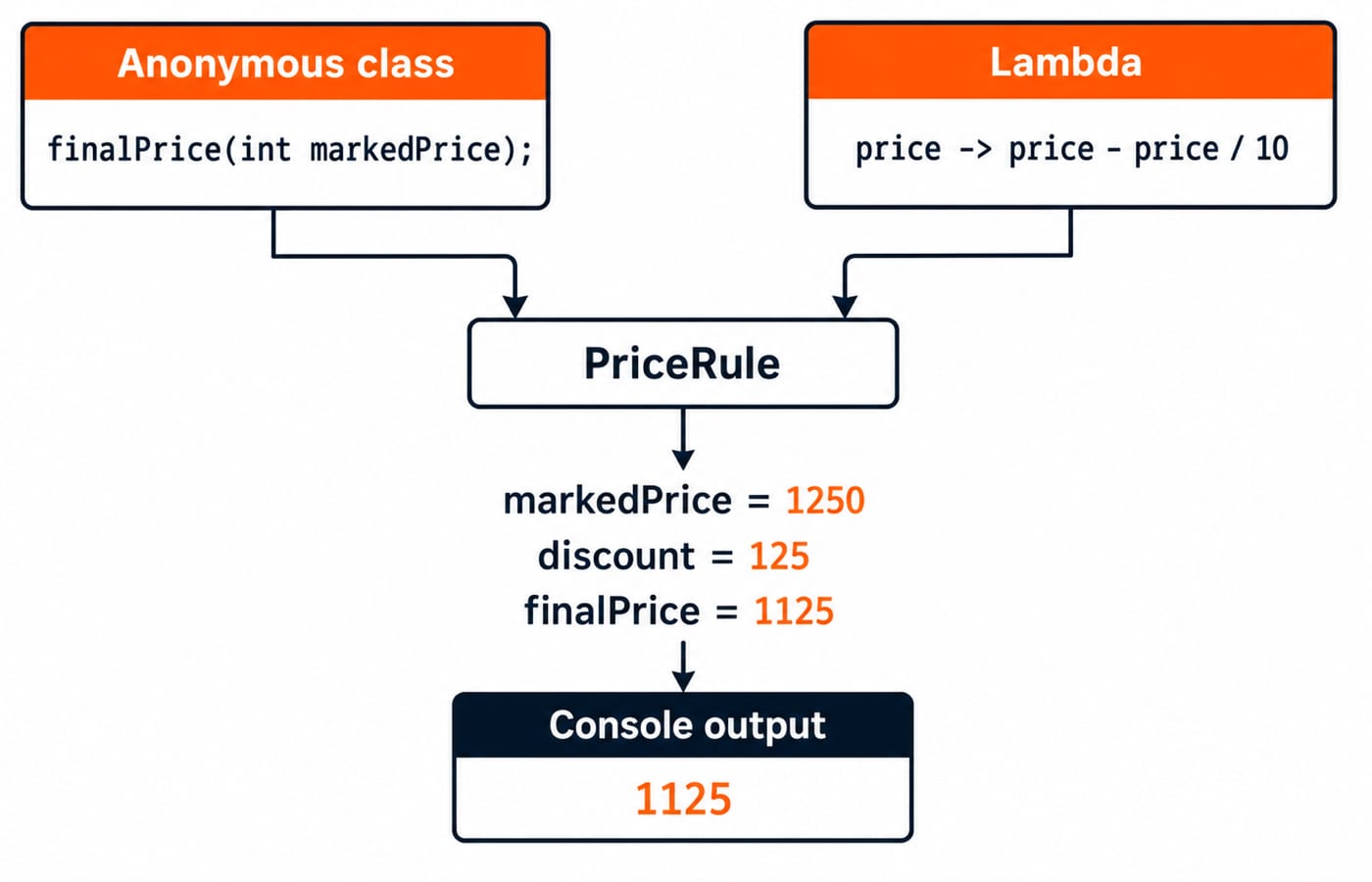
The equivalent lambda is PriceRule tenPercentOff = price -> price - price / 10;. price is the parameter, -> connects input to behaviour, and the expression is the returned result.
@FunctionalInterface
interface PriceRule {
    int finalPrice(int markedPrice);
}

public class FunctionalInterfaceDemo {
    public static void main(String[] args) {
        PriceRule tenPercentOff = price -> price - price / 10;
        System.out.println(tenPercentOff.finalPrice(1250));
    }
}
The output is exactly 1125. With deliberate integer arithmetic, 1250 / 10 = 125, then 1250 - 125 = 1125. The lambda removes anonymous-class boilerplate, but evaluating it still produces an instance whose target type is PriceRule, and the call still follows the finalPrice(int) contract.
Choose the right built-in functional interface
The java.util.function package covers common shapes:
Type | Shape and concrete call |
|---|---|
|
|
|
|
|
|
|
|
|
|
Choose by shape: T -> boolean suggests Predicate<T>, T -> R a Function<T,R>, T -> void a Consumer<T>, no input to T a Supplier<T>, and T -> T a UnaryOperator<T>.
Primitive specialisations can avoid boxing. In an integer-heavy loop, IntPredicate positive = n -> n > 0 avoids repeatedly converting between int and Integer. Treat that as a useful option, not a claim of better speed without measurement.
Target typing, method references and composition order
Context supplies a lambda's target type:
PriceRule a = p -> p - 100;
IntUnaryOperator b = p -> p - 100;
The lambda alone has no useful standalone type. Assignment or a method parameter supplies its contract, so overloaded methods can be ambiguous when two target types fit.
Method references shorten lambdas when the referenced name is clearer:
Function<String, Integer> parse = Integer::parseInt;       // s -> Integer.parseInt(s)
Predicate<String> prefix = "KnowledgeGate"::startsWith;   // s -> "KnowledgeGate".startsWith(s)
ToIntFunction<String> length = String::length;             // s -> s.length()
Supplier<List<String>> lists = ArrayList::new;              // () -> new ArrayList<>()
These are static, bound-instance, unbound-instance, and constructor references respectively.
Order matters in composition:
Function<Integer, Integer> addFee = x -> x + 50;
Function<Integer, Integer> discount10 = x -> x - x / 10;
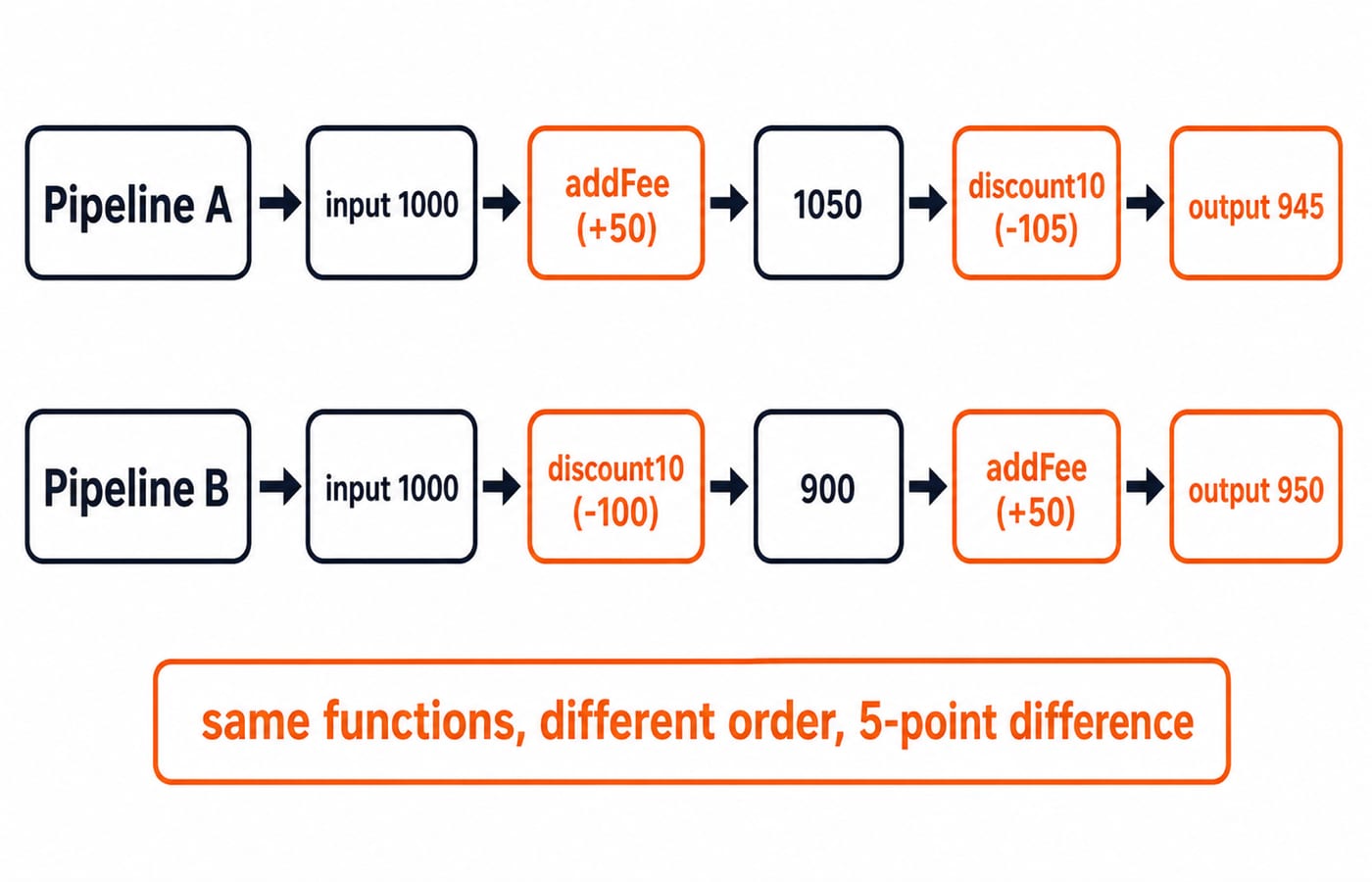
From 1000, addFee.andThen(discount10) first reaches 1050, then subtracts 1050 / 10 = 105, producing 945. Reversing the chain with discount10.andThen(addFee) first gives 1000 - 100 = 900, then 900 + 50 = 950. For f.andThen(g), f runs first. For f.compose(g), g runs first.
Compiler errors and semantic traps
Recognise these three broken and fixed patterns:
Too many abstract methods: annotated
BrokenRulefails; keep one logical SAM or remove lambda use.Captured local mutation:
int bonus = 50; Function<Integer,Integer> f = x -> x + bonus; bonus++;fails becausebonusis not effectively final. Leave it unchanged, or declarefinal int bonus = 50.Checked exception:
Function<Path,String> read = p -> Files.readString(p);fails becauseFunction.applydoes not declareIOException. Catch and wrap it inside the lambda, or define a custom functional interface whose SAM declaresthrows IOException.
Two other traps compile. Inside a lambda, this is the enclosing instance, unlike this inside an anonymous class, which refers to that anonymous object. Also, Predicate<Integer> positive = n -> n > 0 compiles, but positive.test(null) throws NullPointerException when Java tries to unbox that particular null value. This does not make every lambda null-unsafe.
Effectively final locals concern whether a captured variable is reassigned. That is separate from object immutability, explained further in Java string handling, the string pool and immutability.
How exams and interviews test functional interfaces
Use a four-step checklist:
Count logical abstract methods using the JLS rule.
Ignore default and static methods.
Match input and output to
Predicate,Function,Consumer, orSupplier.Trace
composeandandThenfrom the function that actually runs first.
For Predicate<String> longName = s -> s.length() >= 5, longName.test("Java") is false because the length is 4; longName.test("Lambda") is true because the length is 6. Identification check: is an interface with one abstract method and two default methods valid? Yes, it is functional.
For interview depth, be ready to explain why the annotation is a useful compiler check, how lambda and anonymous-class this bindings differ, and when a method reference reads more clearly than a lambda.
Practice task, the short version and next step
Define interface Transformer { int apply(int x); }, then create Transformer doubleIt = x -> x * 2 and Transformer addThree = x -> x + 3. The nested call addThree.apply(doubleIt.apply(8)) produces 19 because 8 * 2 = 16 and 16 + 3 = 19. Now declare the same operations as Function<Integer,Integer> doubleFunction = x -> x * 2 and Function<Integer,Integer> addFunction = x -> x + 3. Then doubleFunction.andThen(addFunction).apply(8) also gives 19, while addFunction.andThen(doubleFunction).apply(8) gives 22.
If basic runnable loops and methods need more work first, use classic programs in C, Java and Python, then return to this exercise.
The short version:
A functional interface has one logical abstract method.
@FunctionalInterfaceis optional but protective.A lambda needs a target type.
Built-in interfaces cover the common shapes.
Composition order can change the result.
For a broader route from Java basics, continue with Complete Java. For structured Java practice, use Java: Concepts, MCQs and Coding Questions. The Coding & DSA category lets you compare the available coding paths.
Keep learning

Abstraction and Interfaces in Java: Abstract Classes, Contracts and Runnable Examples
Learn when Java needs an abstract class, when it needs an interface, and how both work together in one runnable charge-calculation program with exact outputs.
Updated 6 Oct 20266 min readJava
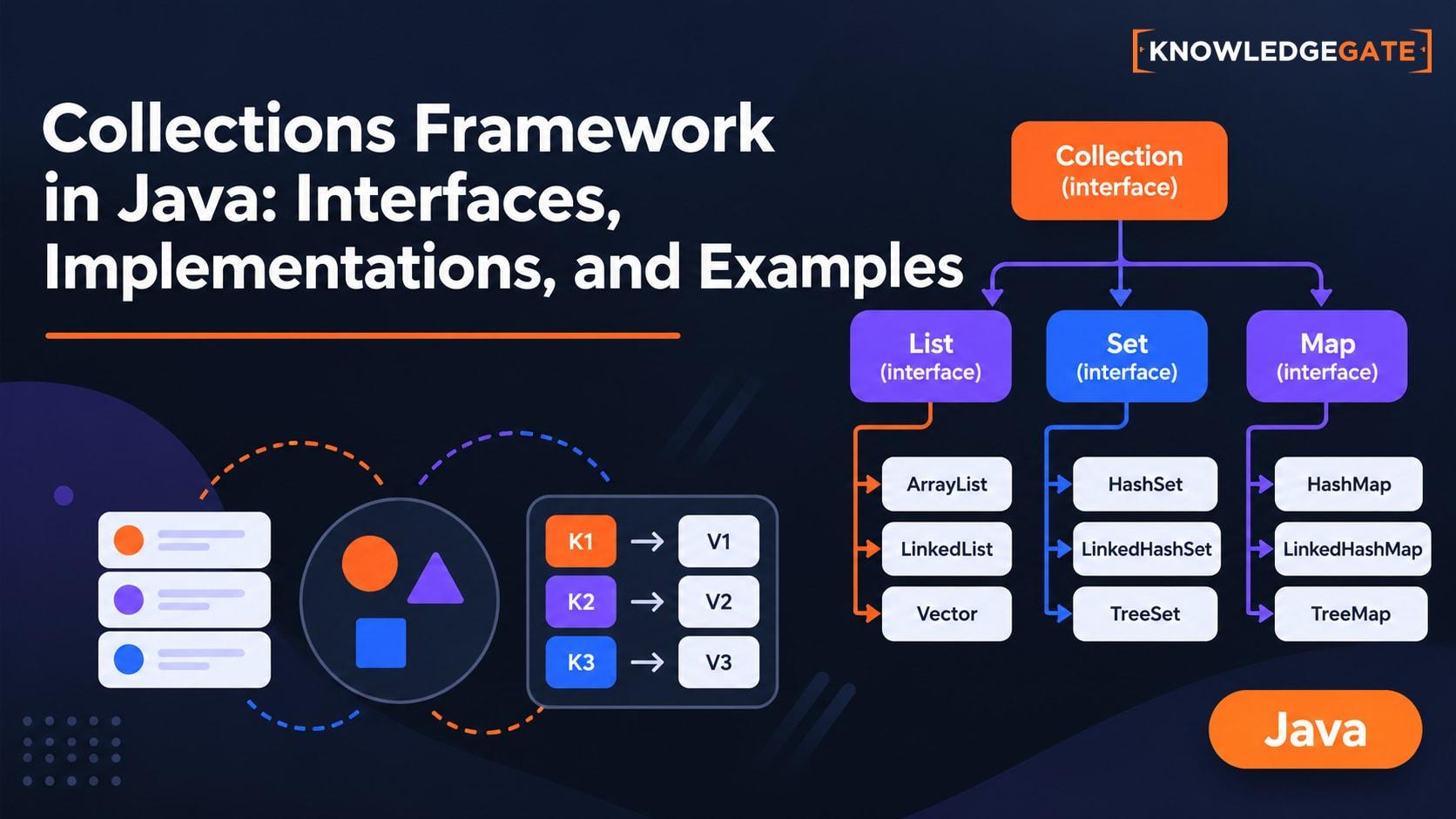
Collections Framework in Java: Interfaces, Implementations, and Examples
Learn how List, Set, Map, and Deque fit together, then choose implementations confidently through one consistent Java example.
Updated 2 Nov 20265 min readJava

ArrayList and LinkedList in Java: Runnable Examples, Costs and Common Errors
Build a reliable mental model for Java lists, run two complete programs, compare operation costs, and avoid overload, bounds and traversal traps.
Updated 14 Nov 20265 min readJava
Records and Sealed Classes in Java: Runnable Examples and Rules
Learn when to use a Java record and when to seal a hierarchy. Compile two complete examples, trace their output, and fix the mistakes learners often make.
Updated 13 Nov 20266 min readJava