FIFO Page Replacement MCQs: 12 Solved Questions with Step-by-Step Explanations
Practise FIFO carefully through 12 questions on hits, faults, preloaded frames, reverse reference strings, queue traces, and Belady's anomaly.
KnowledgeGate Team
Exam prep & CS education
Updated 23 Aug 20268 min read69 views
FIFO sounds simple, yet marks are lost when a hit refreshes the queue, preloaded pages are ignored, or faults are counted without frame states. Cover each answer, trace the string yourself, and only then read the explanation. The costliest habit to unlearn is treating a hit as a refresh: under FIFO a resident page keeps its original place in the arrival queue no matter how often it is referenced. If you want a mixed FIFO, LRU and Optimal set first, start with this broader page replacement MCQ practice.
1. FIFO page replacement rules before the MCQs
Use the same four-step method every time:
Keep pages in arrival order, oldest to newest.
A resident-page reference is a hit and does not change the order.
A miss fills an empty frame first.
A miss with full frames evicts the oldest page and appends the new page.
With three empty frames and 1, 2, 1, 3, 4, trace 1 F -> [1], 2 F -> [1,2], 1 H -> [1,2], 3 F -> [1,2,3], 4 F, evict 1 -> [2,3,4]. That is four faults, one hit, and final order [2,3,4]. The hit does not refresh page 1, which remains oldest.
Review Page Replacement Algorithms for GATE: FIFO, LRU, Optimal if you need the comparison first.
2. FIFO forward-reverse and preloaded-frame MCQs
Question 1
A system uses FIFO policy for page replacement. It has 4 page frames with no pages loaded to begin with. The system first accesses 100 distinct pages in some order and then accesses the same 100 pages but now in the reverse order. How many page faults will occur?
GATE 2010
A. 196
B. 192
C. 197
D. 195
Answer: A. 196. All 100 distinct pages fault, leaving the last four resident. Those four lead the reverse pass and hit; the other 96 fault. Total: 100 + 96 = 196.
Question 2
Suppose for a process P, reference to pages in order are 1,2,4,5,2,1,2,4. Assume that main memory can accommodate 3 pages and the main memory has already 1 and 2 in the order 1 first, 2 second. At this moment, assume FIFO Page Replacement Algorithm is used then the number of page faults that occur to complete the execution of process P is
UGC NET 2018
A. 4
B. 3
C. 5
D. 6
Answer: C. 5. Start with [1,2], page 1 oldest: 1 and 2 hit, then 4 fills the empty frame. Later miss states are [2,4,5], [4,5,1], [5,1,2], and [1,2,4]; the middle 2 hits. The result is five faults and three hits.
3. FIFO frame-trace and page-fault MCQs
Question 3
Consider the memory reference string given below for a memory with 3 frames per process: Reference string: 1, 2, 3, 4, 1, 2, 5, 1, 2, 3, 4, 5. The number of page faults for FIFO page replacement policy is:
NVS 2022
A. eleven
B. ten
C. twelve
D. nine
Answer: D. nine. Pages 1, 2 and 3 fill the three frames, then 4, 1, 2 and 5 each fault and evict 1, 2, 3 and 4 in turn, leaving [1,2,5]. The next 1 and 2 hit. Pages 3 and 4 then fault to give [2,5,3] and [5,3,4], and the closing 5 hits. Nine faults and three hits across twelve references.
Question 4
A process refers to 5 pages A, B, C, D, E in the order: A, B, C, D, A, B, E, A, B, C, D, E. If the page replacement algorithm is FIFO, the number of pages which transfer with an 'empty internal store of 3 frames' is:
A. 8
B. 10
C. 9
D. 7
Answer: C. 9. The first seven references miss, producing [A,B,C], [B,C,D], [C,D,A], [D,A,B], and [A,B,E]. A and B hit; C and D fault to form [B,E,C] and [E,C,D], then E hits. Nine misses mean nine transfers.
Question 5
Consider a main memory with 3 page frames. The following sequence of page references is: 3, 4, 2, 3, 9, 1, 6, 3, 4, 9. What is the number of page faults using the FIFO page replacement algorithm?
DSSSB 2021
A. 9
B. 10
C. 8
D. 7
Answer: A. 9. Pages 3, 4, and 2 fault; the next 3 is the only hit. Then 9, 1, 6, 3, 4, and 9 fault, evicting 3, 4, 2, 9, 1, and 6. Total: 3 + 6 = 9.
Question 6
Consider a main memory with the capacity of 4 page frames which are initially empty. If the page reference string is 1, 3, 4, 4, 3, 2, 1, 7, 5, 6 then what is the number of page fault using FIFO page replacement algorithm?
DSSSB 2021
A. 6
B. 7
C. 8
D. 9
Answer: B. 7. Pages 1, 3, and 4 fault; repeated 4 and 3 hit, then 2 fills the last frame. Page 1 hits, while 7, 5, and 6 fault and evict 1, 3, and 4. That is seven faults and three hits.
Question 7
How many page faults occur for first-in first-out page replacement algorithm for the following reference string when there are 3 frames? 7, 0, 1, 0, 2, 7, 1, 0, 1, 2
DSSSB 2022
A. 5
B. 7
C. 8
D. 10
Answer: C. 8. The first 7, 0, and 1 fault, then 0 hits. Pages 2, 7, 0, 1, and 2 miss, while the intervening 1 hits. The count is 3 + 5 = 8.
For structured concept and practice, use GATE Guidance by Sanchit Sir.
4. Belady's anomaly as a worked FIFO comparison
Question 8
Consider the reference string 0 1 2 3 0 1 4 0 1 2 3 4. If FIFO page replacement algorithm is used, then the number of page faults with three page frames and four page frames are _______ and ______ respectively.
UGC NET 2016
A. 10, 9
B. 9, 9
C. 10, 10
D. 9, 10
Answer: D. 9, 10. With three frames, the first seven fault, 0 and 1 hit, 2 and 3 fault, then 4 hits: nine faults. With four frames, the first four fault, 0 and 1 hit, then every remaining reference faults. That produces ten faults.
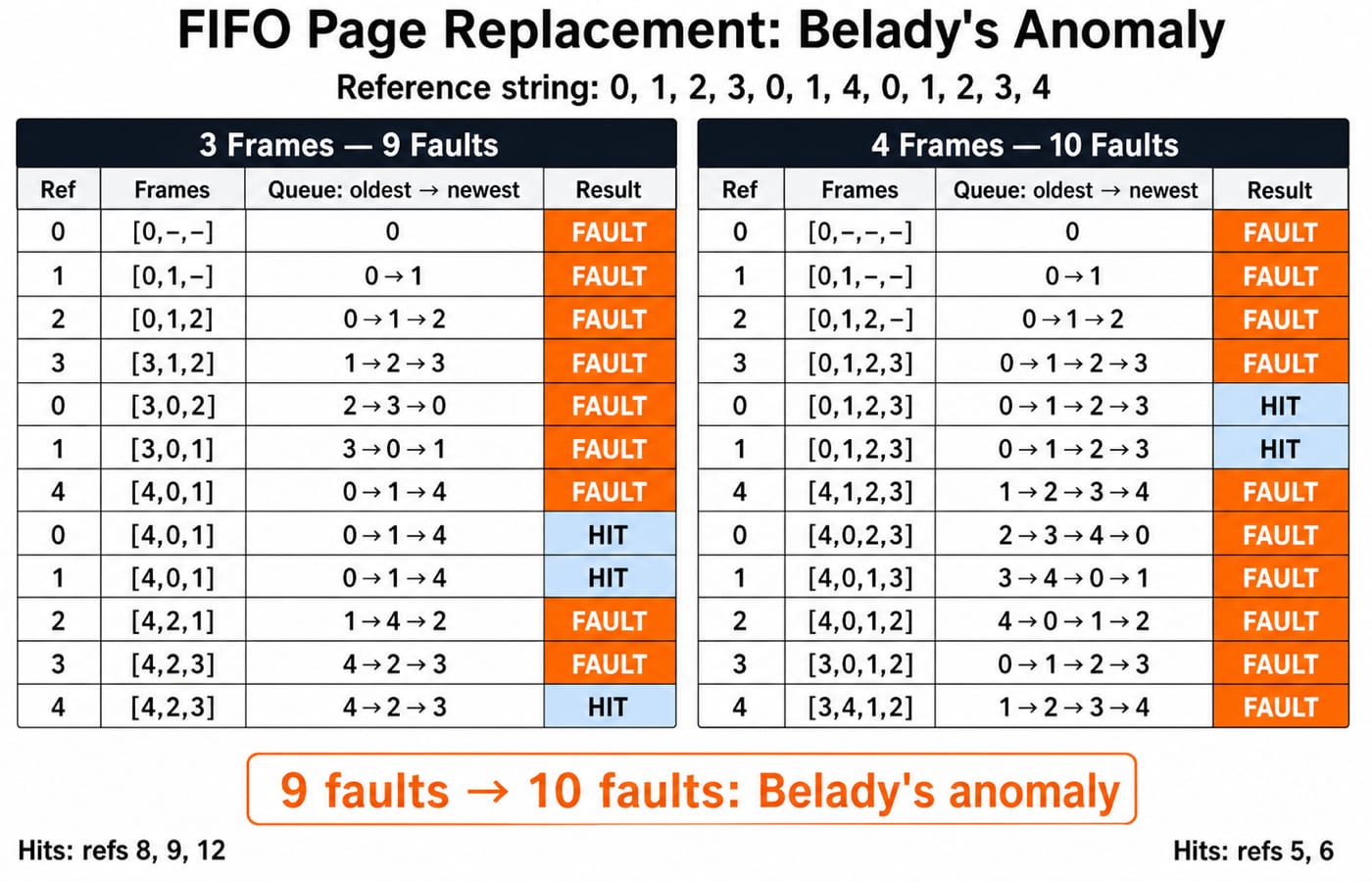
This is Belady's anomaly: this string produces more FIFO faults with four frames than with three. It occurs only for some strings, not after every frame increase.
5. FIFO and Belady's anomaly concept MCQs
Question 9
A virtual memory system uses First In First Out (FIFO) page replacement policy and allocates a fixed number of frames to a process. Consider the following statements: P: Increasing the number of page frames allocated to a process sometimes increases the page fault rate. Q: Some programs do not exhibit locality of reference. Which one of the following is TRUE?
GATE 2007
A. Both P and Q are true, and Q is the reason for P
B. Both P and Q are true, but Q is not the reason for P
C. P is false, but Q is true
D. Both P and Q are false
Answer: B. P is true because FIFO can show Belady's anomaly, and Q is independently true. Q does not explain P; FIFO's order on particular strings causes the anomaly.
Question 10
Consider a virtual memory system with FIFO page replacement policy. For an arbitrary page access pattern, increasing the number of page frames in main memory will
GATE 2001
A. always decrease the number of page faults
B. always increase the number of page faults
C. sometimes increase the number of page faults
D. never affect the number of page faults
Answer: C. Question 8 disproves “always decrease” because its count rises from 9 to 10. “Sometimes” is essential; other strings may improve or remain unchanged.
Question 11
In which one of the following page replacement policies, Belady’s anomaly may occur?
GATE 2009
A. FIFO
B. Optimal
C. LRU
D. MRU
Answer: A. FIFO. FIFO is not a stack algorithm, so three-frame contents need not be a subset of four-frame contents. LRU and Optimal have the stack property, preventing this anomaly.
Question 12
Belady's anomaly is related to ___________ function of the operating system.
A. process scheduling
B. deadlock
C. process synchronisation
D. page replacement
Answer: D. page replacement. The anomaly compares faults as available frames change. It concerns page replacement, not scheduling, deadlock, or synchronisation.
6. FIFO MCQ traps and a reliable answer-check
Before accepting an answer, use this checklist:
Write initially loaded frames before the first reference.
Mark the oldest resident page.
Leave the queue unchanged on a hit.
Count only misses as faults.
Keep faults separate from frames.
Treat “sometimes” as decisive in Belady questions.
Use invariants to catch mistakes. Question 1 has 200 references and four hits, hence 196 faults. Question 2 has three hits and five misses; Question 6 has three hits and seven faults. Question 8 must read three frames = 9, four = 10.
Answer key: 1 A, 2 C, 3 D, 4 C, 5 A, 6 B, 7 C, 8 D, 9 B, 10 C, 11 A, 12 D.
After untimed tracing, use the GATE Test Series for timed Operating Systems practice.
7. FIFO page replacement MCQs: the short version and next step
Most FIFO errors disappear when you keep two rules fixed: arrival order changes only when a fault loads a page, and a hit never refreshes a resident page. Belady's anomaly is the conceptual exception worth remembering: the example has 9 faults with three frames and 10 with four. Redo Questions 2, 6 and 8 without looking at the working. If you cannot state the FIFO queue after every reference, go back to the four rules at the top before mixing FIFO with LRU and Optimal. For a structured sequence rather than loose practice, the GATE CS courses and test series list the Operating Systems options in one place.
Keep learning
Semaphores and Process Ordering MCQs: 10 Solved Questions
Solve 10 semaphore MCQs with worked state traces for count arithmetic, waiting queues, forced alternation, stale reads, barriers and deadlock prevention.
Updated 26 Oct 20268 min readOperating System MCQs

Schedulers and Context Switching MCQs: 12 Solved Questions with Explanations
Solve 12 exam questions on long-term, medium-term and short-term schedulers, the dispatcher, context state, mode switches and process-switch counting.
Updated 25 Oct 20268 min readOperating System MCQs

Process Synchronization MCQs: 10 Solved Cross-Concept Questions with Explanations
Solve 10 mixed Process Synchronization questions, then learn how shared state, atomic operations, waiting behaviour and lock ownership decide each answer.
Updated 24 Oct 20267 min readOperating System MCQs

Process Basics and PCB MCQs: 12 Solved Questions with Explanations
Solve 12 Process Basics and PCB questions, then use each explanation to repair the exact concept boundary behind the correct option.
Updated 20 Oct 20268 min readOperating System MCQs