Multilevel Queue Scheduling MCQs: 10 Solved Questions with Explanations
Attempt 10 published objective questions on MLFQ behaviour, scheduler matching, two-level scheduling and weighted completion time. Each answer explains the decisive rule.
KnowledgeGate Team
Exam prep & CS education
Updated 25 Aug 20268 min read75 views

Multilevel queue questions test whether you can separate fixed queue assignment from feedback-driven movement, follow priority and quantum changes, and keep a Gantt chart consistent when arrivals and context switches are added. GATE, UGC NET, ISRO and BEL questions sit alongside targeted practice questions. Solve each item before reading its explanation, and use the full Q4 trace to check every dispatch and context switch.
Multilevel queue scheduling: fix the model before attempting
Scheme | Queue assignment | Movement |
|---|---|---|
Fixed multilevel queue | A process is permanently assigned to a class queue | No feedback-driven movement |
Multilevel feedback queue (MLFQ) | A process starts in a queue selected by the design | It can move according to observed behaviour |
Separate queue priority, within-queue policy, time quantum, promotion or demotion rule, and starvation control.
Q4 uses Q1 = highest priority, RR with 2 ms quantum, Q2 = RR with 4 ms quantum, and Q3 = RR with 8 ms quantum. Lower queues run only when higher ones are empty; a new process starts in Q1 and drops after using its full quantum. Other MLFQ designs can use different quanta and movement rules.
Classify the stem as fixed multilevel queue, feedback queue, two-level scheduling, or another OS queue before viewing options. Mark the decisive rule. Continue with Process Scheduling MCQs: 12 Solved (GATE), or revise through CPU scheduling: FCFS, SJF, Round Robin & priority.
MLFQ behaviour MCQs: movement, priority and quantum
Q1. Feedback queues, ISRO 2007 and BEL 2007
Feedback queues
A.
are very simple to implementB.
dispatch tasks according to execution characteristicsC.
are used to favour real time tasksD.
require manual intervention to implement properly
Answer: B. Consuming a full quantum or yielding early feeds later placement and priority decisions. This is neither manual nor limited to real-time tasks.
Q2. Long quantum placement in MLFQ
A multilevel feedback queue scheduler generally assigns a long quantum to:
A.
High priority processesB.
Low priority processesC.
New processesD.
Old processes
Answer: B. Q1, Q2 and Q3 use 2 ms, 4 ms and 8 ms. Higher queues favour response; lower queues give CPU-bound work longer, cheaper runs, regardless of age alone.
Q3. False statement about MLFQ, UGC NET June 2015
Which of the following statements is not true for Multi Level Feedback Queue processor scheduling algorithm ?
A.
Queues have different prioritiesB.
Each queue may have different scheduling algorithmC.
Processes are permanently assigned to a queueD.
This algorithm can be configured to match a specific system under design
Answer: C. Permanent assignment belongs to a fixed multilevel queue. MLFQ permits movement plus configurable priorities, policies and rules.
MLFQ numerical MCQ: construct the complete Gantt chart
Q4. Turnaround time, normalised turnaround and efficiency
Suppose the following jobs are to be executed in a uniprocessor system. Multilevel Feedback Queue(MLQ) is used with queues numbered 1-10, quantum = 2i , where i is the queue level number and processes are initially placed in the first queue (i.e., level 1). In this scheduling policy, each process executes at a particular level for one quantum and then moves down a level; processes never move up a level and assume context switch delay of 1ms. The average process turnaround time, the normalized turnaround time for process 2, and the processor efficiency using MLQ is,
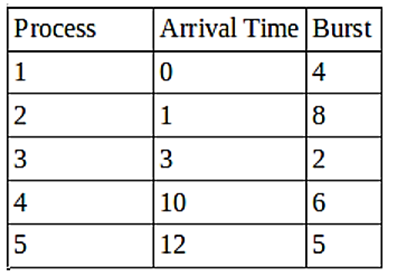
Process | Arrival Time | Burst |
|---|---|---|
1 | 0 | 4 |
2 | 1 | 8 |
3 | 3 | 2 |
4 | 10 | 6 |
5 | 12 | 5 |
A.
11.4, 2, 83.3%B.
11.6, 3.75, 80.6%C.
18.6, 3.375, 71.4%D.
None of these
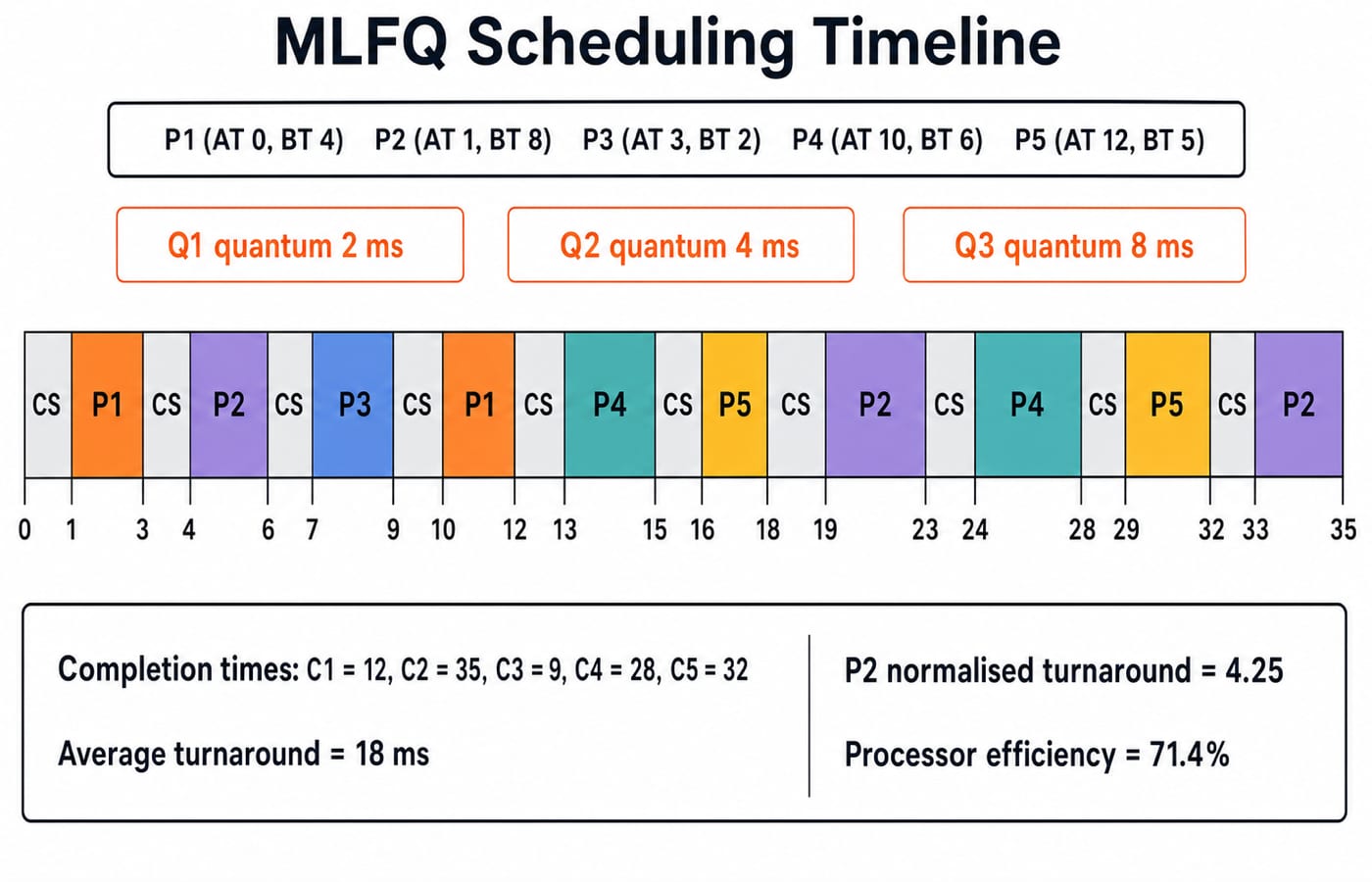
Answer: D. Read quantum = 2^i, giving 2 ms, 4 ms and 8 ms at the first three levels. With a 1 ms switch before every run, the timeline is CS 0-1, P1 1-3, CS 3-4, P2 4-6, CS 6-7, P3 7-9, CS 9-10, P1 10-12, CS 12-13, P4 13-15, CS 15-16, P5 16-18, CS 18-19, P2 19-23, CS 23-24, P4 24-28, CS 28-29, P5 29-32, CS 32-33, P2 33-35.
Completion times:
C1=12,C2=35,C3=9,C4=28,C5=32.Turnaround times, using
completion - arrival:12,34,6,18,20ms.Average turnaround:
(12+34+6+18+20)/5 = 90/5 = 18 ms.P2 normalised turnaround:
34/8 = 4.25.Useful CPU work:
4+8+2+6+5 = 25 ms; efficiency:25/35 x 100 = 71.4%.
Only C's efficiency is correct, so None of these wins.
Scheduling-policy matching and MLFQ process behaviour
Q5. Match four schedulers to their characteristic, UGC NET June 2014
Match the following :
Codes :
A.
a-i; b-iii; c-ii; d-ivB.
a-iv; b-iii; c-ii; d-iC.
a-iii; b-i; c-iv; d-iD.
a-ii; b-iii; c-iv; d-i
Answer: D. MLFQ matches movement criteria (a-ii), FCFS matches batch processing (b-iii), shortest-process-next matches exponential smoothing (c-iv), and round robin matches time-slicing (d-i). Check every pair.
Q6. Correct scheduler statements, MSQ
Which of the following statements are correct?
A.
Round robin is a pre-emptive scheduler and does not have starvation.B.
FCFS schedulers suffer from convoy effect.C.
Preemptive schedular lets the process finish its CPU burst but preempts the process when it went for I/O operation.D.
Multilevel feedback queue scheduler gives priority to I/O intensive process.
Answer: A, B and D. With P1, P2, P3 and 2 ms, round robin gives each a turn; FCFS can leave two 1 ms jobs behind one 20 ms job. Using 1 ms of 2 ms, an I/O-bound process yields and usually stays higher, so D is true. C reverses preemption: I/O blocking is voluntary; preemption interrupts a CPU burst.
MLFQ starvation control and two-level scheduling
Q7. Aging as starvation control, ISRO 2007
The term ‘aging’ refers to:
A.
boosting the priority of a process in a fixed multilevel queue without feedbackB.
tracking how long a page has been in memory for LRU replacementC.
letting a job reside in memory so its page requirement can be estimatedD.
gradually increasing the priority of jobs that wait for a long time to prevent infinite blocking
Answer: D. Aging gradually raises the priority of a process that has waited for a long time. In an MLFQ design, periodic priority boosts can prevent a process from remaining indefinitely in a low-priority queue; the other choices describe unrelated memory-management mechanisms.
Q8. Why two-level CPU scheduling is used, UGC NET December 2014
Consider the following justifications for commonly using the two-level CPU scheduling :
I. It is used when memory is too small to hold all the ready processes.
II. Because its performance is same as that of the FIFO.
III. Because it facilitates putting some set of processes into memory and a choice is made from that.
IV. Because it does not allow to adjust the set of in-core processes.
Which of the following is true ?
A.
I, III and IVB.
I and IIC.
III and IVD.
I and III
Answer: D. Here I = true, II = false, III = true, and IV = false. Two-level scheduling controls an adjustable in-memory set, then chooses among its residents.
Scheduling-order and time-quantum MCQs
Q9. Weighted mean completion-time order, GATE IT 2007
Consider n jobs J₁, J₂,......Jₙ such that job Jᵢ has execution time tᵢ and a non-negative integer weight wᵢ. The weighted mean completion time of the jobs is defined to be

sum(i=1 to n) w_i T_i / sum(i=1 to n) w_i
where Tᵢ is the completion time of job Jᵢ. Assuming that there is only one processor available, in what order must the jobs be executed in order to minimize the weighted mean completion time of the jobs?
A.
Non-decreasing order of tᵢB.
Non-increasing order of wᵢC.
Non-increasing order of wᵢtᵢD.
None-increasing order of wᵢ/tᵢ
Answer: D. Use non-increasing w_i/t_i; the option retains the typo. For A: t=2, w=10 and B: t=5, w=15, ratios 5 and 3 put A first: 10x2 + 15x7 = 125, versus 15x5 + 10x7 = 145. Division by 25 gives 5.0 versus 5.8.
Q10. Time quantum within a queue, ISRO 2020
Which of the following algorithms defines a time quantum?
A.
Shortest Job FirstB.
Round RobinC.
Priority schedulingD.
Multilevel queue scheduling
Answer: B. Round Robin defines a fixed time quantum and preempts a process when its slice expires. A multilevel queue scheduler may use Round Robin within one or more queues, but the quantum belongs to that within-queue policy rather than to the multilevel structure itself.
Multilevel queue MCQ answer audit and next practice step
Question | Correct answer | Decisive rule | Trap |
|---|---|---|---|
Q1 | B | Observed behaviour | Behaviour-based dispatch |
Q2 | B | Lower queue, longer quantum | Long quantum in low queue |
Q3 | C | MLFQ permits movement | Permanent assignment belongs to fixed MLQ |
Q4 | D | Recompute all metrics | One correct value does not make a numerical option correct |
Q5 | D | Verify all pairs | Solve every matching pair |
Q6 | A+B+D | I/O-bound priority | I/O-bound process priority |
Q7 | D | Priority rises with waiting time | Scheduling aging versus page-replacement age |
Q8 | D | Adjustable in-core set | Two-level scheduling can adjust the in-core set |
Q9 | D | Non-increasing | Ratio versus product |
Q10 | B | Round Robin uses a fixed time slice | Queue structure versus within-queue policy |
Q1 to Q3 test definitions and movement; Q4 tests timeline arithmetic; Q5 and Q6 test comparison; Q7 and Q8 test starvation control and two-level scheduling; Q9 and Q10 test ordering and within-queue policy. Attempt all 10, label misses definition, timeline, matching or boundary, then retry them after 48 hours. Below 8, redraw Q4 and review how each queue schedules its own processes.
Use GATE Guidance by Sanchit Sir for GATE or NTA-UGC-NET Paper - 2 for NET. Compare routes through GATE CS Exam Preparation. The short version: separate fixed queues from feedback, draw the timeline, and accept only fully correct options.
Keep learning

Process Basics and PCB MCQs: 12 Solved Questions with Explanations
Solve 12 Process Basics and PCB questions, then use each explanation to repair the exact concept boundary behind the correct option.
Updated 20 Oct 20268 min readOperating System MCQs

Critical Section MCQs: 12 Solved Questions on Race Conditions and Mutual Exclusion
Practise critical-section MCQs on race conditions, mutual exclusion, Bakery ordering, stale writes and priority inversion, with explanations and two complete traces.
Updated 16 Oct 20268 min readOperating System MCQs

Hardware Synchronization MCQs: 10 Solved Test-and-Set, Spinlock and Barrier Questions
Attempt 10 hardware synchronization questions, then check concise explanations of atomic instructions, busy waiting, lock failures and barrier races.
Updated 12 Oct 20267 min readOperating System MCQs
SJF and SRTF Scheduling MCQs: 11 Solved Questions with Step-by-Step Explanations
Solve 11 SJF and SRTF questions with ready-queue decisions, Gantt traces, waiting-time calculations and checked explanations.
Updated 7 Oct 20267 min read82 viewsOperating System MCQs