An enum looks like a list of labels, but one output question can combine implicit numbering, an explicit reset, duplicate values and switch fall-through. Memorising only "the first value is zero" fails when numbering begins at 2 or jumps to 7. In the worked trace, implicit numbering gives READY = 3, PAUSED = 8 and phase_score(RUNNING) = 23. Portability, bit flags and common traps require separate checks. The GATE CS Exam Preparation category provides the broader study route.
Enums in C create named integer constants and an enum type
An enumeration groups related names and gives them integer values:
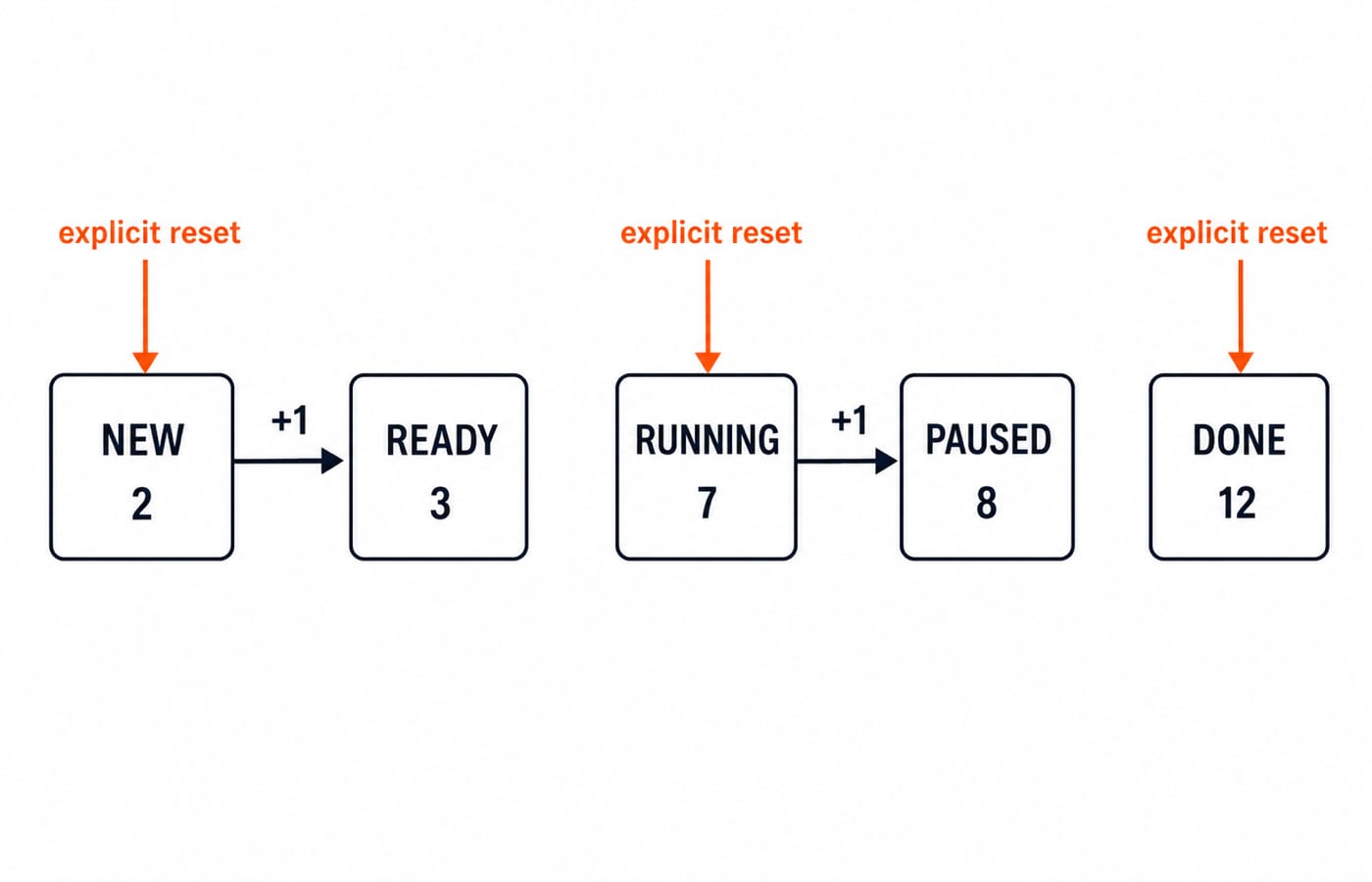
enum Phase { NEW = 2, READY, RUNNING = 7, PAUSED, DONE = 12 };The tag Phase forms the type name enum Phase. The five enumerators are named integer constants usable in constant expressions and as case labels.
The following declaration creates a variable and initialises it with one of those constants:
enum Phase current = READY;In C, enum remains part of the type spelling. enum Phase current; is valid, but bare Phase current; needs a typedef. Use an enum when a variable represents one state from a small named domain.
Enum values in C follow the previous value, not the list position
Work from left to right. An explicit initializer sets the current value, and the next unassigned name receives that value plus one.
Enumerator | Reason | Value |
|---|---|---|
| Explicitly set |
|
|
|
|
| Explicit reset |
|
|
|
|
| Explicit reset |
|
By contrast, enum Rank { BRONZE, SILVER, GOLD }; starts without an initializer, so its values are 0, 1 and 2.
Negative and duplicate values are also allowed:
enum Code { STOP = -2, WAIT, START = 5, RESUME = 5, NEXT };Here, STOP = -2, WAIT = -1, START = 5, RESUME = 5 and NEXT = 6. The duplicate names remain distinct identifiers. A switch cannot contain both as case labels because both equal 5.
The solving rule is one pass: start at 0 only if the first name has no initializer, propagate every omission as the previous value plus one, and restart from every explicit initializer.
Worked enum output trace: calculate 3 8 23 step by step
Trace this program without skipping the missing break:
#include <stdio.h>

enum Phase {
    NEW = 2,
    READY,
    RUNNING = 7,
    PAUSED,
    DONE = 12
};

int phase_score(enum Phase p) {
    int total = READY + PAUSED;

    switch (p) {
        case NEW:     total += 1; break;
        case READY:   total += 2; break;
        case RUNNING: total += 4; /* deliberate fall-through */
        case PAUSED:  total += 8; break;
        default:      total += 16;
    }
    return total;
}

int main(void) {
    printf("%d %d %d\n", READY, PAUSED, phase_score(RUNNING));
    return 0;
}
First fill the enum values. READY follows NEW = 2, so READY = 3. PAUSED follows RUNNING = 7, so PAUSED = 8. The first two printed values are therefore 3 and 8.
Inside phase_score, the initial total is:
total = READY + PAUSED = 3 + 8 = 11The argument is RUNNING, whose value is 7, so control enters case RUNNING. Adding 4 changes the total from 11 to 15. That arm has no break, so execution falls through into case PAUSED even though p is not PAUSED. Adding 8 gives 15 + 8 = 23, and the following break exits the switch. The function returns 23, so the exact output is:
3 8 23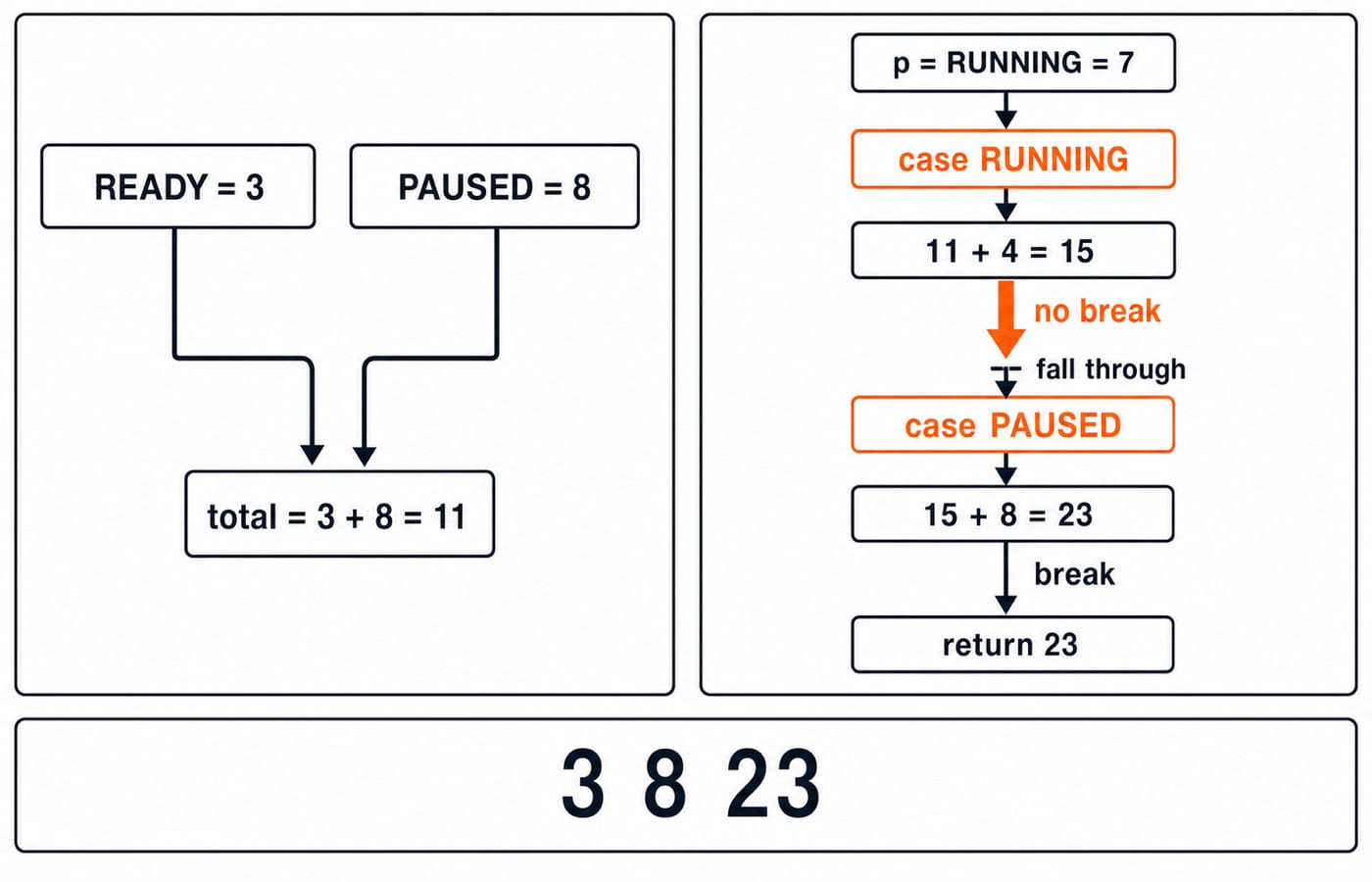
Enum variables need validation, and enum storage is not fixed
The names do not make an enum a closed runtime set. enum Phase p = (enum Phase)5; has no matching enumerator. Validate external input with a switch that lists recognised states and rejects everything else in default.
Do not assume sizeof(enum Phase) == 4 or that it equals sizeof(int). The implementation chooses a compatible integer type that represents the declared values. Displaying it as printf("%d", (int)current); makes the conversion explicit.
Use READY because it communicates a state, not because of an assumed byte width. For files, network messages or APIs, define the wire numbers deliberately and validate them instead of copying raw enum object bytes.
Enum, typedef, macros and bit flags solve different problems
A typedef shortens the type spelling:
typedef enum Phase Phase;
Phase next = DONE;
It does not create another enum, duplicate the enumerators or change DONE = 12. A macro such as #define READY 3 is also different. It performs token replacement and provides no enum type grouping. C enumerator names are unscoped within the ordinary identifier namespace, so another enum in the same scope cannot declare another enumerator named READY.
Enums can name individual bits when every value is a power of two:
enum Permission { READ = 1 << 0, WRITE = 1 << 1, EXECUTE = 1 << 2 };
unsigned mask = READ | EXECUTE;
This gives READ = 1, WRITE = 2 and EXECUTE = 4. Therefore mask = 1 | 4 = 5. The test (mask & WRITE) == 0 is true, while (mask & EXECUTE) == 4 is also true. Store combinations in an unsigned mask because 5 combines two permissions rather than naming one permission enumerator. Do not use the sequential Phase values as flags.
Common C enum traps and the correction for each
Trap | What goes wrong | Correction |
|---|---|---|
Assume the first value is | An uninitialised first enumerator actually starts at | Write the first value before tracing |
Count list positions | Explicit resets are ignored | Propagate from the previous value: |
Reject duplicate values | Valid declarations look invalid | Allow |
Skip a missing | The worked total stops at | Continue into |
Write |
| Write |
Assume every enum uses four bytes | Code depends on a non-portable size | Treat storage choice as implementation-dependent |
Reuse | The identifier collides in the same scope | Choose a distinct enumerator name |
A C question normally needs enum Phase unless a typedef exists. It also does not use C++ scoped-enum syntax such as enum class. Apply the rules of the language named in the question.
Enum exam questions test value filling, declarations and control flow
Recurring question forms include filling values after resets, predicting output, finding duplicate case values, choosing a valid C declaration, distinguishing a typedef from an enumerator, testing a bit mask and rejecting a fixed-size assumption. KnowledgeGate currently offers about 3 practice questions on Enums, so treat that as a small practice signal rather than evidence of topic frequency.
Try this rapid check:
enum E { A, B = 4, C, D = 4, F };The values are A = 0, B = 4, C = 5, D = 4 and F = 5. Therefore C + F = 5 + 5 = 10. A proposed switch containing both case C: and case F: is invalid because both labels equal 5.
After solving the enum logic, use MCQ, MSQ or NAT? GATE Question Types Explained to decide whether the answer is entered as an MCQ, MSQ or NAT response. Do not infer enum frequency or weightage from a three-question practice set; exam-specific claims require the relevant official notification.
Enums in C: the short version and next step
For a reliable trace, write every explicit value, propagate each omitted value as the previous value plus one, mark duplicate numbers, validate values at input boundaries, and follow every switch arm through its break. Here, READY = 3, PAUSED = 8, phase_score(RUNNING) = 23, and READ | EXECUTE = 5. For a structured route through C declarations, control flow, functions, structures and practice, use the C Language Course: Concepts, MCQs and Coding. Or change RUNNING = 7 to RUNNING = 9: PAUSED becomes 10, and 3 + 10 + 4 + 8 = 25, so the output becomes 3 10 25.