Closure Properties in Theory of Computation: Proof Methods, Worked Examples and Exam Traps
Learn how to prove closure with machine constructions and disprove it with counterexamples across regular, context-free, decidable and recognisable languages.
KnowledgeGate Team
Exam prep & CS education
Updated 22 Sep 20265 min read
Memorising a yes or no closure table is fragile because the answer changes with both the language class and the operation. A safer method is to construct a machine when closure holds, or produce a standard counterexample when it fails. This guide covers regular, context-free, decidable and Turing-recognisable languages, while the Semester & College Exam Courses collection places the topic in the wider CS curriculum.
Closure properties: what the definition actually quantifies
A class of languages is closed under a binary operation if, for every , the language also belongs to . For a unary operation such as complement, Kleene star or reversal, closure means that applying the operation to every language in keeps the result in .
The quantifier “for every” matters. One successful pair cannot prove closure, but one valid pair whose result leaves the class disproves it.
Keep three questions separate:
What does the operation do to the strings or languages?
Does the resulting language belong to the class?
What construction or counterexample proves that class-level claim?
Positive proofs usually build a machine of the required type. Negative proofs choose members of the class whose result is a known non-member.
Language operations: calculate before naming a theorem
Let and over . Then
\[
.
\]
A complement cannot be calculated until its universe is fixed, normally as .
For concatenation, calculate every pair:
and
and
and
Therefore,
\[
L_1L_2=\{1,01,001,111,1101\}.
\]
The string appears once because a language is a set, even though two pairs generate it. Union collects existing strings. Concatenation joins one string from the first language to one from the second.
Regular-language closure: a product-DFA example
Let contain binary strings ending in 0. Its DFA has , the non-final start state, and final state . On 0, either state moves to ; on 1, either moves to .
Let contain strings with an even number of 1s. State is initial and final, while is non-final. A 0 leaves the state unchanged and a 1 toggles .
For , form product states , , and . Start at ; only is final.
State | On 0 | On 1 |
|---|---|---|
Trace exactly:
\[
S_0\xrightarrow{1}S_1\xrightarrow{0}S_3\xrightarrow{1}S_0\xrightarrow{0}S_2.
\]
The trace ends in , so is accepted.
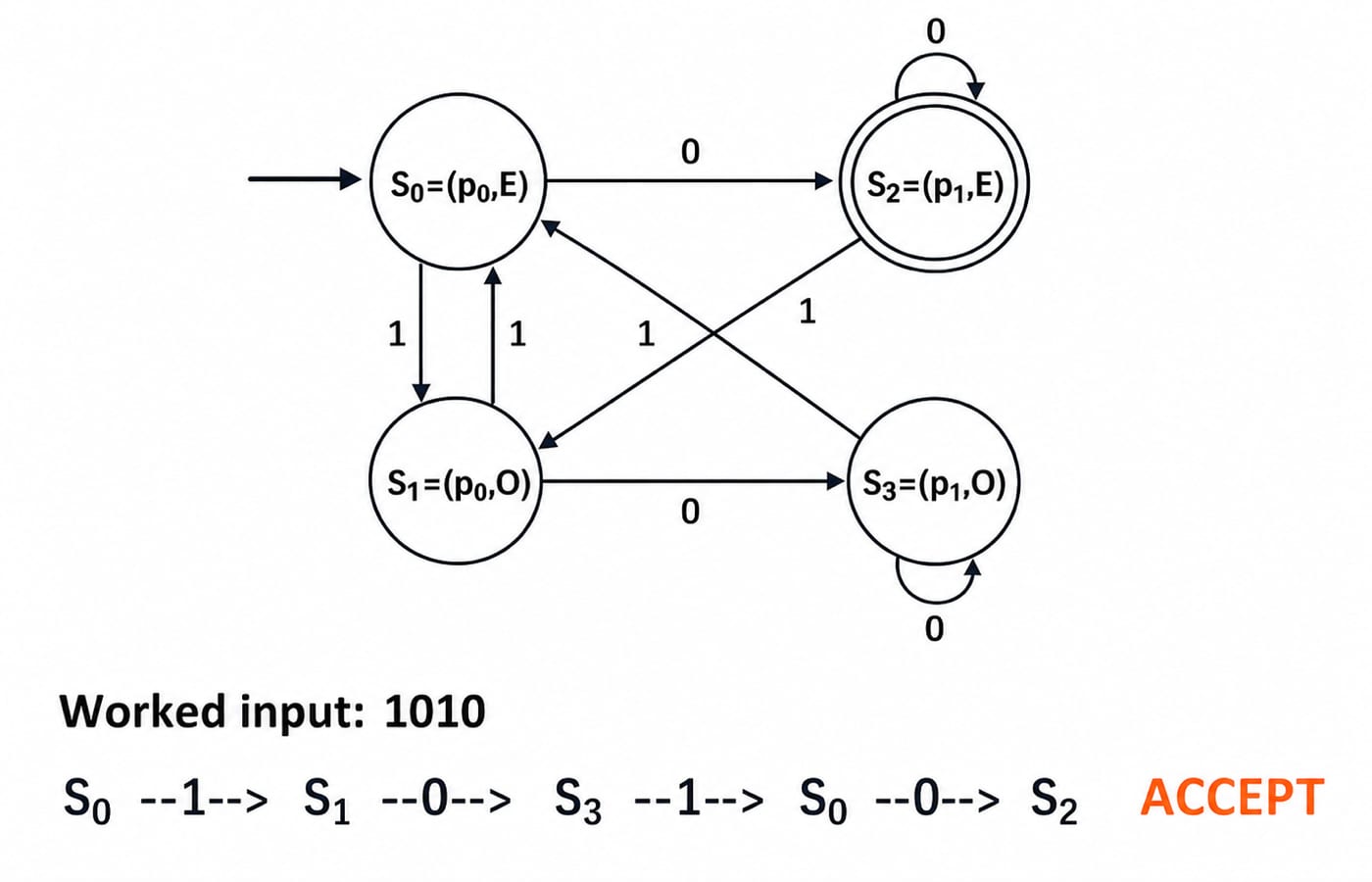
Changing the final product states proves closure under union or difference. The Regular Language Properties: Closure and Decision Tests guide develops the wider construction toolkit.
Closure-properties comparison table
Operation | Regular | Context-free | Decidable | Turing-recognisable |
|---|---|---|---|---|
Union | Yes | Yes | Yes | Yes |
Intersection | Yes | No | Yes | Yes |
Complement | Yes | No | Yes | No |
Difference | Yes | No | Yes | No |
Concatenation | Yes | Yes | Yes | Yes |
Kleene star | Yes | Yes | Yes | Yes |
Reversal | Yes | Yes | Yes | Yes |
Precision point: Context-free languages are closed under intersection with a regular language, although they are not closed under arbitrary CFL intersection. Also, , so complement and intersection help explain the difference row.
Use the table for recall, not as the proof. An unfamiliar variation should be settled by a construction or counterexample.
Context-free non-closure: force three counts to agree
Consider
\[
.
\]
A grammar is , , . It matches the number of s and s. Similarly,
\[
\]
is generated by , , . It matches the number of s and s. Each language is context-free because each grammar manages one matched pair of counts.
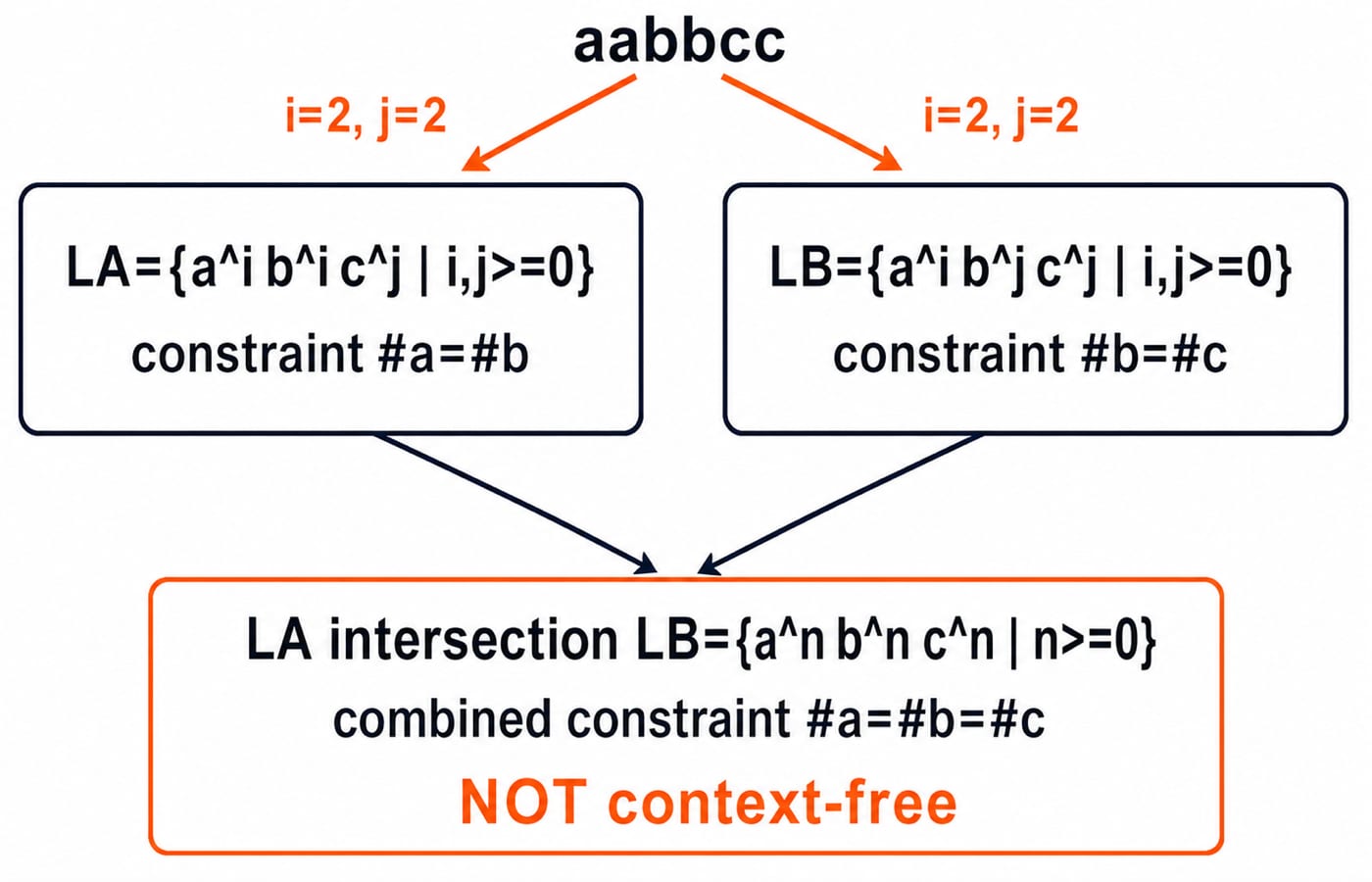
Membership in enforces , while membership in enforces . Thus both constraints together give
\[
L_A\cap L_B=\{a^n b^n c^n\mid n\ge0\},
\]
which is not context-free. For , satisfies both input constraints. That string illustrates the equality, but the whole non-context-free intersection language is the counterexample.
The Context-Free Grammars and PDAs: CNF, GNF, Pumping Lemma guide covers the machinery for recognising and disproving CFL claims.
Turing-machine closure: deciders and recognisers
For decidable languages, let and halt on every input. Run both deciders for union and accept if either accepts. For intersection, accept only if both accept. For complement, run and swap its accept and reject outcomes. Guaranteed halting makes each construction safe.
Recognisers require more care because one may loop on a non-member. For recognisable union, dovetail and by alternating one transition from each, then accept when either accepts. For intersection, record each acceptance and accept after both have occurred.
Why does complement fail? is recognisable but undecidable. If it and its complement were both recognisable, dovetailing their recognisers would always reveal which side contains the input and would therefore decide , a contradiction. The Turing Machines and Decidability: Halting Problem Proof article develops the adjacent proof ideas.
Closure-properties question patterns and traps
Check these four statements:
P: Regular languages are closed under complement. True, because a complete DFA can have its final and non-final states swapped.
Q: Context-free languages are closed under intersection. False, as the counterexample shows.
R: A context-free language intersected with a regular language is context-free. True, using a PDA and DFA product construction.
S: Turing-recognisable languages are closed under complement. False, as the argument shows.
The answer is P and R only.
Typical forms include selecting correct statements, matching a class to an operation, supplying a counterexample and choosing a machine construction. Three traps deserve special attention:
Flipping final states in an incomplete DFA. First add a dead state and complete every transition, then flip.
Treating one successful pair as proof. Closure quantifies over every pair in the class.
Running one recogniser until it halts before starting the other. Alternate their steps by dovetailing.
Closure properties: the short decision method
Ask four questions: What is the language class? What operation is applied? Can I build a machine that remains in the class? If not, can I force a known non-member with a counterexample? For Turing machines, add one decisive question: must the machine halt, or only recognise?
The proof anchors are compact: product construction for regular intersection, for CFL non-closure, and dovetailing for recognisable union and intersection. After learning the method, use the over 30 published Closure Properties questions for varied practice.
The Theory Of Computation / Automata Theory course is the structured next step for connecting closure properties to automata, grammars, Turing machines, decidability and practice.
Keep learning
Linear Bounded Automata: Tape Limits, a Worked LBA Trace and Exam Traps
See exactly what an LBA bounds, where it sits in the language hierarchy, and how a six-cell marking machine accepts aabbcc while rejecting three near misses.
Updated 4 Oct 20266 min readTheory of Computation
Decision Properties in Theory of Computation: DFA Tests, CFG Boundaries and Turing Machine Undecidability
Learn an algorithm-first way to classify membership, emptiness, finiteness, inclusion, equivalence and universality for DFAs, CFGs and Turing machines.
Updated 29 Sep 20266 min readTheory of Computation
FA to Regex Conversion: State Elimination with a Fully Worked Example
Learn a mechanical state-elimination method for converting a finite automaton to a regular expression, then verify the result with a second order and short strings.
Updated 25 Sep 20265 min readTheory of Computation
Epsilon NFA Conversion: Epsilon-Closure, Worked DFA Table and Exam Traps
Learn a mechanical epsilon-NFA conversion method through one four-state machine, complete set traces, a reachable-subset DFA table, and epsilon elimination.
Updated 24 Sep 20266 min readTheory of Computation