CFL Identification: Decision Rules, Worked Examples and Exam Traps
Learn a repeatable way to classify context-free languages, from constructive grammar and stack evidence to safe closure arguments and a complete non-CFL proof.
KnowledgeGate Team
Exam prep & CS education
Updated 19 Sep 20267 min read
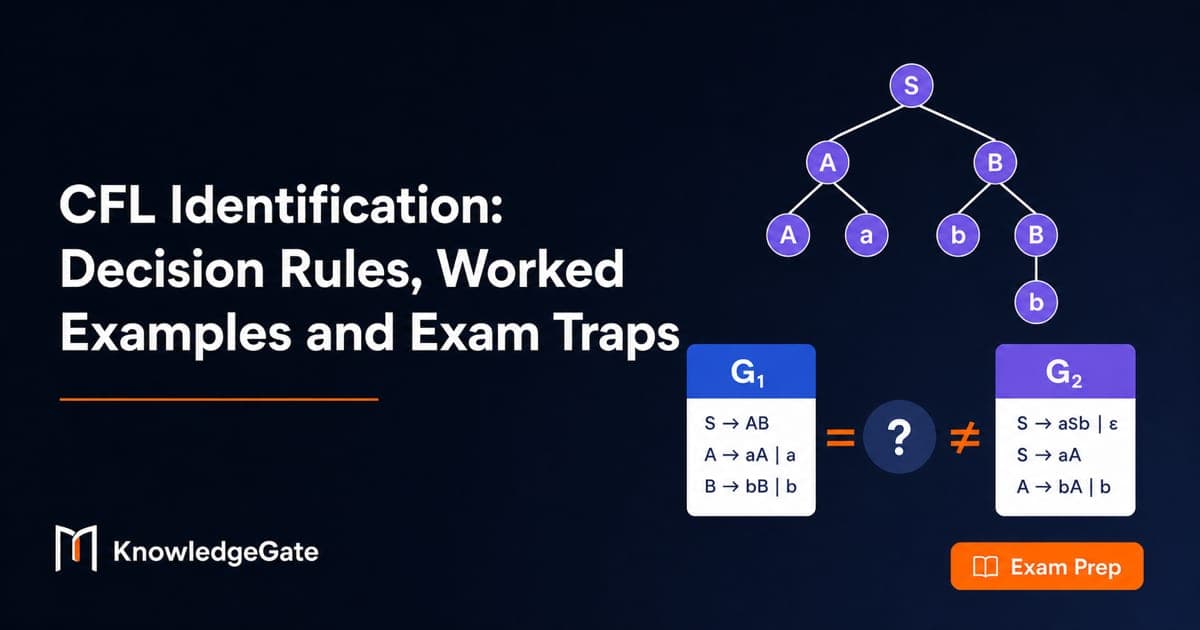
Learners often treat every language with counting as non-context-free, even though a pushdown automaton can handle one unbounded dependency very well. A better method uses constructive CFG or PDA evidence, closure properties, and a complete pumping-lemma proof instead of guesses from surface notation. We will contrast i=j or j=k with i=j and j=k, then use the marked mirror language w#w^R to make the stack idea concrete. The wider CS Fundamentals track places this topic alongside the foundations it depends on.
1. CFL identification starts with the language hierarchy
The strict containment chain is:
Regular languages ⊂ DCFL ⊂ CFL
Both containments are proper. A DFA or regular expression proves the language is context-free. Proving it non-regular does not prove it non-context-free.
Positive certificates are exact constructions. A context-free grammar that generates precisely L, or a pushdown automaton that recognises precisely L, proves that L is context-free. For example,
L1 = {a^n b^n | n >= 0}
is not regular, but the grammar S -> aSb | epsilon proves that it is a CFL. In contrast,
L2 = {a^n b^n c^n | n >= 0}
requires three blocks to share one unbounded count and is not context-free. “One equality versus two linked equalities” is a useful warning signal, not a theorem. A construction or proof must carry the conclusion.
2. Look for a construction before proving non-context-freeness
Start with four questions:
Is there one nested or paired dependency?
Is there a separator that tells a PDA when to switch modes?
Can a recursive CFG generate exactly the required pairing?
Does the construction accept a member and reject a near miss?
If the grammar-stack equivalence is unfamiliar, first review Context-Free Grammars and Pushdown Automata.
Consider the marked mirror language M = {w#w^R | w in {0,1}*}. It has the grammar S -> 0S0 | 1S1 | #. One derivation is:
S => 0S0 => 00S00 => 001S100 => 001#100
The PDA view is just as direct. It pushes 0,0,1 before #, switches mode at #, then pops against 1,0,0.
With stack top at the left and bottom marker Z, the exact trace is:
Z -> 0Z -> 00Z -> 100Z -> 100Z -> 00Z -> 0Z -> Z -> accept
The unchanged 100Z step consumes #. The near miss 001#010 is rejected immediately after the separator because the next input is 0 while the stack top is 1.
3. Fully worked CFL identification: why OR differs from AND
Classify
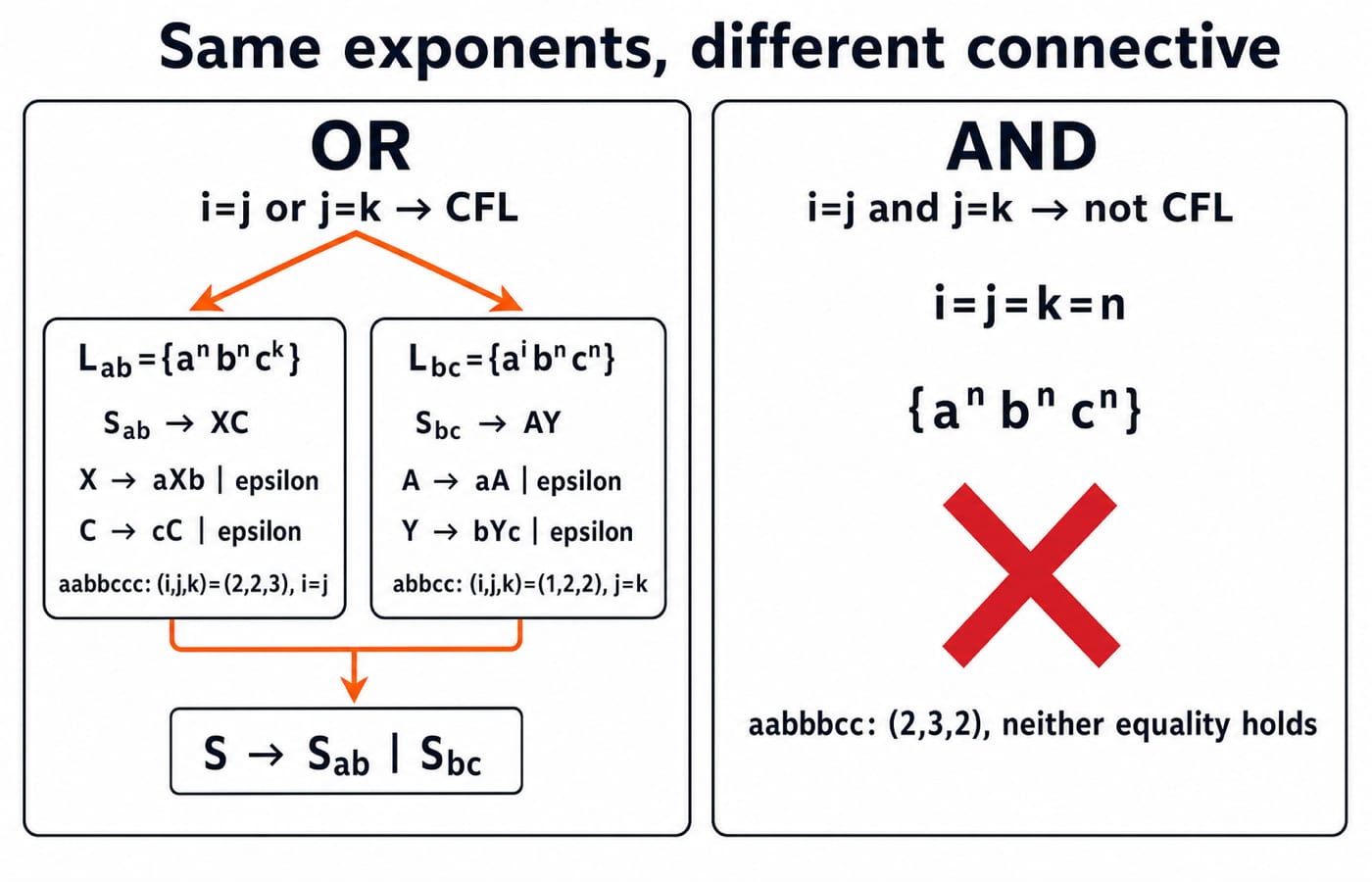
L_or = {a^i b^j c^k | i=j or j=k; i,j,k >= 0}.
Split it into a union. For the i=j branch, use
L_ab = {a^n b^n c^k | n,k >= 0}
with S_ab -> XC, X -> aXb | epsilon, and C -> cC | epsilon. For the j=k branch, use
L_bc = {a^i b^n c^n | i,n >= 0}
with S_bc -> AY, A -> aA | epsilon, and Y -> bYc | epsilon. Add the start rule S -> S_ab | S_bc. CFLs are closed under union, so this exact grammar proves that L_or is context-free.
Check both branches. For aabbccc, (i,j,k)=(2,2,3), so i=j:
S => S_ab => XC => aXbC => aaXbbC => aabbC => aabbcC => aabbccC => aabbcccC => aabbccc
For abbcc, (i,j,k)=(1,2,2), so j=k:
S => S_bc => AY => aAY => aY => abYc => abbYcc => abbcc
Now test aabbbcc, with (2,3,2). Neither 2=3 nor 3=2, so neither branch generates it. Change only the connective:
L_and = {a^i b^j c^k | i=j and j=k} = {a^n b^n c^n}.
This language is not context-free. The or lets a grammar choose one dependency. The and demands both dependencies across the same three blocks.
4. Use closure properties only in valid directions
CFLs are closed under | CFLs are not closed in general under |
|---|---|
Union, concatenation, Kleene star | Intersection with another CFL |
Reversal, homomorphism, inverse homomorphism | Complement, difference |
Intersection with a regular language |
“Not closed” means that some pair produces a result outside the class. It does not mean every pair does.
For the key warning, take C1 = {a^i b^i c^j | i,j >= 0} and C2 = {a^i b^j c^j | i,j >= 0}. Each is context-free, but
C1 intersection C2 = {a^n b^n c^n | n >= 0},
which is not context-free. Therefore, “CFL intersect CFL is CFL” is false.
The useful safe inference runs one way: if L were context-free and R is regular, then L intersection R would be context-free. That supports contradiction proofs. Finding a regular or context-free subset after an intersection does not prove that the original language is context-free.
5. Pumping-lemma proof that {a^n b^n c^n} is not a CFL
The quantifier order matters. If L is context-free, some pumping length p exists such that every s in L with |s| >= p has a decomposition s=uvxyz satisfying |vxy| <= p, |vy| > 0, and u v^t x y^t z in L for every t >= 0. A non-CFL proof must defeat every legal decomposition, not select one convenient split.
Assume L={a^n b^n c^n} is context-free and choose s=a^p b^p c^p. The window vxy has length at most p, so it cannot touch both the a block and the c block. Such a window would have to cross all p copies of b and include symbols on both sides, making it longer than p. Therefore, v and y together can alter symbols from at most two adjacent block types.
Pump down with t=0. At least one count decreases because |vy|>0, while at least one untouched block remains at count p. The three counts cannot all be equal, so uxz lies outside L for every legal decomposition. This contradiction proves that L is not context-free.
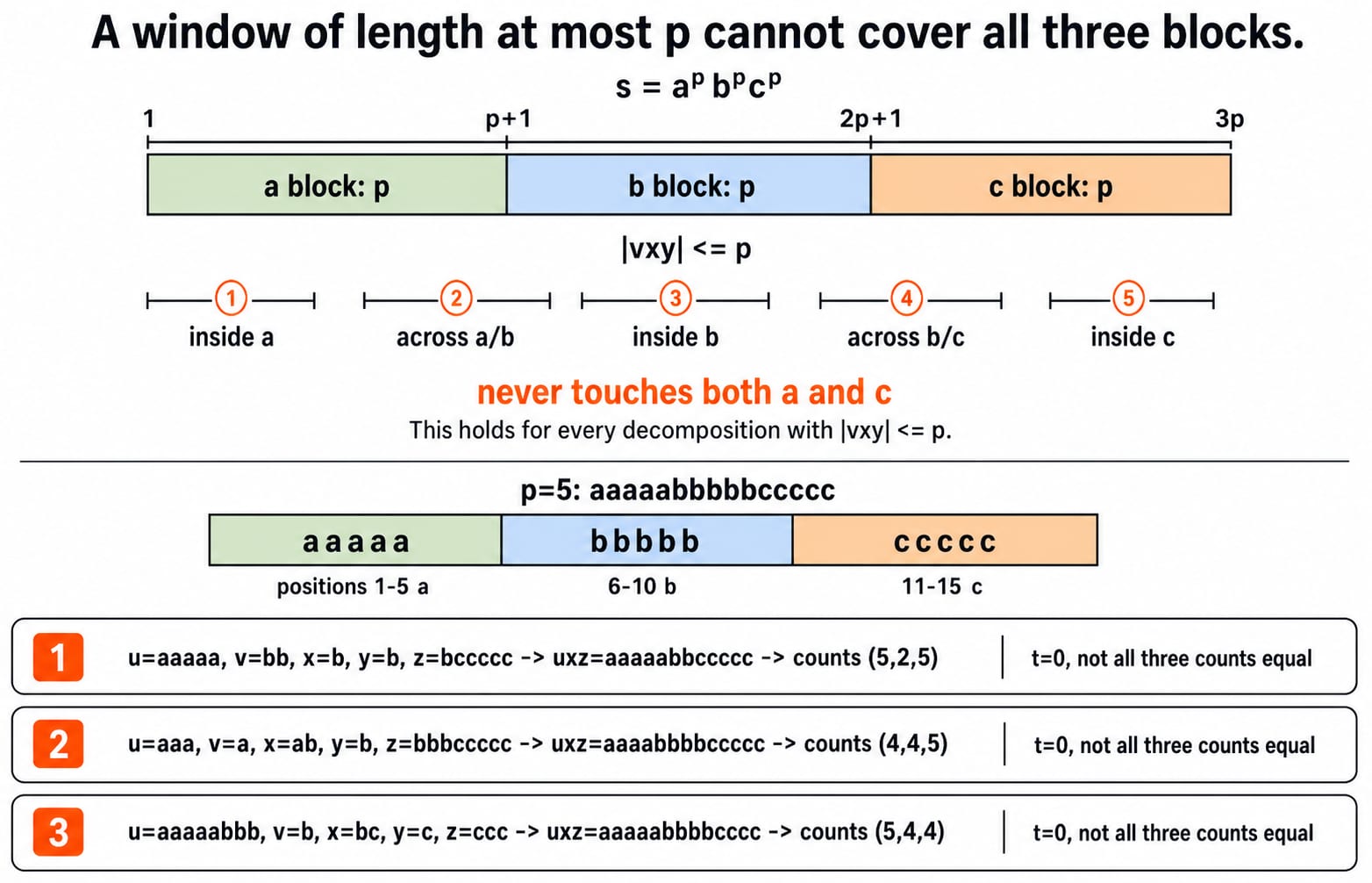
The boundary is important: the pumping lemma can disprove CFL membership. Satisfying a few chosen decompositions never proves that a language is context-free.
6. A shorter non-CFL proof using a regular filter
Define
E = {w in {a,b,c}* | count_a(w)=count_b(w)=count_c(w)}.
The string abcabc belongs to E, even though its letters are interleaved. Now apply the regular filter R=a*b*c*, which retains only strings with every a before every b, and every b before every c. The intersection is exactly
E intersection R = {a^n b^n c^n | n >= 0}.
For a checkpoint, aabbcc is in both sets with counts (2,2,2), while abcabc is removed by R. If E were context-free, closure under intersection with a regular language would make the intersection context-free. Section 5 proves the opposite, so E is not context-free.
Stack order also explains a useful benchmark contrast. The marked mirror w#w^R is a CFL because the separator triggers a reverse-order pop. COPY={ww | w in {0,1}*} is not a CFL because it demands the same order.
7. Exam-style patterns, traps, and a 60-second routine
Prompts may ask for classification, a closure rule, CFG matching, a pumping-proof diagnosis, or mirror versus copy.
Use this 60-second routine:
First 15 seconds: translate
or,and, reverse, separator, and equal counts.Next 20 seconds: seek a DFA, CFG, PDA, or union of CFLs.
Next 15 seconds: apply only valid closure moves.
Final 10 seconds: if construction fails, select a non-CFL proof.
For i=j or j=k, split into the two grammars from Section 3 and stop: it is a CFL.
Watch these traps:
Counting means non-CFL. One stack can compare one nested dependency.
Non-regular means non-CFL. Regular languages are a proper subset of CFLs.
Non-closure makes every CFL intersection non-CFL. Non-closure is not a result about every pair.
One bad split defeats pumping. The proof must defeat every legal decomposition.
KnowledgeGate has a rounded pool of 70+ published practice questions tagged to CFL Identification. Continue with Context-Free Grammar MCQs: 11 Solved GATE Questions, then test the proof logic with Pumping Lemma MCQs: 12 Solved Questions.
8. CFL identification: the short version and next step
Construct first. Split an or, exploit a separator or reversal, use only valid closures, then prove a negative with a regular filter or a correctly quantified pumping argument. The anchors are: {a^n b^n} is CFL, i=j or j=k is CFL, and {a^n b^n c^n} is not CFL. Re-derive both OR-branch grammars and the p=5 illustration without looking.
For a focused continuation, use Theory Of Computation / Automata Theory. For the broader exam-preparation route, use GATE Guidance by Sanchit Sir.
Keep learning
Linear Bounded Automata: Tape Limits, a Worked LBA Trace and Exam Traps
See exactly what an LBA bounds, where it sits in the language hierarchy, and how a six-cell marking machine accepts aabbcc while rejecting three near misses.
Updated 4 Oct 20266 min readTheory of Computation
Decision Properties in Theory of Computation: DFA Tests, CFG Boundaries and Turing Machine Undecidability
Learn an algorithm-first way to classify membership, emptiness, finiteness, inclusion, equivalence and universality for DFAs, CFGs and Turing machines.
Updated 29 Sep 20266 min readTheory of Computation
FA to Regex Conversion: State Elimination with a Fully Worked Example
Learn a mechanical state-elimination method for converting a finite automaton to a regular expression, then verify the result with a second order and short strings.
Updated 25 Sep 20265 min readTheory of Computation
Epsilon NFA Conversion: Epsilon-Closure, Worked DFA Table and Exam Traps
Learn a mechanical epsilon-NFA conversion method through one four-state machine, complete set traces, a reachable-subset DFA table, and epsilon elimination.
Updated 24 Sep 20266 min readTheory of Computation