

Bounded and Unbounded Lattices: Distributive, Complemented and Boolean Algebra Examples
Learn a reliable property-by-property method for classifying lattices, with a complete divisor-lattice calculation and counterexamples that separate common implications.
KnowledgeGate Team
Exam prep & CS education
Updated 7 Nov 20266 min read

A poset may have a meet and join for every pair without having a global bottom or top. Bounded, distributive, complemented, and Boolean are separate labels. Each property has a separate test, divisor lattices provide a complete calculation, and definitions can break two tempting implications that a diagram's overall shape might suggest. If partial orders, least upper bounds, or greatest lower bounds feel uncertain, revise set theory and relations first. For Hasse construction and the basic LUB/GLB test, use Lattices and Hasse Diagrams for GATE; once those operations exist, the separate task is to classify the lattice as bounded, distributive, complemented, or Boolean.
Lattice prerequisite: every pair needs one meet and one join
A partially ordered set (L, <=) is a lattice when every pair x,y has a unique greatest lower bound, x meet y, and unique least upper bound, x join y, inside L. Common bounds alone are not enough.
For D_6 = {1,2,3,6} under divisibility, 2 meet 3 = gcd(2,3) = 1 and 2 join 3 = lcm(2,3) = 6. Other pairs also work, so D_6 is a lattice. In {2,3,6}, 2 and 3 have no internal lower bound. It is not a lattice.
Meet and join are idempotent, commutative, associative, and obey absorption:
x meet (x join y) = xx join (x meet y) = x
Order and operations agree: x <= y exactly when x meet y = x, equivalently when x join y = y.
Bounded versus unbounded: global endpoints are separate
A bounded lattice has least element bottom and greatest element top, with bottom <= x <= top for every x. Texts often call them 0 and 1, but these are order labels. In D_6, bottom is 1 and top is 6.
The integers Z under their usual order form an unbounded lattice: meet is min and join is max. For -3 and 4, they are -3 and 4. Every integer k has k-1 below and k+1 above, so no global endpoints exist.
Infinite does not mean unbounded. [0,1] with min and max is infinite and bounded. Conversely, every non-empty finite lattice is bounded because repeated finite meets and joins produce global bottom and top.
Fully worked classification: divisors of 72
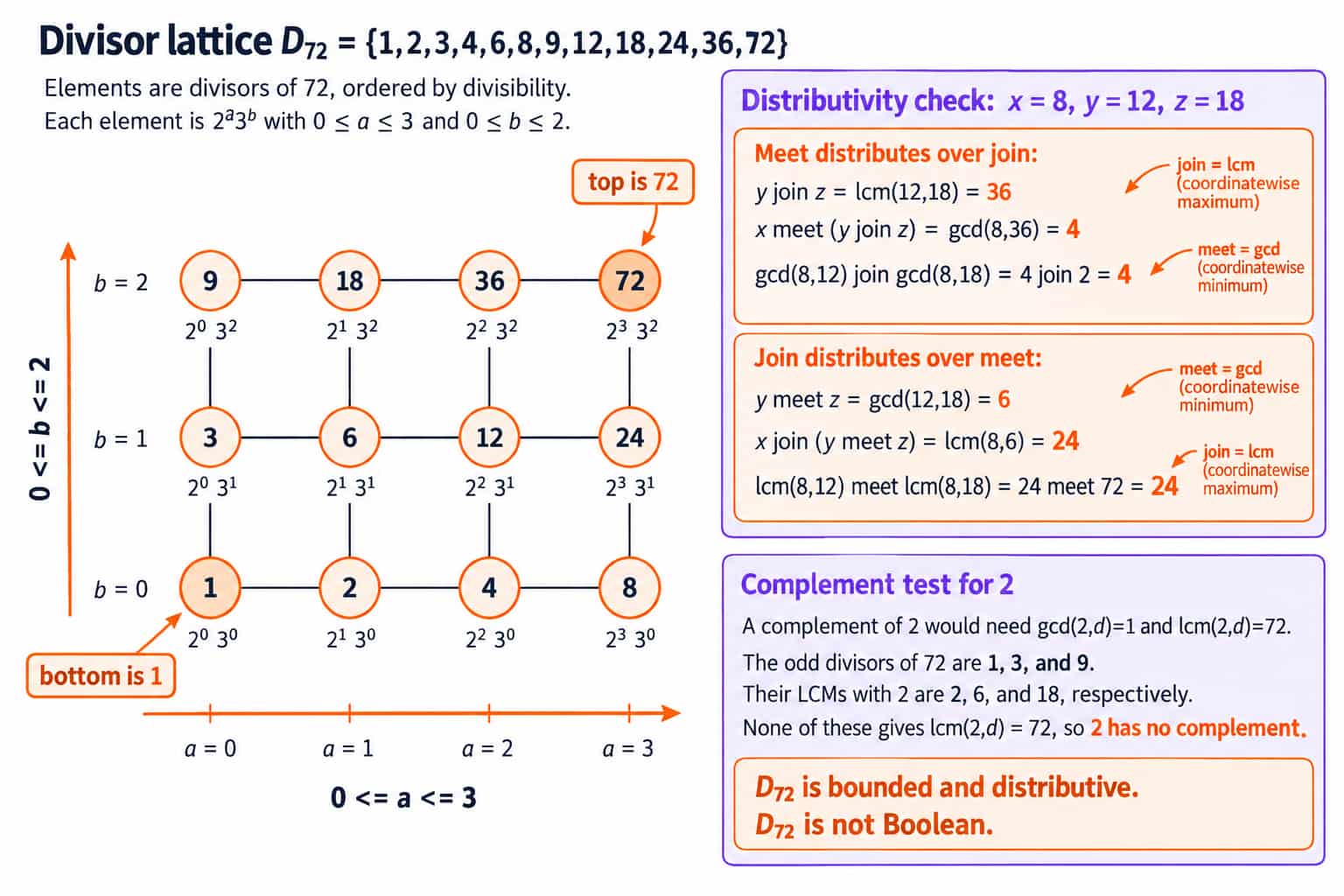
Take D_72 = {1,2,3,4,6,8,9,12,18,24,36,72} under divisibility. Every element has the form 2^a 3^b with 0 <= a <= 3 and 0 <= b <= 2. GCD takes the smaller exponent in each coordinate, while LCM takes the larger. Both results remain in the set, so D_72 is a lattice. Its bottom is 1 and its top is 72.
For x=8, y=12, z=18, calculate both distributive identities:
y join z = lcm(12,18) = 36, sox meet (y join z) = gcd(8,36) = 4. The other side isgcd(8,12) join gcd(8,18) = 4 join 2 = 4.y meet z = gcd(12,18) = 6, sox join (y meet z) = lcm(8,6) = 24. The other side islcm(8,12) meet lcm(8,18) = 24 meet 72 = 24.
One triple illustrates the identities. The exponent-pair model proves them for every triple because coordinatewise minimum and maximum distribute on a chain. Therefore D_72 is bounded and distributive.
It is not complemented. A complement of 2 would need gcd(2,d)=1 and lcm(2,d)=72. The odd divisors 1, 3, and 9 satisfy the first condition, but their LCMs with 2 are 2, 6, and 18. Thus 2 has no complement, and D_72 is not Boolean.
Test distributive, complemented, and Boolean in order
Distributivity requires both identities for all triples:
x meet (y join z) = (x meet y) join (x meet z)x join (y meet z) = (x join y) meet (x join z)
In a bounded lattice, x' complements x only when x meet x' = bottom and x join x' = top. Both equations are compulsory. Complements are unique in a bounded distributive lattice, although an element may have several complements when distributivity is absent.
A Boolean algebra is a bounded, distributive, complemented lattice. The eight three-bit vectors form one: meet is bitwise AND, join is bitwise OR, bottom is 000, top is 111, and complement flips every bit.
For x=101 and y=011, x meet y = 001, x join y = 111, and x' = 010. Bitwise AND and OR distribute, and every vector has exactly one bit-flipped complement. This Boolean algebra is also isomorphic to the power set of a three-element set.
Two counterexamples separate the labels
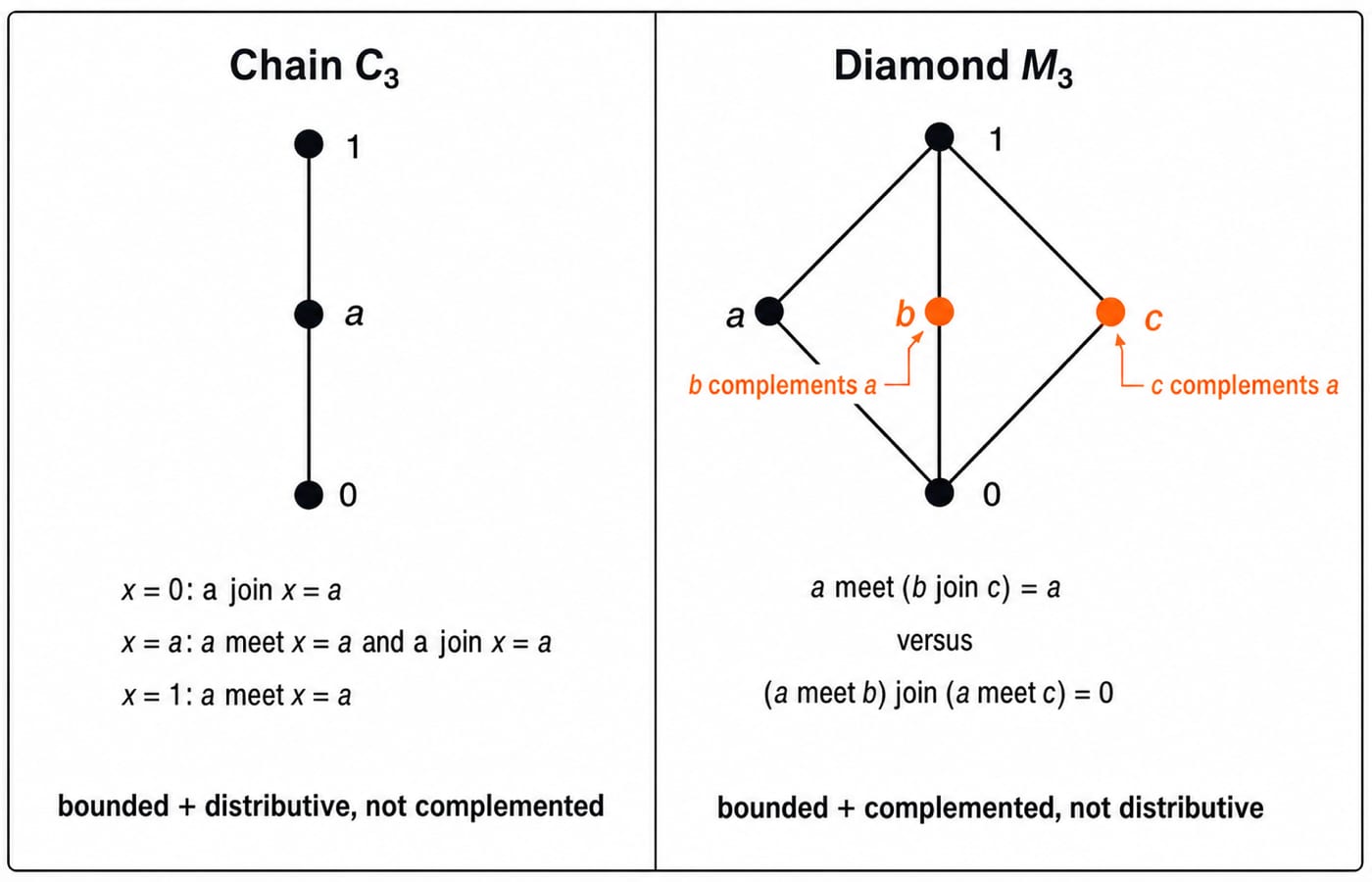
The chain C_3 = {0 < a < 1} is bounded and distributive because meet is min and join is max. But a has no complement. Candidate 0 gives a join 0 = a; candidate 1 gives a meet 1 = a; and candidate a reaches neither required endpoint. So bounded plus distributive does not imply complemented or Boolean.
The diamond M_3 = {0,a,b,c,1} has three incomparable atoms. Distinct atoms meet at 0 and join at 1; 0 and 1 complement each other. Both b and c complement a. Yet with x=a, y=b, z=c,
a meet (b join c) = a meet 1 = a,
while
(a meet b) join (a meet c) = 0 join 0 = 0.
Since a != 0, distributivity fails. Complemented does not imply distributive, so M_3 is not Boolean.
Common lattice traps and their corrections
Confusing pairwise values with global bounds. In
D_72,8 meet 12 = 4, but bottom is 1. A meet depends on the pair; bottom works for every element.Checking one complement equation. In
C_3,a meet 0 = 0, buta join 0 = a. Both equations are compulsory.Assuming one label implies another.
C_3andM_3disprove the tempting implications. Check lattice, bounds, distributivity, then complements.Trusting any divisibility subset.
D_72is closed under GCD and LCM, but{8,12,18,72}omitsgcd(8,12)=4, so the meet is missing. Abstract diagram labels also need not follow ordinary numeric size.
How questions test these lattice properties
Typical tasks ask whether a Hasse diagram is a lattice, request bounds, meets, joins, or complements, test distributivity, reject an implication with C_3 or M_3, or present a power-set or divisor lattice for classification. Confirm paper-specific coverage in the current official syllabus or notification.
Use this scratch order: check troublesome pairs for one meet and join, find global bounds, test both complement equations, then prove or disprove distributivity. One failed pair or triple settles a negative result.
As a mini-check, D_6 has bounds 1 and 6, complement pairs 1 <-> 6 and 2 <-> 3, and a prime-set map to P({2,3}). It is Boolean. The subset {2,3,6} fails at the first lattice test. The solved Set Theory and Relations MCQs provide adjacent practice.
The short version and the next step
The ladder is fixed: every pair needs a meet and join; bounded adds global endpoints; complemented gives every element a partner reaching both endpoints; distributive requires both identities; Boolean needs all three properties. Keep D_72 as bounded and distributive but not complemented, three-bit vectors as Boolean, Z as unbounded, C_3 as not complemented, and M_3 as not distributive.
Write each divisor of 72 as 2^a 3^b, recompute both identities for 8, 12, 18, and prove that 2 has no complement. Then reject M_3 using the mismatch a versus 0.
For broader study, explore GATE CS courses and preparation. For a structured sequence including Discrete Mathematics and Relations, GATE Guidance by Sanchit Sir can organise the wider preparation path.
Go deeper with the full courseEngineering Mathematics for GATE Exam
Keep learning

Lattice and Boolean Algebra MCQs: 10 Solved Questions on Bounded, Distributive and Complemented Lattices
Work through ten solved lattice problems in MCQ, MSQ, NAT and fill-blank form, with a four-test method for deciding whether a poset is a lattice or a Boolean algebra.
Updated 30 Oct 20268 min read182 viewsDiscrete Mathematics MCQs
Function Equivalence MCQs: 12 Solved Boolean Algebra Problems
Solve 12 function-equivalence questions step by step, from De Morgan's law and absorption to minterm sets, counterexamples and a four-option MSQ.
Updated 30 Oct 20268 min readDigital Electronics MCQs
Function Equivalence in Boolean Algebra: Three Proof Methods for GATE
Two Boolean expressions can look different yet describe the same function. Prove equivalence exactly with a truth table, Boolean algebra, a K-map, or an XOR miter.
Updated 14 Sep 20265 min read62 viewsDigital Logic

Digital Fundamentals and Boolean Algebra Explained: Gates, Laws and Simplification
Connect bits, gates, truth tables and Boolean expressions, then simplify a three-input majority function and verify that the reduced circuit is equivalent.
Updated 12 Sep 20265 min read126 viewsDigital Logic