

Bellman-Ford Algorithm Explained: Relaxation, Negative Cycles and a Worked Example
Follow every relaxation in a complete Bellman-Ford run, reconstruct the shortest paths, then detect a reachable negative cycle after one edge changes.
KnowledgeGate Team
Exam prep & CS education
Updated 21 Nov 20266 min read
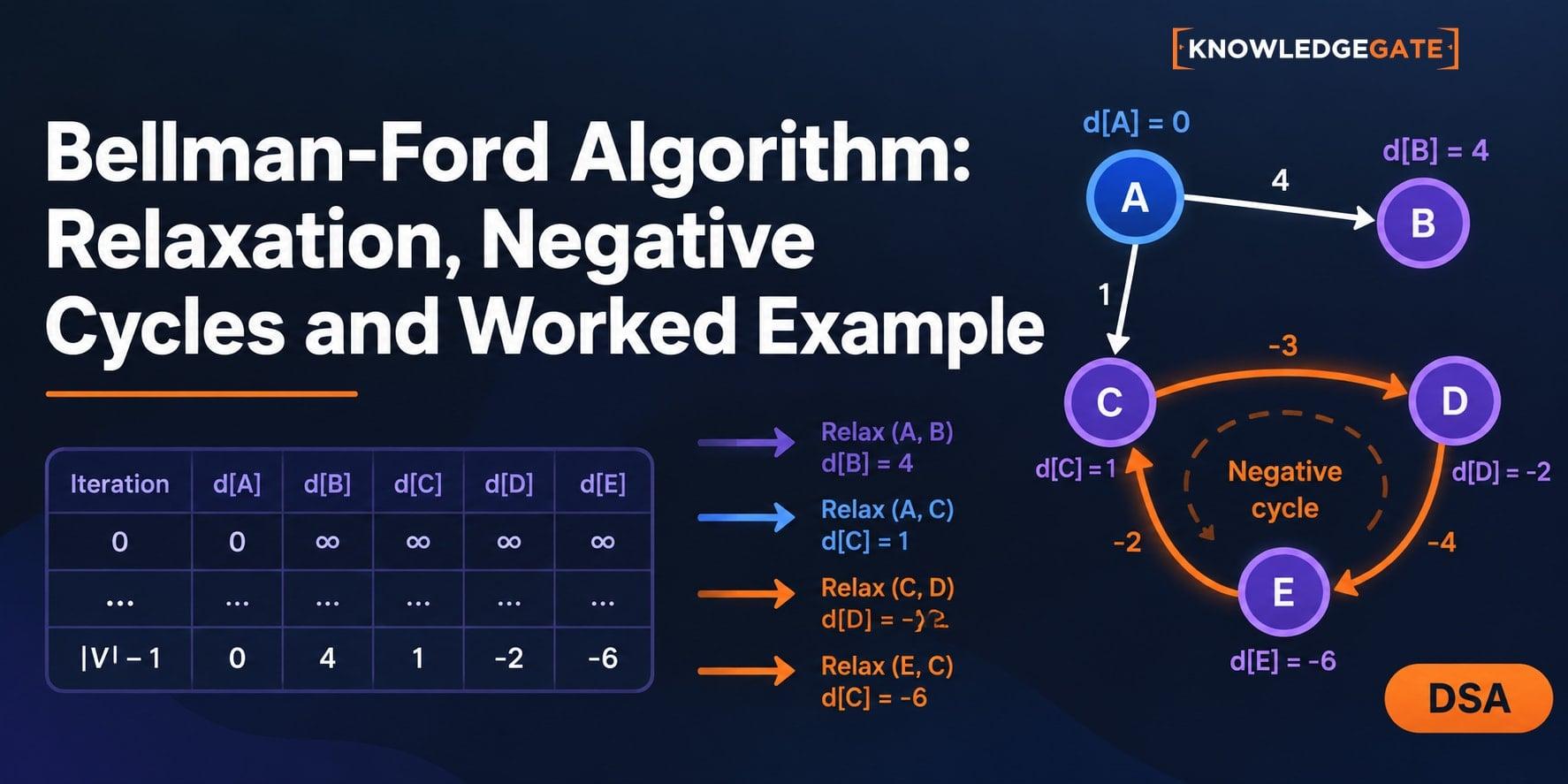
Bellman-Ford can look like repeated edge scanning without much logic. The difficult parts are what each scan guarantees, how edge order affects intermediate values, and why a final scan reveals a reachable negative cycle. On the worked graph, edge order delays improvements across four passes; changing B -> A from +2 to +1 creates the reachable negative cycle exposed by the extra scan. In the GATE syllabus, Bellman-Ford connects graph traversal, shortest paths, greedy preconditions and dynamic programming-style relaxation.
What Bellman-Ford solves, and when Dijkstra is not enough
Bellman-Ford takes a directed weighted graph G = (V, E) and source s. It finds d[v], the minimum total edge weight from s to each reachable vertex v. An unreachable vertex keeps distance infinity.
Unlike Dijkstra's greedy method, Bellman-Ford permits negative edges and reports a negative-weight cycle reachable from the source. Dijkstra finalises the smallest tentative distance, so a later negative edge can invalidate that choice; Bellman-Ford keeps labels revisable through repeated full-edge scans. For the cross-algorithm decision, Shortest Path Algorithms: Dijkstra, Bellman-Ford and Floyd-Warshall compares the methods on separate examples. The five-vertex trace below isolates Bellman-Ford's edge order, predecessor reconstruction and extra-scan certificate.
If a reachable negative cycle can lead to a vertex, no finite shortest-path value exists there. Another trip around the cycle reduces the walk cost again.
Relaxation is the one operation to understand
For edge (u, v, w), require d[u] != infinity, then compare d[u] + w with d[v]. If it is smaller, set d[v] = d[u] + w and pred[v] = u. A tie is not an improvement.
If d[A] = 4, edge A -> C weighs -3, and d[C] = 7, the candidate is 4 + (-3) = 1, so d[C] becomes 1. If d[A] were infinity, the edge would do nothing. Never treat infinity plus a negative number as a path value.
After pass i, shortest paths using at most i edges are guaranteed to be represented. Helpful edge order can carry in-place updates farther within one pass, but correctness after at most |V| - 1 passes does not depend on order. The repeated improvement resembles how dynamic programming builds answers from smaller states, though Bellman-Ford need not use a DP table.
Set up the five-vertex worked graph
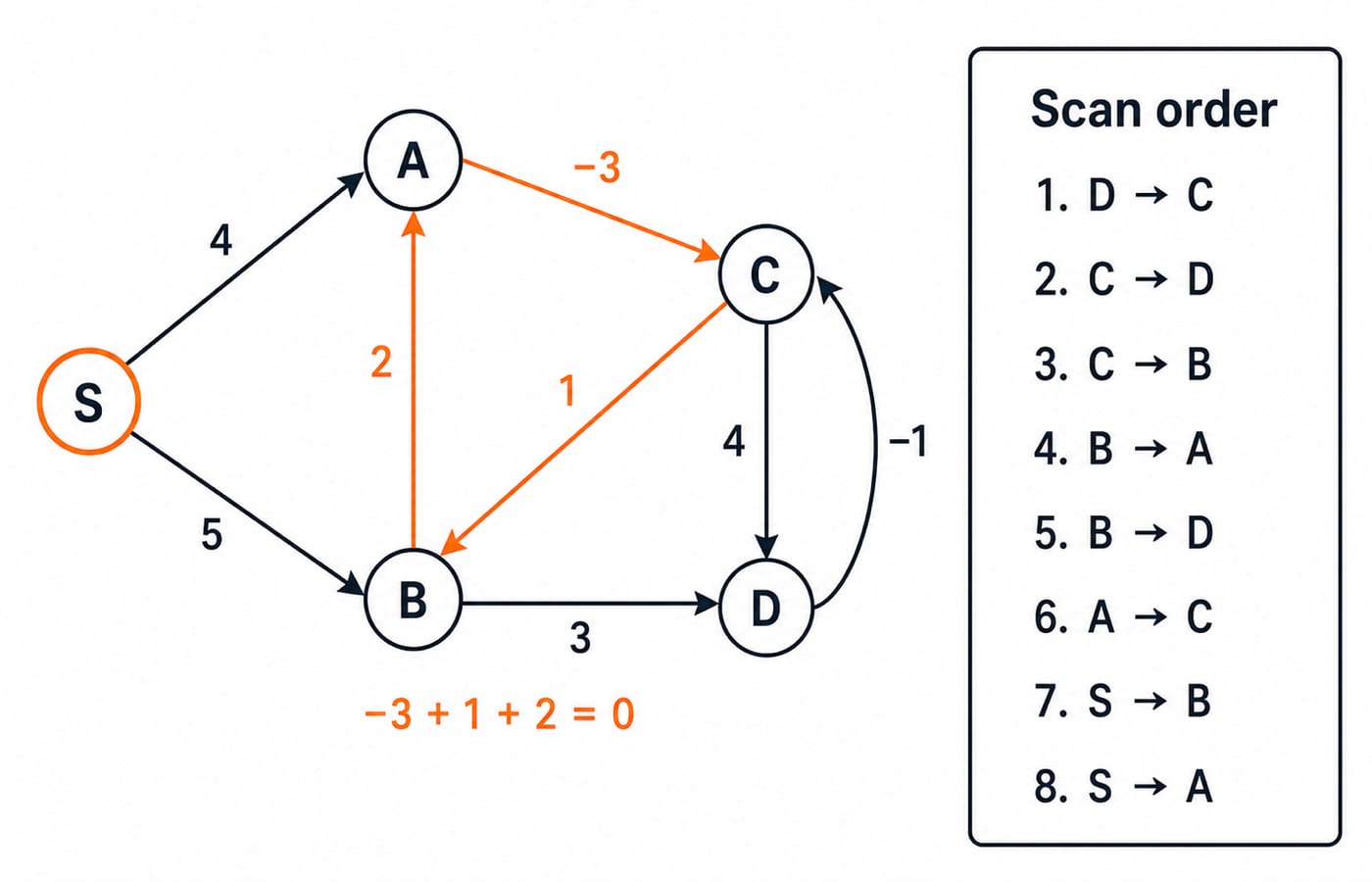
Let V = {S, A, B, C, D} and source S. Every pass scans this exact directed edge order:
D -> C (-1)C -> D (4)C -> B (1)B -> A (2)B -> D (3)A -> C (-3)S -> B (5)S -> A (4)
Initially, d[S] = 0; other distances are infinity; predecessors are NIL. Cycle A -> C -> B -> A weighs -3 + 1 + 2 = 0, so negative edges exist without a negative cycle.
Run all four passes and account for every change
The columns stay in the order S, A, B, C, D.
Stage | S | A | B | C | D |
|---|---|---|---|---|---|
Initial | 0 | infinity | infinity | infinity | infinity |
After pass 1 | 0 | 4 | 5 | infinity | infinity |
After pass 2 | 0 | 4 | 5 | 1 | 8 |
After pass 3 | 0 | 4 | 2 | 1 | 5 |
After pass 4 | 0 | 4 | 2 | 1 | 5 |
In pass 1, the first six edges start from infinity. S -> B sets d[B] = 5, then S -> A sets d[A] = 4.
In pass 2, B -> A proposes 5 + 2 = 7, which cannot beat 4. B -> D sets d[D] = 5 + 3 = 8, then A -> C sets d[C] = 4 - 3 = 1.
In pass 3, D -> C offers 8 - 1 = 7, no improvement. C -> D gives 1 + 4 = 5 < 8, and C -> B gives 1 + 1 = 2 < 5. Now B -> A offers 2 + 2 = 4, a tie, while B -> D offers 2 + 3 = 5, another tie. Other candidates fail.
Pass 4 changes nothing, so a changed flag can stop the algorithm. Four is the maximum because |V| = 5, hence |V| - 1 = 4, not because four updates occurred.
Final predecessors are pred[A] = S, pred[C] = A, pred[B] = C, and pred[D] = C. Path S -> A -> C -> B costs 4 - 3 + 1 = 2; S -> A -> C -> D costs 4 - 3 + 4 = 5.
Turn the pass logic into an implementation
dist[source] = 0; all other dist values = INF
all pred values = NIL

repeat at most |V| - 1 times:
    changed = false
    for each edge (u, v, w):
        if dist[u] != INF and dist[u] + w < dist[v]:
            dist[v] = dist[u] + w
            pred[v] = u
            changed = true
    if changed == false: break

scan every edge once more for a reachable relaxation
At most |V| - 1 scans of |E| edges give O(VE) time. Distance and predecessor arrays use O(V) extra space. Early stopping does not change the worst-case bound. Use a numeric type wide enough for path sums and guard against INF + w. Edge order changes intermediate rows, not correct final distances when no reachable negative cycle exists.
Detect a reachable negative cycle with one extra scan
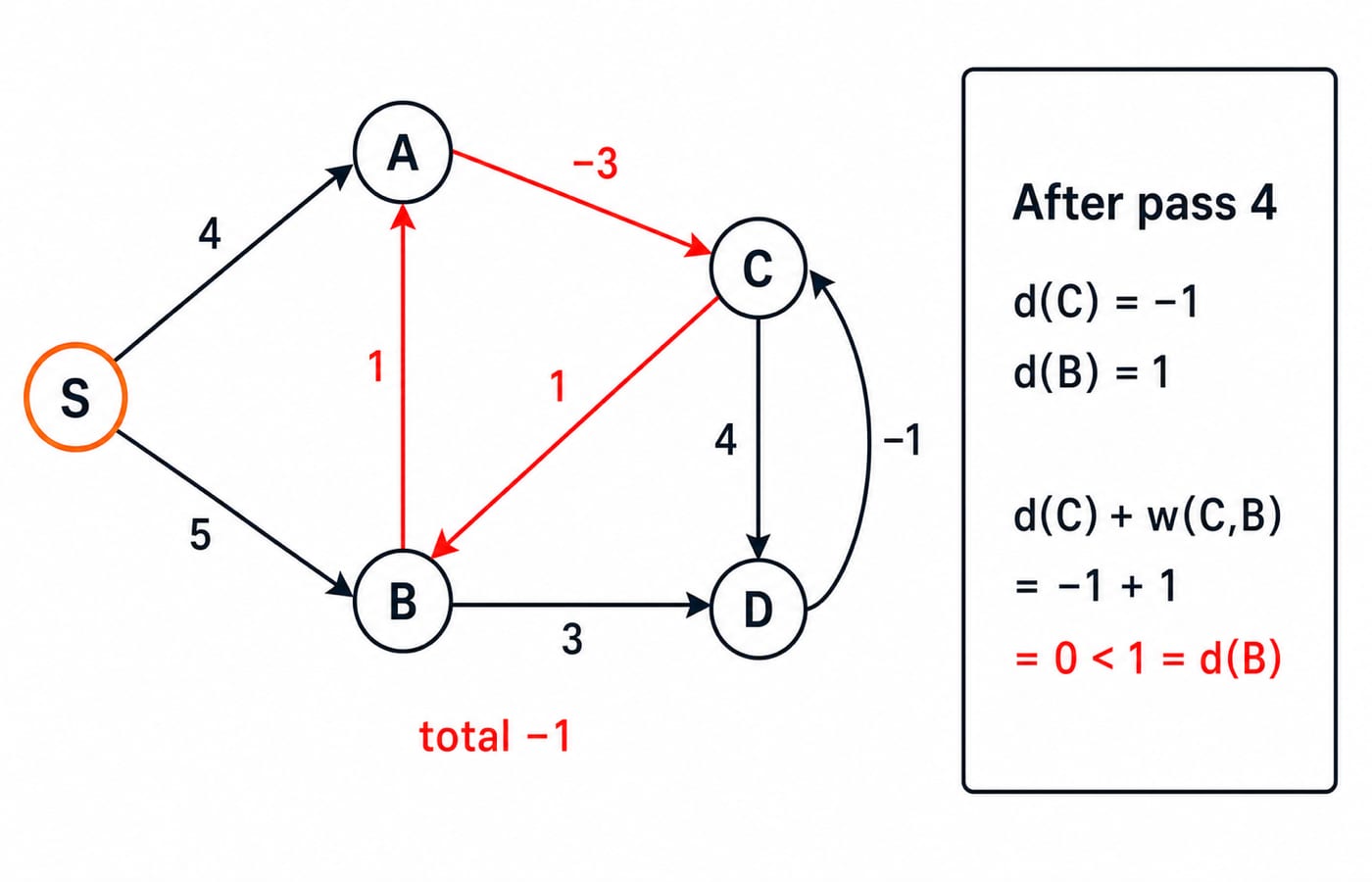
Change only B -> A from +2 to +1. Cycle A -> C -> B -> A now weighs -3 + 1 + 1 = -1, and S -> A makes it reachable.
Using the same in-place scan order gives:
Stage | S | A | B | C | D |
|---|---|---|---|---|---|
After pass 1 | 0 | 4 | 5 | infinity | infinity |
After pass 2 | 0 | 4 | 5 | 1 | 8 |
After pass 3 | 0 | 3 | 2 | 0 | 5 |
After pass 4 | 0 | 2 | 1 | -1 | 4 |
On the separate extra scan, C -> B (1) still offers -1 + 1 = 0 < 1. Continued improvement after |V| - 1 passes certifies a reachable negative cycle.
The reachability guard remains essential. Single-source Bellman-Ford reports only negative cycles reachable from S. A disconnected negative cycle does not invalidate source distances elsewhere.
How exam-oriented questions test Bellman-Ford
Practice questions ask you to fill a distance row for a stated edge order, decide whether a negative edge is allowed, distinguish a negative edge from a negative cycle, or identify an extra-pass witness. Each form tests whether you can apply the invariant rather than recite the algorithm's name.
Watch for these traps:
Running
|V|main passes instead of at most|V| - 1.Updating from infinity or counting a tie as relaxation.
Looking for any negative edge instead of a negative cycle.
Forgetting that edge order affects intermediate rows.
Reporting a negative cycle that is unreachable from the source.
Choosing Dijkstra merely because currently known distances look non-negative.
Use the GATE Test Series to practise under question-solving conditions, always noting the stated edge order.
Bellman-Ford in the shortest possible revision note
Initialise the source to zero and other distances to infinity. Relax every edge for at most |V| - 1 passes. Stop when a complete pass changes nothing. Scan once more, with the reachability guard, for continued improvement. Use Bellman-Ford when negative weights and reachable negative-cycle reporting matter, accepting O(VE) time.
Reproduce the table without looking. Then change B -> A to +1 and explain the extra-scan inequality aloud. For a structured subject route, continue with GATE Guidance by Sanchit Sir.
Go deeper with the full courseDSA using Java
Keep learning

Bellman-Ford Algorithm MCQs: 12 Solved Questions with Explanations
Solve 12 Bellman-Ford MCQs with concise explanations, worked relaxation and complexity calculations, and previous-year question links.
Updated 11 Aug 20267 min read70 viewsAlgorithms MCQs

Bellman-Ford Algorithm Interview Questions: Model Answers and a Worked Trace
Learn Bellman-Ford as an interview explanation, not a memorised recipe. Trace a fixed edge order, diagnose a reachable negative cycle and test robust code.
Updated 11 Nov 20265 min readInterview Corner
Shortest Path Algorithms: Dijkstra, Bellman-Ford and Floyd-Warshall with Worked Examples for GATE CS
Learn the relaxation idea behind shortest paths, trace three core algorithms by hand, and choose the right method from edge weights and source count.
Updated 21 Sep 20265 min read58 viewsDSA & Algorithms

Kruskal's Algorithm and MST Explained: A Step-by-Step Worked Example
Learn what an MST is, how DSU makes Kruskal's cycle decisions, and how a seven-vertex graph reaches six selected edges with total weight 14.
Updated 19 Nov 20265 min readDSA & Algorithms