Attribute Closure and FD-Set Equivalence MCQs: 12 Solved Questions
Solve ten MCQs and two MSQs by growing closures to a fixed point. Each answer shows the decisive dependency, key test or coverage witness.
KnowledgeGate Team
Exam prep & CS education
10 Sep 20267 min read69 views
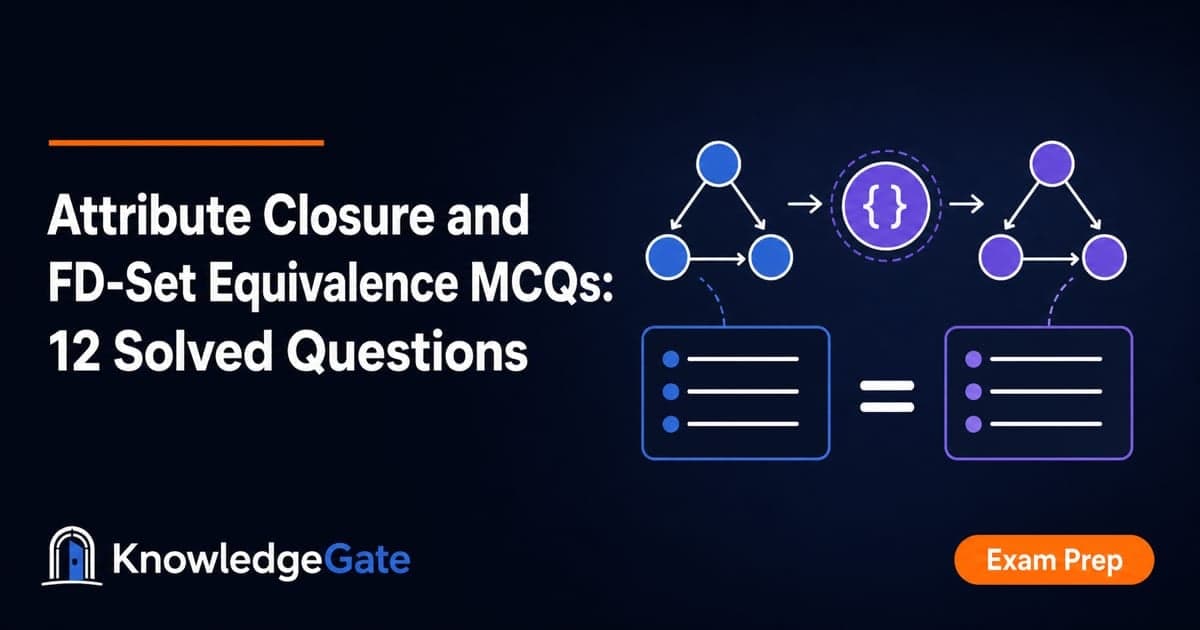
An FD can become usable only after several closure rounds; FD-set equivalence repeats that fixed-point test in both directions. Write each closure as a sequence of growing sets, then check key minimality or directional coverage separately. The Attribute Closure and Equivalence of Sets question set adds more practice on the same subtopic.
Use one closure loop for every question
For an attribute set X, start with X+ = X. Scan every FD Y -> Z. If Y is contained in the current closure, add Z. Repeat complete scans until one full pass adds nothing. Then accept the result. To test X -> Y, check that every attribute of Y lies in X+. A candidate key needs a full closure and minimality, so removing any attribute must destroy the full closure.
For Questions 3 and 4, use R(A,B,C,D,E,F,G) and F = {A->B, C->D, AB->E, BE->C, EF->G}. The rounds are A+ = {A} -> {A,B} -> {A,B,E} -> {A,B,C,E} -> {A,B,C,D,E}. Stop because F is absent, so EF->G cannot fire. Starting with AF+ = {A,F} runs the same chain, then EF->G adds G, giving {A,B,C,D,E,F,G}.
For equivalence, F covers G only if F implies every FD in G. The sets are equivalent only when coverage also holds from G to F. Read the wider DBMS map first if these relational-model ideas need revision.
Questions 1-3: compute closures and know when to stop
Question 1
Consider the relation R(A, B, C, D, E, F) with the following functional dependencies:
- A -> B
- C -> DE
- AC -> F
What is the closure (AC)+?
A.
ABCDEFB.
ACFDEC.
ABCDED.
ACFD
Answer: A. ABCDEF. Start at {A,C}. A->B gives {A,B,C}, C->DE gives {A,B,C,D,E}, and AC->F completes {A,B,C,D,E,F}. B omits B, C omits F, and D omits B and E.
Question 2
Let R = ABCDE is a relational scheme with functional dependency set F = {A → B, B → C, AC → D}. The attribute closures of A and E are
A.
ABCD, φB.
ABCD, EC.
Φ, φD.
ABC, E
Answer: B. ABCD, E. A+ grows as {A} -> {A,B} -> {A,B,C} -> {A,B,C,D}. The last FD fires after C arrives. E+ = {E} because no FD starts with E; a closure always retains its starting attributes. See the full worked solution.
Question 3
For given FD set of R(ABCDEFG)
{A->B, C->D, AB->E, BE->C, EF->G}, which of the following does NOT belong to A+?
A.
AB.
CC.
GD.
E
Answer: C. G. From the Section 1 trace, A+ = {A,B,C,D,E}. Only EF->G can introduce G, but F never enters the closure.
Questions 4-6: turn closure into candidate-key and superkey decisions
Question 4
For given FD set of R(ABCDEFG) {A->B, C->D, AB->E, BE->C, EF->G}, which of the following does NOT belong to AF+?
A.
CB.
FC.
BD.
None of these
Answer: D. None of these. From {A,F}, derive B, E, C, D and finally G, so AF+ = {A,B,C,D,E,F,G}. AF is minimal because A+ lacks F,G, while F+ = {F}.
Question 5
Let R = (A, B, C, D, E, F) be a relation scheme with the following functional dependencies:
C -> F, E -> A, EC -> D, A -> B
Which of the following is a key of R?
A.
CDB.
ECC.
AED.
AC
Answer: B. EC. Neither E nor C appears on a RHS, so both must be in every key. EC+ grows through E->A, A->B, C->F and EC->D to {A,B,C,D,E,F}. Removing either starting attribute prevents full closure. See the full worked solution.
Question 6
Consider a relation R(ABCDEF) with the FD set F = {A → B, B → C, C → D, D → E}. The number of super keys of R is:
A.
8B.
6C.
16D.
None of these
Answer: C. 16. A+ = {A,B,C,D,E}, so it lacks F, while AF is the minimal key. Every superkey contains A,F; each of B,C,D,E is optional, giving 2^4 = 16. Examples are {A,F} and {A,B,D,F}. {A,B,C,D,E} is not a superkey because it lacks F.
Questions 7-9: test whether an FD is implied
Question 7
Suppose the following functional dependencies hold on a relation U with attributes P,Q,R,S, and T:
P → QR
RS → T
Which of the following functional dependencies can be inferred from the above functional dependencies?
A.
PS → TB.
R → TC.
P → RD.
PS → Q
Answer: A, C and D. P+ = {P,Q,R}, proving C. PS+ gains Q,R, then RS->T adds T, proving A and D. R+ = {R}, so B fails without S. See the full worked solution.
Question 8
Given the relational schema 𝑅 = (𝑈,𝑉, 𝑊, 𝑋, 𝑌, 𝑍) and the set of functional dependencies:
{𝑈 → 𝑉, 𝑈 → 𝑊, 𝑊𝑋 → 𝑌, 𝑊𝑋 → 𝑍, 𝑉 → 𝑋}
Which of the following functional dependencies can be derived from the above set?
A.
𝑉𝑊 → 𝑌𝑍B.
𝑊𝑋 → 𝑌𝑍C.
𝑉𝑊 → 𝑈D.
𝑉𝑊 → 𝑌
Answer: A, B and D. Union gives WX->YZ, proving B. From {V,W}, V->X makes both WX dependencies usable, so VW+ = {V,W,X,Y,Z} and A and D hold. U is absent, so C fails. See the full worked solution.
Question 9
In a schema with attributes A, B, C, D and E following set of functional dependencies are given
A → B
A → C
CD → E
B → D
E → A
Which of the following functional dependencies is NOT implied by the above set?
A.
CD → ACB.
BD → CDC.
BC → CDD.
AC → BC
Answer: B. BD → CD. CD+ reaches E,A,B, so it contains AC. BD+ = {B,D} and lacks C. BC+ gains D, while AC+ gains B. Thus only B is not implied. See the full worked solution.
Questions 10-12: detect redundancy and compare two FD sets
Question 10
An organization needs to maintain database having five attributes A, B, C, D, E. These attributes are functionally dependent on each other for which functionality dependency set is given as: F:{A→BC,D→E,BC→D,A→D\}. Consider a universal relation (R(A, B, C, D, E) with functional dependency set 𝐹. Also all attributes are simple and take atomic values only.
Identify the redundant functional dependency in F
A.
BC→DB.
D→EC.
A→DD.
A→BC
Answer: C. A→D. Remove A->D. The remaining FDs take A+ through {A,B,C}, then add D through BC->D and E through D->E, so A->D is still implied. By contrast, without BC->D, BC+ = {B,C}. See the full worked solution.
Question 11
Consider the following sets of functional dependencies over a relation R={p,q,r,s,t}
S1 = {t→q, pr→q, pq→st, r→p}
S2 = {rs→p, q→t, p→s}
Which of the following is true:
A.
S1 covers S2B.
S2 covers S1C.
S1 and S2 are equivalentD.
none of the above
Answer: D. none of the above. Under S2, q+ = {q,t}, but under S1, q+ = {q}, so S1 does not cover S2. Under S1, pr+ = {p,r,q,s,t}; under S2, it reaches only {p,r,s}. Therefore S2 does not cover S1 either.
Question 12
F = {A->B, B->C, C->A}
G = {A->BC, B->AC, BC->A, AB->C}
Then which of the following is true? Here, F covers G when F logically implies every FD in G.
A.
F covers GB.
G covers FC.
Both of them cover each otherD.
None of them cover each other
Answer: A. F covers G. Under F, the chains imply A->BC, B->AC, BC->A and AB->C, covering all of G. Under G, C+ = {C}, so G cannot imply C->A from F.
Diagnose the traps, score the set and choose the next step
Wrong move | Correction |
|---|---|
Scan each FD once | Repeat full scans until no attribute is added. |
Let a closure become empty | A closure always contains its starting set. |
Treat full closure as proof of a candidate key | Test minimality separately. |
Put every non-key attribute in every superkey | The key is mandatory; other attributes are optional. |
Require | It is enough that |
Call two sets equivalent after one-way coverage | Prove coverage in both directions. |
Call an FD redundant because it looks unimportant | Remove it and prove the remainder still implies it. |
Use these as study thresholds, not official cutoffs. At 10-12 correct, redo Questions 8 and 11 without the explanations. At 7-9, write closures by rounds and repeat Questions 3, 6 and 9. At 0-6, reproduce A+ and AF+ from the first section, then retry Questions 1-6 before equivalence.
For a semester-oriented CS route, use ZERO TO HERO. For placement-focused DBMS revision, use Computer Science Fundamentals for Placements by Sanchit Sir. Browse the CS Fundamentals collection.
The short version is simple: grow a closure to a fixed point, test the RHS against it, check key minimality separately, and prove FD-set equivalence in both directions. Now hide every answer, write the closure sequence for all 12 items, and circle the first FD that adds a new attribute in each round.
Keep learning
SQL Library Functions MCQs: 12 Solved Math, Aggregate, String and Date Questions
Practise 12 solved SQL library function MCQs with inside-out calculations, exact intermediate values and clear explanations of the common traps.
Updated 3 Oct 20268 min readDBMS MCQs

SQL Introduction, Components & Structure MCQs: 12 Solved Questions
Test your SQL foundations with 12 explained MCQs covering terminology, query behaviour, metadata, dynamic SQL, database models and QBE.
28 Sep 20267 min readDBMS MCQs
GROUP BY Clause MCQs: 10 Solved SQL Questions with Explanations
Solve ten published GROUP BY questions, then check each answer with row-level and group-level reasoning. Two full traces make the common SQL traps visible.
Updated 25 Sep 20268 min readDBMS MCQs
Third Normal Form (3NF) MCQs: 12 Solved Questions with Explanations
Solve 12 real 3NF exam MCQs with clear explanations, candidate-key closures, a raw-row decomposition, and the prime-attribute exception that separates 3NF from BCNF.
Updated 24 Sep 20267 min readDBMS MCQs