Arrival of the British in India: 1600 Charter, Surat and Plassey Explained
A charter, a port arrival and a battle answer different history questions. Separate the Company's early trading milestones from its growing political power, then test your understanding with two worked checks.
KnowledgeGate Team
Exam prep & CS education
Updated 17 Oct 20266 min read
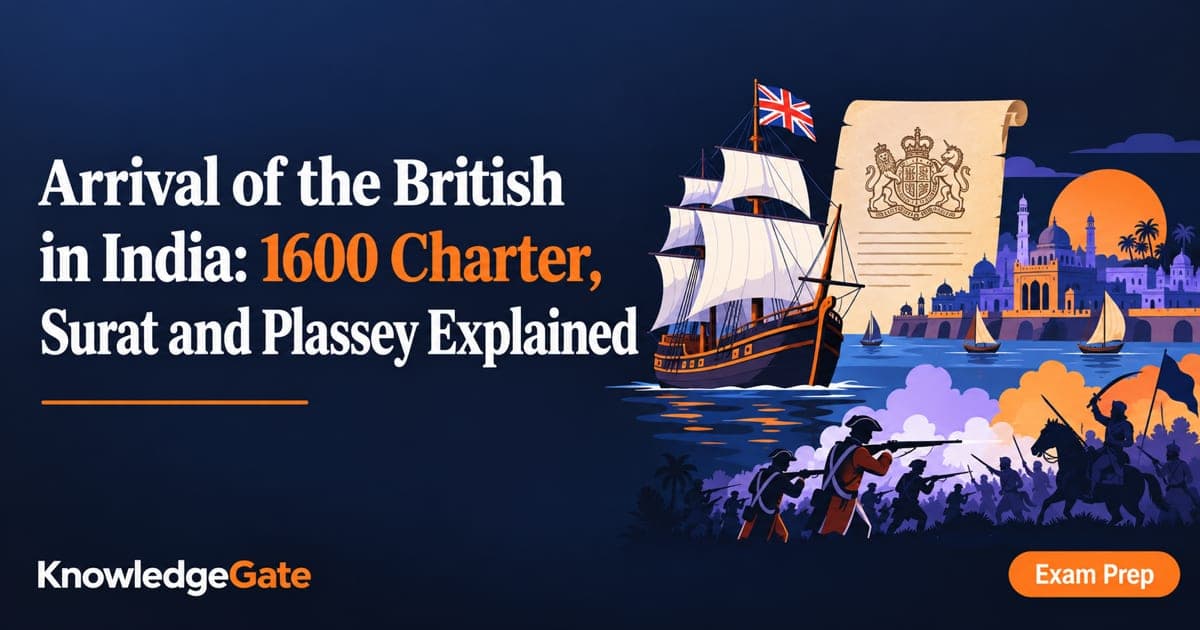
“When did the British arrive in India?” becomes confusing when you remember several dates without their events. The years 1600, 1608, 1613 and 1757 mark different stages: a charter, arrival at Surat, factory permission and Plassey. The precise early-period name is the English East India Company, behind the familiar phrase “British arrival”. Build the sequence below, then use the wording of each question to choose the right milestone.
The 1600 charter created a trading company, not an Indian government
A charter is a formal document granting rights or privileges. The Company's charter record gives 31 December 1600, when Queen Elizabeth I of England issued its founding charter. Its monopoly protected the Company's exclusive English trading privilege in eastern commerce.
That privilege did not make the Company the government of an Indian territory. English royal backing and permission from Indian authorities were separate requirements. The Company still had to negotiate access to ports and trading facilities under local and imperial authority.
Keep another period-specific word clear: a factory was a trading establishment staffed by commercial agents called factors. It supported buying, storing and selling goods; it did not necessarily manufacture them.
So “Who issued the Company's charter?” calls for Elizabeth I. “Which Mughal emperor's court did Sir Thomas Roe visit?” calls for Jahangir. Each name belongs to a different relationship, and substituting one for the other changes the answer.
Why India attracted the Company, and why entry required permission
The commercial attraction was goods that could be purchased in Asian markets and sold profitably elsewhere. Indian cotton textiles and silk were important attractions. Spices also drove European interest in Asian trade, though the wider spice trade should not be treated as exclusively Indian supply.
India already had producers, merchants, ports and trading networks. The Company sought access to these systems. Surat offered an entry into western Indian commerce, where ships connected overseas demand with established merchants and inland supplies. NCERT's From Trade to Territory explains the early Company story through commerce and competition among European traders.
Ships and naval strength mattered in that competition. They did not make an English charter binding on Mughal officials. Early seventeenth-century entry took place under powerful Mughal authority, so commercial success required negotiation as well as maritime capability.
Later regional rivalries created openings for political intervention. Keep that later setting separate from the conditions around 1600. Reading the entire story backwards from conquest hides the negotiations and contingent choices that shaped it.
Surat chronology: work from the event to the date
UCLA's MANAS account supplies the Surat arrival year, 1608, and dates Roe's embassy to 1615. Here, 1615 means Roe's arrival in India. The historical account in History of India, volume VII, distinguishes the local agreement following the 1612 naval fighting from imperial ratification in January 1613.
Event | Year |
|---|---|
Company charter | 1600 |
Company ships at Surat | 1608 |
Swally/Suvali naval victory over the Portuguese | 1612 |
Surat factory permission | 1613 |
Roe's embassy to Jahangir, arrival in India | 1615 |
Plassey | 1757 |
Try this original practice prompt: arrange A: Plassey, B: Surat factory permission, C: Company charter, D: Company arrival at Surat in chronological order.
First attach dates: A = 1757, B = 1613, C = 1600, D = 1608. Sorting from earliest to latest gives C, D, B, A.
Now check the gaps step by step:
Arrival follows the charter: 1608 − 1600 = 8.
Factory permission follows arrival: 1613 − 1608 = 5.
Plassey follows that permission: 1757 − 1613 = 144.
The total is 8 + 5 + 144 = 157, matching 1757 − 1600 = 157. These are differences between calendar-year labels, not precise elapsed anniversaries.
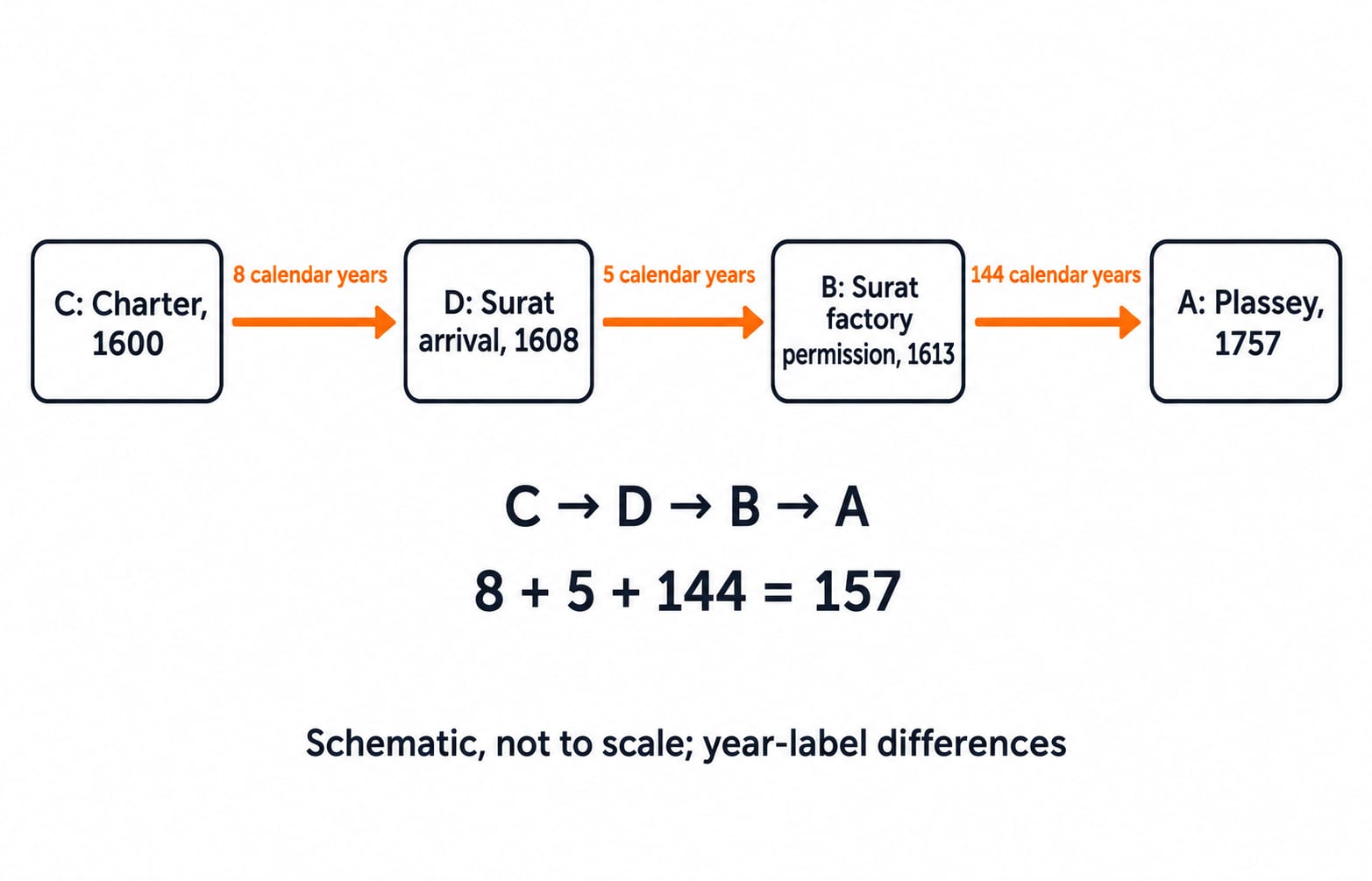
The arithmetic checks your ordering. The event labels decide the answer: a question about ships reaching Surat requires 1608; a question about the Company's formation requires 1600.
Plassey marks a political turning point, not the first landing
The National Army Museum dates the Battle of Plassey to 23 June 1757. It took place at Palashi in Bengal, with Robert Clive leading Company forces against Siraj-ud-Daulah, the nawab of Bengal.
NCERT's account explains the importance of the conspiracy involving Mir Jafar, one of Siraj-ud-Daulah's commanders. Clive promised to make him nawab, and the troops under Mir Jafar stayed out of the fighting. After the defeat, Siraj-ud-Daulah was killed and Mir Jafar was installed as nawab.
The outcome gave the Company substantially greater influence over Bengal's government. This helps explain why Plassey belongs in a discussion of the transition from commerce towards political power. The Company could now influence who occupied the nawab's position, extending its role beyond securing trading privileges.
Keep the geographical scale precise. A major victory and political intervention in Bengal did not mean that every Indian region immediately passed under Company rule. Likewise, 1757 cannot answer a question about the Company's earliest arrival at Surat.
Four traps that make a correct date look wrong
A remembered date is useful only when attached to the correct event. Repair these associations before attempting another chronology exercise.
Misreading | Repair |
|---|---|
“1600 means arrival at Surat.” | It is the Company's charter year. |
“Factory means a modern production plant.” | Here it means a trading establishment. |
“Roe founded the Company.” | He was James I's ambassador to Jahangir; his embassy dates to 1615, fifteen years after the charter. |
“1757 means all India came under Company rule.” | Plassey was a turning point in Bengal. |
Be especially careful with “first factory” questions. The place, coast, grant and actual establishment milestone matter. Surat factory permission, 1613 is a qualified statement; calling it the first English factory anywhere in India ignores other early trading posts and the wording that distinguishes them.
Keep an event-place-person table in your revision notes. To fit it into a broader revision system, use SSC CGL General Awareness: Build a Durable Static GK Core as a companion.
How to practise the topic for General Awareness
SSC's CGL 2026 notice includes History within General Awareness. Matching, chronology and statement evaluation are useful ways to practise this material; they are study recommendations, not a prediction of chapter weightage. UPSC and state PSC readers can also use the explanation while following their own exam's syllabus.
Try a second original worked check:
Statement 1: “The 1600 charter by itself conferred authority to govern India.”
Statement 2: “Sir Thomas Roe came to India as ambassador to Jahangir in 1615.”
The answer is Statement 2 only. Statement 1 confuses an English trading privilege with authority over Indian territory. Statement 2 correctly identifies Roe's diplomatic role and arrival year; it does not date his first audience with Jahangir.
Explain the reason before checking your notes. If you miss a statement, identify whether the error concerns authority, person, place or year. Readers preparing across recruitment exams can use the Govt Jobs category to identify their own preparation pathway.
The short version and your next revision step
Remember four anchors: 1600 charter, 1608 Surat arrival, 1613 Surat factory permission and 1757 Plassey. Close your notes and reproduce each date with its event and location: England for the charter, Surat for the trading milestones, and Palashi in Bengal for the battle.
Then explain why Elizabeth I, Jahangir and Siraj-ud-Daulah belong to different parts of the story. For broader General Awareness practice alongside the other papers, explore SSC CGL Tier 1 preparation. Return to this timeline whenever a question's wording makes two dates seem plausible.
Keep learning
SSC MTS Exam Pattern and Marking Scheme: Sessions, Scores and Attempt Strategy
The two MTS sessions need different attempt strategies. Use a session table, worked scores and a timed rehearsal to separate qualifying marks from merit and find which errors to repair first.
21 Oct 20264 min readSSC CGL
SSC GD Constable Preparation Strategy: A 12-Week, 15-Hour Plan
Unsure whether to revise, repair weak topics or take another mock? Use this adaptable 12-week plan to budget study hours, track mistakes and keep physical preparation on your calendar.
13 Oct 20265 min readSSC CGL
SSC MTS Syllabus: What to Study in Each Section
Turn the SSC MTS topic list into practical study tasks. Work through small examples in numerical ability, reasoning, awareness and English, then use your errors to choose the next lesson.
9 Oct 20265 min readSSC CGL
SSC MTS Eligibility and Selection Process: Age, Qualification and Stages
Check your qualification date and birth-date window before planning preparation. This dated SSC MTS example explains age relaxation, the two CBE sessions and Havaldar's additional physical tests.
Updated 5 Oct 20264 min readSSC CGL