

3AC, Quadruples and Triples Interview Questions: Worked Answers
Translate one expression into 3AC, quadruples and triples, then explain which instructions can move. Worked answers show why indirect triples preserve references and why dependencies still matter.
KnowledgeGate Team
Exam prep & CS education
Updated 11 Nov 20265 min read

Recalling four field names is easy; interviewers care whether you can explain what each field stores and when a reference becomes unsafe. Connect each field to the value it represents and the instruction that produces it. The earlier Three-Address Code (3AC): Quadruples, Triples and Indirect Triples with a Worked Example guide develops the full record-level comparison; the interview prompts here practise concise answers and the dependency checks behind safe triple reordering.
What is three-address code, and does every instruction use three addresses?
Prompt: Why does t1 = a + b count as three-address code?
Model answer: It has two source operands, a and b, and one destination, t1. The operator + is not an address. Here, addresses can be names, constants or compiler-generated temporaries; they need not be literal physical memory addresses.
These basic assignment forms use at most three addresses:
t1 = a + b: binary operation, three addresses.t2 = -c: unary operation, two addresses.x = t2: copy, two addresses.
Quadruples and triples are record representations of such instructions, not additional compiler phases or different translation algorithms. For the broader compiler-design path, read intermediate code generation for unary-minus lowering, control flow and DAG optimisation. The record-level interview distinction is narrower: named quadruple results, positional triple references and pointer-controlled execution order.
How do you translate an expression into 3AC?
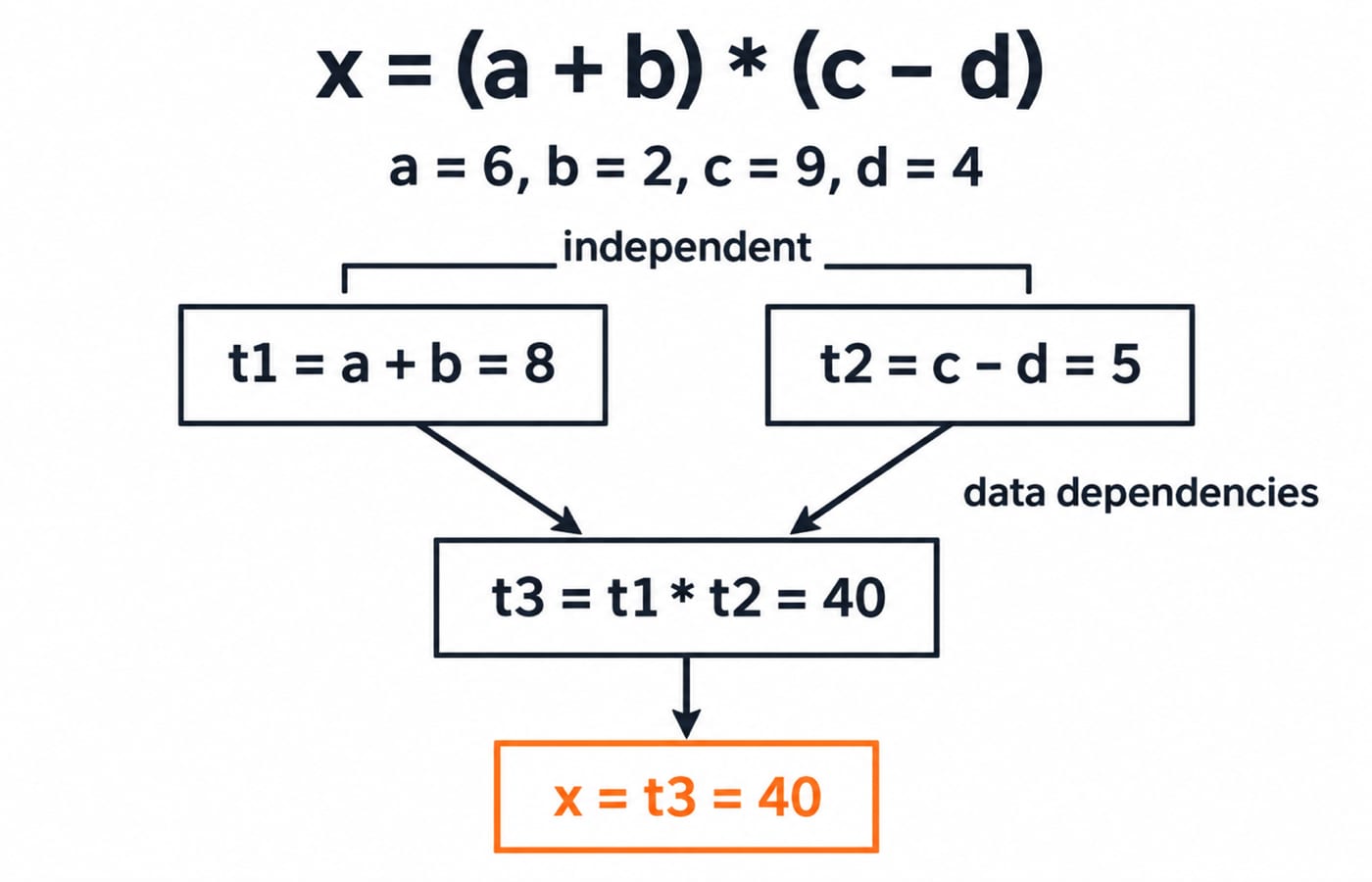
Prompt: Translate x = (a + b) * (c - d) and explain its dependencies.
Assume ordinary integer arithmetic with no side effects, overflow or exceptions. The symbolic form is:
t1 = a + b
t2 = c - d
t3 = t1 * t2
x = t3
For a runtime check, take a = 6, b = 2, c = 9 and d = 4. First, t1 = 6 + 2 = 8. Next, t2 = 9 - 4 = 5. Therefore, t3 = 8 * 5 = 40, and the copy gives x = 40.
The first two instructions are independent. Multiplication needs both results, and the final copy needs the multiplication result.
Follow-up: Could this use fewer instructions? Yes. Replace the final two lines with x = t1 * t2. The four-instruction form keeps the quadruple and triple tables row-for-row comparable.
What are the quadruples for that expression?
Prompt: Write the quadruples and identify the result field.
Each record has four fields: (op, arg1, arg2, result). Indices below start at zero; unused denotes an empty field.
Index | op | arg1 | arg2 | result |
|---|---|---|---|---|
0 | + | a | b | t1 |
1 | - | c | d | t2 |
2 | * | t1 | t2 | t3 |
3 | = | t3 | unused | x |
Model answer: The copy still has a destination, x; only its second argument is unused. The index is a separate display label.
If the independent first two rows swap, their results remain named t1 and t2. Multiplication therefore keeps the same operand names. This preserves these local data references.
How do triples remove the explicit result field?
Prompt: Write the same sequence as triples.
Before filling the table, define the notation: (i) refers to the result produced by record i, not the literal integer i. Our copy convention is (=, source, destination). Other textbooks may reverse copy operands, so state your convention explicitly.
Index | op | arg1 | arg2 |
|---|---|---|---|
0 | + | a | b |
1 | - | c | d |
2 | * | (0) | (1) |
3 | = | (2) | x |
Model answer: Records 0, 1 and 2 implicitly produce 8, 5 and 40. Record 3 stores record 2's value into x. Its arg2 is a destination because this is a copy; that rule does not apply to every operation.
The row number labels the producer without adding a fourth stored result field. Triples save one stored field per record.
Why do indirect triples help when instructions move?
Prompt: Swap the independent addition and subtraction. What must be repaired?
If ordinary triples are physically reordered and renumbered, the records become:
0: (-, c, d)
1: (+, a, b)
2: (*, (1), (0))
3: (=, (2), x)
Record 2's references change to preserve producer identities. Multiplication happens to commute, but coincidentally equal outputs cannot justify leaving references unrepaired.
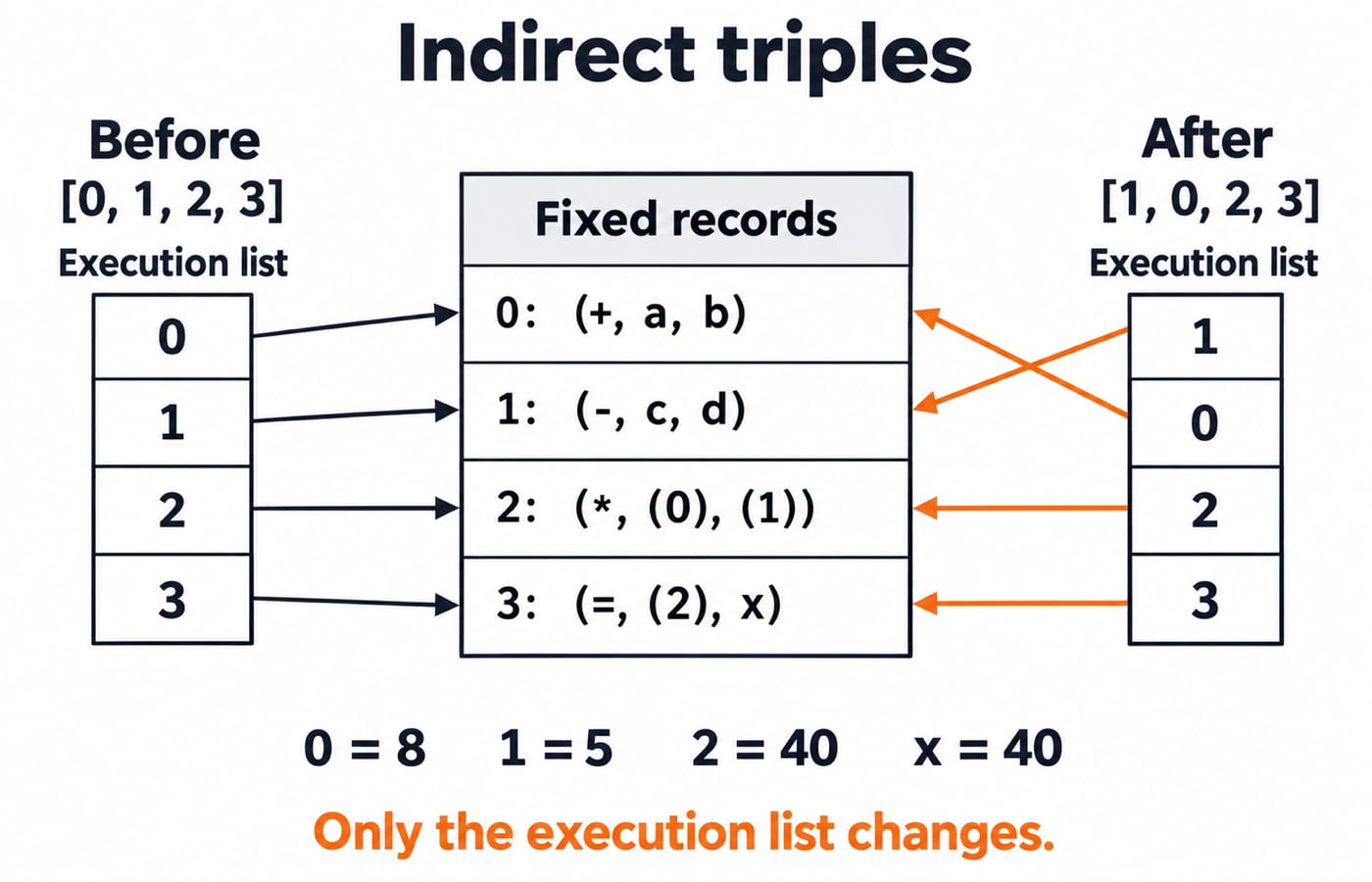
Indirect triples retain the original records and use an execution-pointer list. Change [0, 1, 2, 3] to [1, 0, 2, 3]; the stored multiplication remains (*, (0), (1)). Its references identify stable records, not positions in the execution list.
NYU's compiler lecture notes on quadruples and indirect triples, sections 6.2.2–6.2.3, describe these record layouts and explain why moving pointers to fixed triples avoids repairing their producer references.
Indirection adds a pointer structure. Reject [2, 0, 1, 3]: multiplication would run before either operand was produced.
Which interview traps reveal shallow understanding?
Unary minus: Confusing unary and binary operators leads to inventing a second input. For t1 = -c, use (uminus, c, unused, t1). With c = 9, the result is -9.
Repeated expressions: Treating translation as automatic optimisation can silently delete an evaluation. For y = (a + b) * (a + b), an unoptimised translation is:
u1 = a + b
u2 = a + b
u3 = u1 * u2
y = u3
With unchanged operands, reuse is valid:
u1 = a + b
u2 = u1 * u1
y = u2
For a = 6, b = 2, the first sequence computes 8 * 8 = 64; the second computes u1 = 8, then u2 = 8 * 8 = 64. Both store 64 in y.
Performance: Fewer intermediate records do not guarantee a runtime speedup.
How do you practise the interview and written-test versions?
Use these rehearsal prompts: “Explain quadruples in 30 seconds”, “Convert the expression”, “Defend the safe swap” and “Explain why indirect triples still need dependency checks”. For written answers, state indexing and copy conventions first.
Now use subtraction: z = (a + b) - (c - d). The same inputs give 8 - 5 = 3. Initial triples are:
0: (+, a, b)
1: (-, c, d)
2: (-, (0), (1))
3: (=, (2), z)
After physically swapping rows 0 and 1, repair row 2 to (-, (1), (0)). It still computes 8 - 5 = 3. Unchanged references instead compute 5 - 8 = -3, exposing the mistake multiplication hid. Continue with three-address-code worked practice once you can explain that sign change.
What should you remember before your next interview?
3AC splits operations into simple instructions. Quadruples name results; triples refer to result-producing records. Indirect triples separate record identity from execution order.
Spend five minutes reconstructing both tables without notes, then explain the valid swap aloud. Change multiplication to subtraction and account for both 3 and the incorrect -3. If you can identify the producer behind every operand, you understand more than the field names.
For structured study of the foundations, explore the Compiler Design course.
Go deeper with the full courseCompiler Design
Keep learning

Three-Address Code (3AC): Quadruples, Triples and Indirect Triples with a Worked Example
Carry one expression through 3AC, quadruples, triples and indirect triples. See how every record is formed, valued and safely reordered.
Updated 16 Sep 20266 min read89 viewsCompiler Design
3AC, Quadruples and Triples MCQs: 11 Solved Questions with Explanations
Solve 11 MCQs on 3AC sequencing, intermediate representations, backpatching, array offsets, quadruples, triples and shared DAG nodes, with compact worked explanations.
Updated 24 Aug 20268 min read70 viewsCompiler Design MCQs

Intermediate Code Generation in Compiler Design: Three-Address Code, Quadruples, Triples and Worked Examples
Learn how a compiler produces intermediate code, represents it as quadruples or triples, removes repeated work with a DAG, and handles control flow.
Updated 1 Aug 20266 min read183 viewsCompiler Design

Three-Address Code, Quadruples and Triples for GATE: Intermediate Code Generation Solved
Translate a repeated arithmetic expression into six TAC instructions, then align every instruction with its quadruple and triple representation.
Updated 30 Oct 20265 min read63 viewsGATE Strategy & Roadmap