UPPSC Polytechnic Lecturer 2022 Previous Year Questions (PYQs) with Solutions
Real questions from the UPPSC Polytechnic Lecturer 2022 paper, solved. Every question below shows its options, the correct answer, and a full text solution — free to read, no login needed. Open any question to practice it interactively inside its course.
- Questions:
- 7
- With solutions:
- 7
- Tagged UPPSC Polytechnic Lecturer 2022 in the bank:
- 8
- Q1.UPPSC 2022
A point P(5, 1) is rotated by 90° about a pivot point (2, 2). What is the coordinate of new transformed point P′ ?
- A.
(3, 5)
- B.
(5, 3)
- C.
(2, 4)
- D.
(1, 5)
Correct answer: A
Solution
Key insight: To rotate a point about a pivot, first translate the point so the pivot is at the origin, apply the rotation, then translate back.
Step 1: Translate the point by subtracting the pivot: (5, 1) − (2, 2) = (3, −1).
Step 2: Rotate 90° counterclockwise using the rule (x, y) → (−y, x): (3, −1) → (1, 3).
Step 3: Translate back by adding the pivot: (1, 3) + (2, 2) = (3, 5).
Final answer: (3, 5).
- A.
- Q2.UPPSC 2022
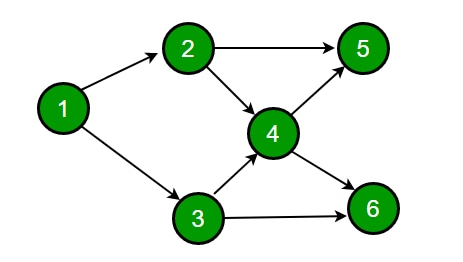
Consider the directed acyclic graph (DAG) on V = {1, 2, 3, 4, 5, 6} shown below. Which of the following sequences is NOT a topological ordering?
- A.
1 2 3 4 5 6
- B.
1 3 2 4 5 6
- C.
1 3 2 4 6 5
- D.
3 2 4 1 6 5
Correct answer: D
Solution
Concept: A topological ordering of a directed acyclic graph is a linear arrangement in which every directed edge u → v places u before v. To test a proposed ordering, record each vertex’s position and check every edge; one reversed edge is enough to reject the ordering.
Application: The graph has the edges 1 → 2, 1 → 3, 2 → 4, 2 → 5, 3 → 4, 3 → 6, 4 → 5, and 4 → 6. Check each candidate against these precedence constraints:
For 1 2 3 4 5 6, every source vertex appears before its destination for all eight edges.
For 1 3 2 4 5 6, vertex 1 precedes 2 and 3; vertices 2 and 3 precede their destinations; and vertex 4 precedes 5 and 6.
For 1 3 2 4 6 5, swapping the relative positions of 5 and 6 causes no violation because the graph has no edge between 5 and 6; all eight listed edges still point forward.
For 3 2 4 1 6 5, vertex 1 occurs after both 2 and 3, so the edges 1 → 2 and 1 → 3 point backward in the sequence.
Cross-check: In every topological ordering of this graph, vertex 1 must precede both 2 and 3. The sequence 3 2 4 1 6 5 places 1 after both, independently confirming the violation.
Result: The sequence 3 2 4 1 6 5 is not a topological ordering.
- A.
- Q3.UPPSC 2022
What is the worst-case time complexity of search operation on unordered and ordered list using linear search algorithm respectively?
- A.
O(n) and O(1)
- B.
O(n) and O(log n)
- C.
O(n) and O(n)
- D.
O(log n) and O(log n)
Correct answer: C
Solution
Linear search always scans elements one-by-one. Unordered list → worst case O(n)
Ordered list → still worst case O(n) because the target may be at the end or absent.
✔ Answer = O(n), O(n)
- A.
- Q4.UPPSC 2022
In the IPv4 addressing format, the number of networks allowed under Class C addresses is
- A.
2^14
- B.
2^7
- C.
2^21
- D.
2^24
Correct answer: C
Solution
In class C, 8 bits are reserved for Host Id and 24 bits are reserved for Network Id. Out of these 24 Network Id bits, the leading 3 bits are fixed as 110. So remaining 21 bits can be used for different networks.
A video solution is available for this question — log in and enroll to watch it.
- A.
- Q5.UPPSC 2022
Let F: R2→R2 be the mapping defined by the function
F(x,y) = \left(\frac{x}{3}, \frac{y}{4}\right),What will be the image of
\frac{x^2}{9} + \frac{y^2}{16} = 1under F?
- A.
The circle x^2 + y^2 = 1 - B.
The line \frac{x}{3} + \frac{y}{4} = 1 - C.
The ellipse x^2 + y^2 = 1 - D.
None of the above
Correct answer: A
Solution
The mapping F(x,y) = (x/3, y/4) transforms the ellipse x^2/9 + y^2/16 = 1 into a unit circle. By substituting u=x/3 and v=y/4, the equation simplifies to u^2 + v^2 = 1.
- A.
- Q6.UPPSC 2022
Module based programming language is -
- A.
C
- B.
C++
- C.
ml
- D.
Ada
Correct answer: D
Solution
Ada is widely recognized as a module-based programming language because it was designed with modularity as a core principle. It supports packages and tasks for organizing code, making it the standard answer in academic contexts for this question.
- A.
- Q7.UPPSC 2022
Which of the following algorithm does not use divide and conquer strategy?
- A.
Merge sort
- B.
Quick sort
- C.
Binary sort and Stressian Multiplication
- D.
Travelling Salesperson Problem (TSP)
Correct answer: D
Solution
The correct answer is Option D: Travelling Salesperson Problem (TSP). Divide and conquer algorithms work by breaking a problem into smaller subproblems, solving them recursively, and combining their results. Merge sort (Option A) divides the array into halves, sorts them, and merges them back. Quick sort (Option B) partitions data around a pivot and recursively sorts subarrays. Binary search (likely intended in Option C) repeatedly halves the search space. In contrast, TSP is typically solved using dynamic programming or backtracking to explore all possible routes and find the shortest one. It does not follow the divide-and-conquer paradigm because subproblems overlap significantly and cannot be independently solved without considering the global path constraints. Thus, TSP is the only option that does not utilize divide and conquer.
- A.