For real x, let f(x) = x3 + 5x + 1. Then f(x) is:
For real x, let f(x) = x3 + 5x + 1. Then f(x) is:
Answer: C. f is one-to-one and onto R — ConceptA differentiable function is strictly increasing on an interval if its derivative is positive throughout that interval (strictly decreasing if the…
- A.
f is one-to-one but not onto R
- B.
f is onto R but not one-to-one
- C.
f is one-to-one and onto R
- D.
f is neither one-to-one nor onto R
Attempted by 1 students.
Show answer & explanation
Correct answer: C
Concept
A differentiable function is strictly increasing on an interval if its derivative is positive throughout that interval (strictly decreasing if the derivative is negative throughout); either way it is one-to-one (injective) there, since a strictly monotonic function can never repeat a value. Separately, a continuous function on R is onto (surjective) R if its values are unbounded both below and above - the Intermediate Value Theorem then guarantees it passes through every real number, which holds for any odd-degree polynomial with a positive leading coefficient, since it tends to minus infinity as x tends to minus infinity and to plus infinity as x tends to plus infinity.
Application
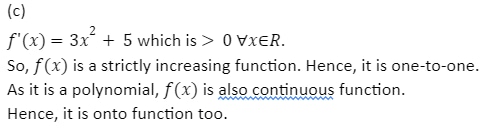
Differentiate f(x) = x3 + 5x + 1 to get f'(x) = 3x2 + 5.
For every real x, x2 >= 0, so 3x2 >= 0, which makes f'(x) = 3x2 + 5 >= 5 > 0 for every real x - the derivative never touches zero and never goes negative.
Since f'(x) > 0 on all of R, f is strictly increasing on R, so f is one-to-one.
f is a polynomial, so it is continuous everywhere; as x tends to minus infinity, f(x) tends to minus infinity, and as x tends to plus infinity, f(x) tends to plus infinity.
By the Intermediate Value Theorem, a continuous function that is unbounded below and above on R must take every real value, so f is onto R.
f is therefore both one-to-one and onto R.
Cross-check
f'(x) = 3x2 + 5 = 0 has no real solution (it would need x2 = -5/3, impossible for a real number), so f has no stationary point anywhere on R - confirming the graph never flattens or turns, which is consistent with f being strictly increasing across all of R.